
Borrowing at 30%+: When Does a Business Loan Stop Creating Value and Start Destroying It?
Published September 13, 2026
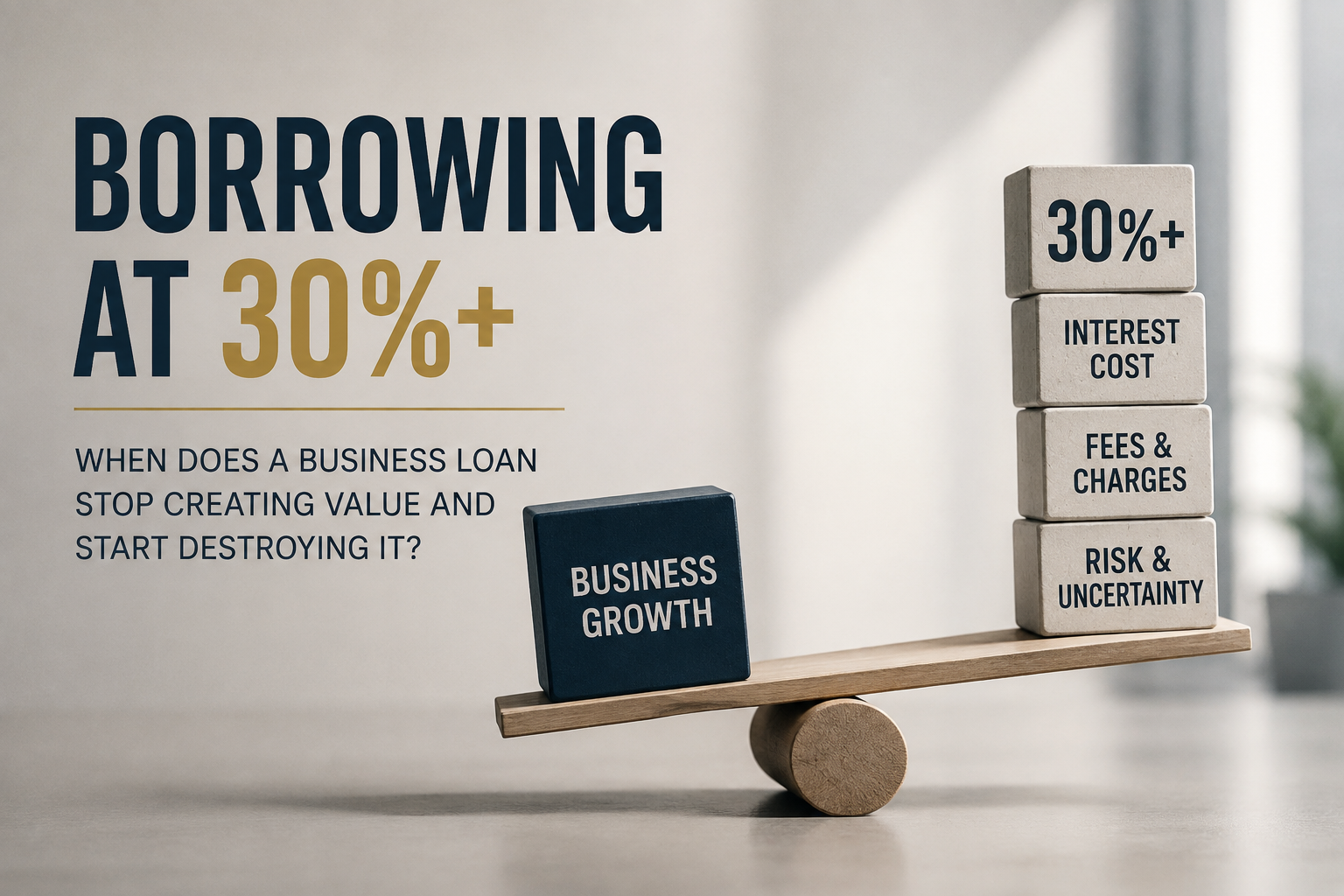
Nigerian manufacturers paid an average 32.1% interest rate on bank borrowing in 2025, according to data from the Manufacturers Association of Nigeria (MAN). That was an improvement from 35.6% in 2024, but every major manufacturing sector surveyed still recorded an average borrowing rate above 30%.
At that price, borrowing is no longer merely a financing decision.
It is a capital-allocation test.
Consider a business offered a ₦500 million facility at approximately 32% per annum. The headline interest alone is about ₦160 million a year, before arrangement fees, management fees, legal costs, other facility charges and the economic effect of how and when interest is paid.
Before management asks, “Will the bank give us ₦500 million?”, there is a more important question:
What exactly will this ₦500 million earn?
A bank's willingness to lend does not prove that borrowing will create value. It proves that the bank is willing to take the credit risk, usually on terms designed to protect the bank. Whether the transaction creates value for the borrower is an entirely different question.
Nigeria's Cost-of-Capital Problem Is Real
The current financing environment did not arise in isolation. Nigeria has experienced an aggressive monetary-tightening cycle as the Central Bank of Nigeria sought to contain inflation and restore monetary and foreign-exchange stability.
As at September 2026, the CBN's Monetary Policy Rate stands at 26.5%. The Cash Reserve Requirement for deposit money banks is 45%. Commercial borrowing rates are consequently much higher.
MAN's latest data illustrates the pressure clearly. Manufacturers paid an average borrowing rate of 32.1% in 2025, compared with 35.6% in 2024. The average was 32.5% in the first half of 2025 and 31.8% in the second half.
Nigeria therefore has a genuine financing problem. Businesses are justified in asking for a financial system capable of supplying productive enterprises with affordable, appropriately structured long-term capital.
When money becomes expensive, capital-allocation discipline becomes more important, not less.
Management cannot control the Monetary Policy Rate. It can control what it borrows, what it borrows for, what return it demands from the investment and whether the resulting cash flow can service the debt.
The Wrong Question: “Can We Repay the Loan?”
Many borrowing decisions begin with this question: Can we afford the monthly repayment?
That matters. But it is not enough. A company can successfully repay a loan and still destroy shareholder value by taking it.
The real questions are: What is the true effective cost of the facility? What incremental return will the borrowed capital generate? How quickly will that return become cash? Is the return comfortably above the relevant hurdle rate? What happens if revenue falls, margins compress, customers pay late, interest rates reset upward, the naira depreciates or the project is delayed? And after compensating lenders and accepting all those risks, what remains for shareholders?
A 32% Loan Does Not Merely Require a 32% Gross Margin
Suppose a company borrows ₦500 million at 32% and management says: “Our gross margin is 40%, so we can afford the loan.” Not necessarily.
Gross margin is not return on invested capital.
That margin may still have to absorb salaries, electricity and diesel, logistics, rent, repairs and maintenance, insurance, administrative overhead, bad debts, depreciation, taxes, additional working capital and financing costs.
A company can therefore have a 40% gross margin and still earn a return on incremental capital far below its financing cost. Borrowing decisions should not be justified by turnover or gross margin. The relevant question is what incremental economic return and cash flow the additional capital will generate.
First, Know What the Money Really Costs
A facility described as “30% per annum” may economically cost more than 30%. Consider a ₦500 million facility with 30% interest, a 1% management fee, a 1% arrangement fee, 0.5% legal/documentation costs and 0.5% other compulsory facility costs.
Headline interest is ₦150 million. Additional charges in this simplified illustration amount to ₦15 million. If some charges are deducted upfront, the company may receive less than ₦500 million in usable cash while its obligations are still calculated by reference to the full facility.
Payment timing matters too. A facility requiring interest monthly is economically different from one where equivalent interest is settled much later.
What is the effective annual cost of the money we will actually have available to deploy?
IFRS 9's effective-interest methodology reflects the same underlying principle in financial reporting: directly attributable transaction costs and fees integral to a financial liability are incorporated into its effective interest rate. The label attached to a charge does not change its economic effect.
The ₦500 Million Test: Where Does Value Destruction Begin?
Assume, purely for illustration, that a company can borrow ₦500 million at a pre-tax effective financing cost of 34%. That represents approximately ₦170 million of annual financing cost.