Tax Planning and Tax Evasion Are Not Close Cousins. They Are Opposites
Published June 24, 2026
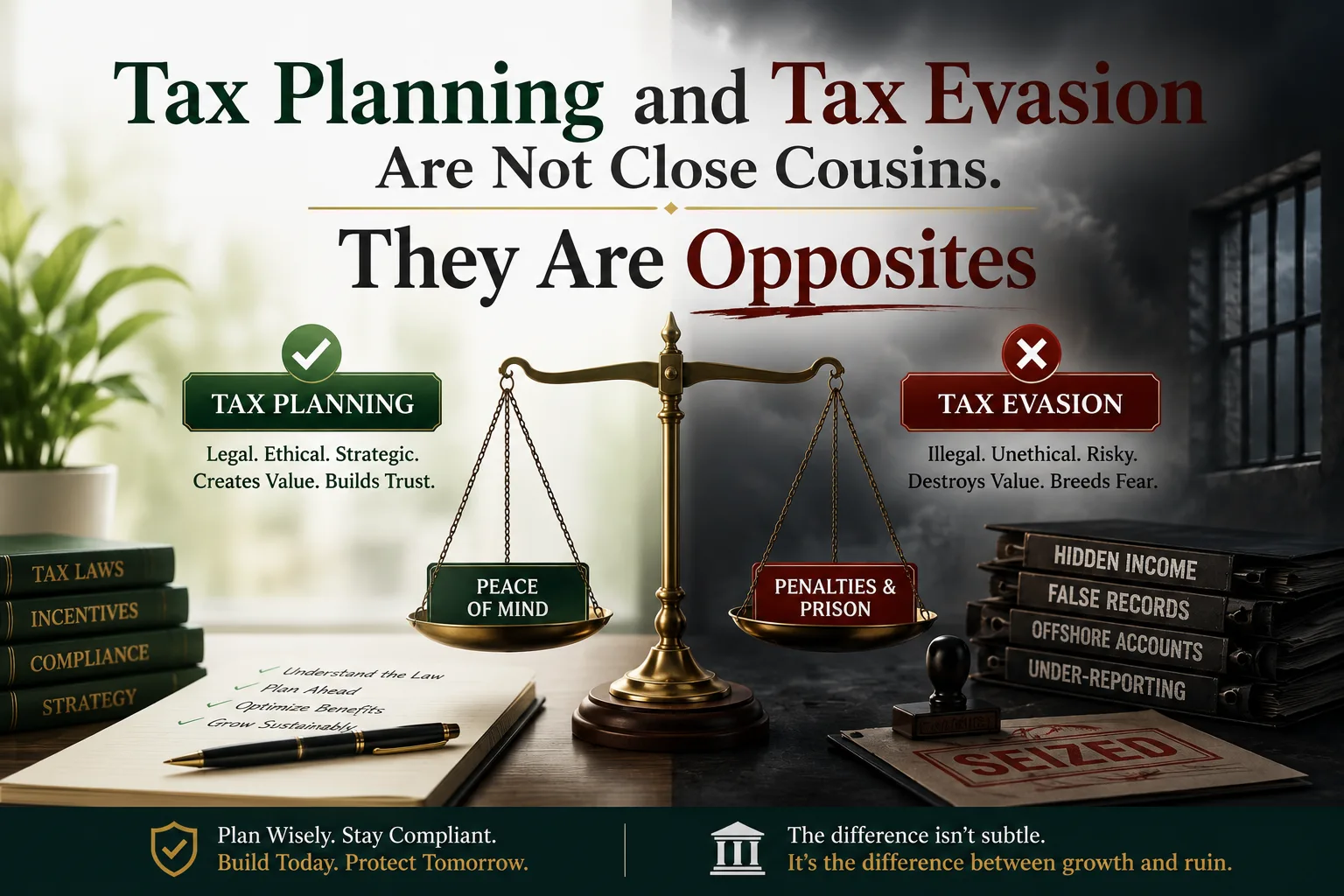
Two business owners sit across from two different accountants in the same week. The first asks: “What can I legitimately do to reduce what I owe?” The second asks: “Can you make this look smaller than it actually is?” Both owners believe they are asking for the same thing. They are not. One is asking for tax planning. The other is asking their accountant to commit a criminal offence, and to drag the accountant into it as a co-defendant. This article exists because that confusion is common, expensive, and now, under the Nigeria Tax Administration Act 2025, considerably more dangerous than it used to be.
A Distinction the Law Has Always Drawn, Even When Taxpayers Have Not
Nigerian tax law has long recognised two entirely different things that taxpayers often describe with the same word: “reducing my tax.” The first is tax avoidance, sometimes called tax planning — the lawful arrangement of one's affairs to pay no more tax than the law actually requires. The second is tax evasion — the unlawful concealment, misrepresentation, or falsification of facts to reduce a liability that is genuinely owed. The Nigerian Court of Appeal captured the legitimacy of the first concept decades ago, citing Lord Denning's observation that a transaction does not cease to be a genuine commercial transaction for tax purposes merely because it was also entered into with the object of reducing tax — provided it is a real transaction, not a sham.
That qualification carries the entire weight of the distinction. A real transaction, undertaken for genuine commercial reasons, that happens to also reduce tax: lawful. A transaction or declaration constructed specifically to deceive a tax authority about what actually happened: unlawful, regardless of how the paperwork is dressed.
What a Tax Consultant Can Lawfully Do
The boundaries of legitimate tax planning are wide, and a competent adviser should be using the full width of them on a client's behalf. This includes:
• Claiming every deduction, allowance, and relief the law actually provides — wholly, exclusively, and necessarily incurred business expenses; capital allowances; pension contributions; and the small company exemptions and thresholds introduced under the Nigeria Tax Act 2025
• Structuring genuine transactions — financing arrangements, business combinations, the timing of capital expenditure — in the manner that is most tax-efficient among the lawful alternatives actually available
• Choosing between lawful elections where the tax code itself offers a choice, such as available accounting treatments or timing options for recognising income and expenditure
• Ensuring full and accurate compliance so that no liability is overstated through error, ignorance, or excessive caution — overpaying tax is not a virtue, it is simply a different kind of mistake
• Representing a client in a genuine dispute over the correct interpretation or application of the law to their actual facts — disagreement with a tax authority's assessment is not evasion, provided the facts presented are true
Every item on that list shares one feature: the facts presented to the tax authority are accurate. What changes is how those true facts are organised, timed, and characterised within the choices the law itself permits.
What a Tax Consultant Cannot Lawfully Do
The boundary is crossed the moment a position depends on the tax authority believing something that is not true. In practice, this includes:
• Recording fictitious expenses, inflated costs, or expenditure that was never actually incurred, in order to reduce reported profit
• Omitting genuine income or revenue from a return — cash sales left out of the books, related-party income left undeclared, or transactions structured specifically to stay invisible to the tax authority
• Disguising the true nature of a transaction — characterising what is genuinely a dividend, a sale, or a salary as something else purely to attract a lower rate or an exemption it does not actually qualify for
• Constructing artificial, circular, or pre-arranged transactions that have no commercial substance beyond the tax saving itself — Nigerian courts have consistently held that such schemes will be looked through to their true effect
• Backdating documents, fabricating supporting paperwork, or knowingly submitting false declarations to support a return
None of these require sophistication to describe, because none of them are genuinely complicated. They share a single common thread: a deliberate gap between what is presented to the tax authority and what actually happened.
The Test That Actually Matters If a transaction would still make commercial sense even if it carried no tax benefit at all, it is almost certainly legitimate planning. If a transaction exists for no reason other than to create a tax outcome that does not reflect what genuinely happened, it is at serious risk of being treated as evasion — however carefully the paperwork has been constructed. |
Why the Nigeria Tax Administration Act 2025 Has Sharpened This Further
The NTAA 2025 has not redrawn the line between planning and evasion — that line has existed in Nigerian tax jurisprudence for decades. What it has done is attach a far more serious set of consequences to crossing it, and extended those consequences explicitly to anyone who assists.
Under Section 118 of the Act, any person — whether or not connected to a tax authority — who knowingly aids or abets the commission of a tax offence is liable, on conviction, to a fine or imprisonment for a term of up to three years, or both. Section 124 separately addresses false declarations made in connection with tax matters. Where the offending party is a company, Section 126 extends personal liability to any director, manager, or officer who consented to, connived in, or whose negligence contributed to the offence — meaning the consequence is not confined to the company's balance sheet.
The practical effect is that the adviser who agrees to “help” structure a deliberately false position is no longer merely exposed to professional embarrassment if discovered. They are exposed to the same statutory liability as the client who asked for the favour. Any accountant still treating that request as a routine professional courtesy has not yet absorbed what the law now actually says.
Why a Genuine Adviser Will Say No — and Why That Is Good News for You
Clients sometimes interpret a consultant's refusal as unhelpfulness, or as excessive caution from someone unwilling to fight for them. The opposite is closer to the truth. An adviser who is willing to falsify a position on request is not someone who is fighting hard on your behalf — they are someone who has not yet been caught, and whose risk you are quietly inheriting alongside them.
A tax authority that later discovers a falsified return does not treat the original adviser as a sympathetic bystander. The return carries the adviser's professional involvement, and in many cases their direct preparation. When the consequence arrives, it arrives for the business that signed the return and the adviser who prepared it — together, not separately.
A consultant who declines to falsify a position, and instead works within the genuine limits of the law, is offering something more durable: a position that survives scrutiny, an audit trail that holds up, and a professional relationship that does not carry a hidden liability waiting to surface at the worst possible moment — typically, as we have written about elsewhere, exactly when a major contract, licence, or transaction depends on a clean compliance history.
The Grey Areas Are Narrower Than People Assume
Much of the popular discussion around tax planning treats the boundary as hopelessly blurred — a matter of aggressive interpretation versus conservative interpretation, where reasonable professionals might land in different places. In our experience, genuine grey areas are far rarer than commonly believed.
Most disputes that end up framed as “interpretation” are, on closer inspection, disputes about facts — whether an expense was genuinely incurred for the purpose claimed, whether a transaction actually occurred on the terms documented, whether income was genuinely excluded for a defensible reason or simply left out. Once the facts are established truthfully, the available interpretations of how the law applies to those facts are usually narrower, and the position usually clearer, than the request that prompted the conversation in the first place.
Our Position
Joe Adinma & Co. will use every lawful means available to ensure a client pays no more tax than the law genuinely requires. We regard that as a core part of the professional service we owe every client, and we pursue it diligently. We will not falsify a return, disguise a transaction, or assist in concealing income or assets from a tax authority — not as a matter of personal discomfort, but because doing so is now a defined criminal offence under the Nigeria Tax Administration Act 2025, with consequences that fall on the adviser as much as the client.
If you are uncertain whether something you are considering sits on the right side of that line, the conversation is worth having before the position is taken, not after a tax authority has asked the question for you. We are always glad to have that conversation.
Where We Can Help Our tax practice focuses on Federal tax compliance — Companies Income Tax, VAT, WHT, and related obligations administered by the Nigeria Revenue Service. We assist with lawful tax structuring, compliance reviews, NRS liaison, and the resolution of genuine disputes over assessment. Contact our tax practice in Port Harcourt to discuss your position confidentially. |
This article reflects the general legal distinction between tax avoidance and tax evasion under Nigerian law, and the relevant offence provisions of the Nigeria Tax Administration Act 2025 as currently understood. It is published for general information purposes and does not constitute professional or legal advice on any specific transaction or set of facts.