JOE ADINMA & CO.
FINANCIAL REPORTING INSIGHT
IFRS 18:
The 2027 Standard That Is Already a 2026 Problem
What Nigerian boards, CFOs and finance teams need to do now
Your total profit may not change. But your operating profit, bank covenants, management KPIs, investor story, cash-flow presentation and financial-reporting architecture might.
By Joe Adinma, FCA, FCTI — Managing Partner, Joe Adinma & Co. (Chartered Accountants)
Last updated: 1 October 2026
A September close, read through IFRS 18
Imagine a Nigerian manufacturing group closing its September 2026 management accounts.
It is profitable. It has significant bank facilities. Some borrowings are dollar-denominated. Its loan agreements contain interest-cover and leverage tests. Management routinely tells the board and lenders that “adjusted EBITDA” is the best measure of underlying performance. Its finance team records exchange gains and losses in a broad general-ledger account and prepares the annual financial statements through a combination of ERP reports and year-end Excel schedules.
Nothing about that description is unusual.
Now introduce IFRS 18 — Presentation and Disclosure in Financial Statements.
From annual reporting periods beginning on or after 1 January 2027, IFRS 18 replaces IAS 1. The new Standard does not ordinarily change whether the company has earned ₦10 billion, ₦15 billion or ₦20 billion of total profit. What it can change is how that performance is classified, presented, explained and compared.
And because IFRS 18 is applied retrospectively, a calendar-year company will need its 2026 comparative information on the new basis.
IFRS 18 starts in 2027. But for a 31 December year-end company, the numbers being generated today are already becoming the IFRS 18 comparatives.
That changes the question completely. It is no longer whether finance teams should learn a new presentation standard before next year. It is whether today's systems, charts of accounts, treasury coding, management reports, public performance measures and loan documentation can support tomorrow's financial statements.
Nigeria's own financial-reporting regulator is not treating IFRS 18 as a formatting exercise. In its signed 2025 financial statements, the Financial Reporting Council of Nigeria states that the Standard's presentation and disclosure effects are expected to be “pervasive”, particularly for the statement of financial performance and Management-defined Performance Measures. The FRC also confirms that its 2026 comparative information will require restatement when it applies IFRS 18 from 1 January 2027, and identifies expected changes to the presentation of interest received and interest paid in its cash-flow statement.
This is therefore not a formatting project for December 2027. It is a financial-reporting transition that has already begun.
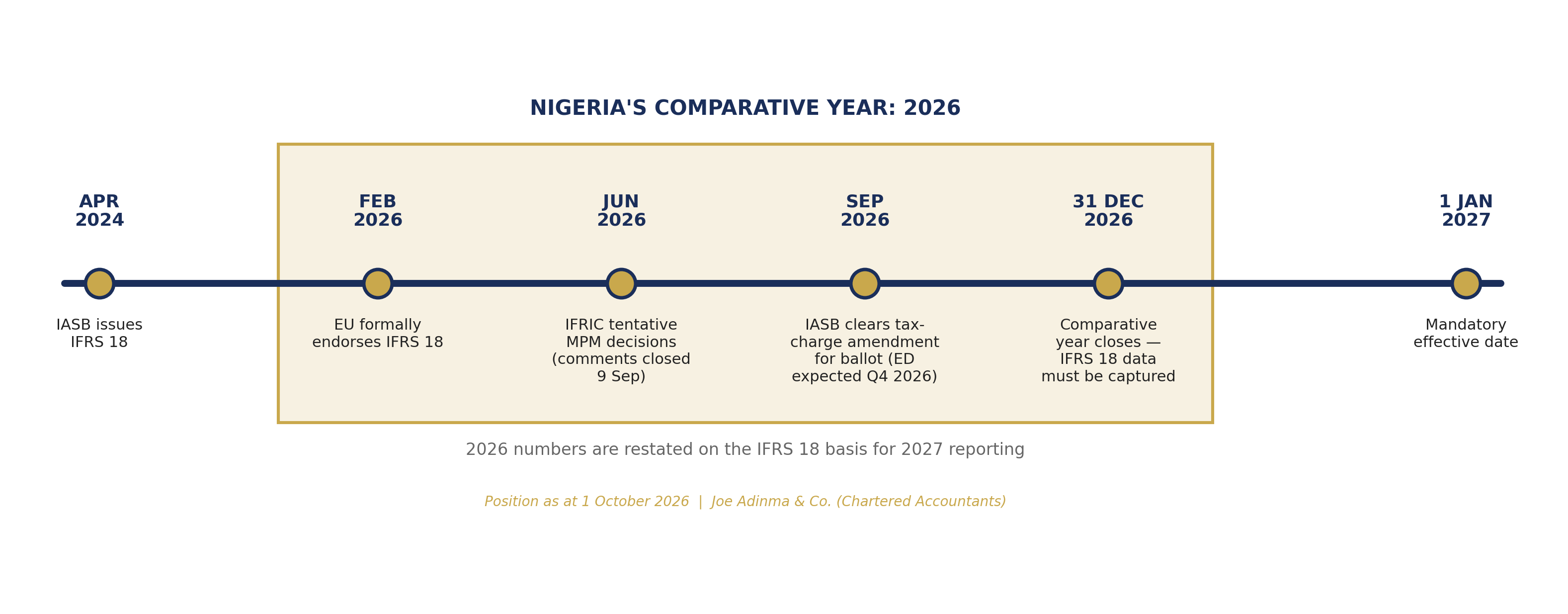
IFRS 18's road to 2027 — the comparative year is already running, and the Standard is still being refined.
1. What IFRS 18 actually changes
IFRS 18 was issued by the International Accounting Standards Board in April 2024 to improve how companies communicate financial performance. It replaces IAS 1, while carrying forward many familiar presentation requirements and relocating some requirements to other Standards.
The most important changes fall into three areas:
A more structured statement of profit or loss, including defined subtotals for operating profit and profit before financing and income taxes.
New disclosures for qualifying Management-defined Performance Measures (MPMs).
Stronger principles for aggregation, disaggregation and labelling, intended to reduce the loss of useful information inside overly broad captions.
IFRS 18 also brings consequential amendments to IAS 7 on the statement of cash flows and to IAS 34 for interim reporting.
2. Same profit. Very different business.
Consider two simplified Nigerian companies operating in the same industry:
Item | Company A | Company B |
Revenue | ₦100bn | ₦100bn |
Operating expenses | (₦82bn) | (₦98bn) |
Operating profit | ₦18bn | ₦2bn |
Investing / other qualifying income | — | ₦18bn |
Finance costs | (₦3bn) | (₦5bn) |
Profit before tax | ₦15bn | ₦15bn |
Both companies report ₦15 billion profit before tax. Yet they are not telling the same economic story.
Company A's profit is earned predominantly by its operating activities. Company B's operating result is far weaker, and most of its profit before tax arises outside the operating category.
That distinction matters enormously in Nigeria, where high finance costs, investment income, foreign-exchange movements and complex funding structures can materially reshape the journey from operating performance to profit before tax.
IFRS 18 responds by requiring income and expenses to be classified into operating, investing, financing, income taxes and discontinued operations, subject to specific rules — including special requirements for entities with specified main business activities.
3. What the new profit or loss architecture can look like
For a simplified non-financial company, an IFRS 18-style presentation could look like this:
Illustrative statement of profit or loss | ₦bn |
Revenue | 100.0 |
Cost of sales and other operating expenses | (82.0) |
OPERATING PROFIT | 18.0 |
Investing income / (expenses), net | 2.0 |
PROFIT BEFORE FINANCING AND INCOME TAXES | 20.0 |
Finance income / (expenses), net | (8.0) |
PROFIT BEFORE INCOME TAX | 12.0 |
Income tax expense | (3.6) |
PROFIT | 8.4 |
The example is deliberately simple; actual classification must follow IFRS 18. But the visual point is important. Users can see the operating result before investing and financing effects reshape the bottom line.
A company can have a good factory, a good product and a good operating margin — and still have a financing structure that destroys much of the value created by operations.
4. In Nigeria, finance costs may become an even louder boardroom number
Suppose a manufacturer earns ₦12 billion of operating profit but incurs ₦8 billion of finance costs. The factory may be performing well, yet two-thirds of the operating result is being consumed by financing.
This is not a stretch. The Manufacturers Association of Nigeria's 2025 survey put the average manufacturing borrowing rate at 32.1%. At that cost of debt, a company carrying meaningful leverage does not need a stressed balance sheet to see financing consume a large share of its operating result.
On 22 September 2026, the Central Bank of Nigeria cut the Monetary Policy Rate by 350 basis points, from 26.5% to 23%. The CBN itself described the move as an operational reset to strengthen policy transmission, not a change in its underlying policy stance. A lower policy rate does not reprice existing facilities overnight, and how much of the cut reaches business lending rates — and how quickly — remains to be seen. For the 2026 comparative year, nearly three-quarters of the year had already been financed at the old rates.
We examined this environment in our companion analyses, “Borrowing at 30%+: When Does a Business Loan Stop Creating Value and Start Destroying It?” and “CBN Cut the MPR by 350 Basis Points. How Much Will Your Business Actually Save?”
For boards, the conversation can shift from “we made a profit” to harder questions: How much did the operating business actually earn? How much value did financing consume? Is the debt structure still rational? Should facilities be refinanced, repriced or reduced? Are prices and margins sufficient to support the capital structure?
IFRS 18 is an accounting standard, not a corporate-finance strategy. But clearer presentation can make poor financing decisions harder to hide inside the final profit number.
5. The covenant risk: IFRS 18 may not change profit, but it can change the conversation with your bank
This is one of the most commercially important transition issues.
Loan and bond agreements often contain covenants linked to measures such as operating profit, EBIT, EBITDA, interest cover or leverage. The effect of IFRS 18 will depend on the exact contractual wording. A covenant with a carefully fixed contractual definition may behave differently from one that refers dynamically to financial-statement subtotals or accounting standards.
Companies should therefore not assume that “presentation only” means “no covenant impact.” They should identify facilities and other agreements that use accounting-derived measures, determine whether definitions could be affected, model the consequences and engage lenders early where clarification or amendment is needed.
A covenant problem caused by accounting ambiguity that management could reasonably have spotted months earlier is no longer just an accounting issue. It is a governance issue.
6. Foreign exchange: one GL account may no longer be good enough
Foreign-exchange gains and losses are a particularly Nigerian implementation issue.
Consider three exposures: a dollar loan used to finance the business; a foreign supplier payable for imported inventory; and a foreign-currency intercompany balance. All may generate exchange differences. But under IFRS 18, classification generally follows the category of the income or expense arising from the item that generated the exchange difference, subject to the Standard's detailed requirements and relevant relief.
A finance team that currently posts all exchange differences into one broad account called “FX Gain/Loss” may therefore lack the information required for reliable classification.
Intercompany balances need their own decision. In April 2026, the IFRS Interpretations Committee published an agenda decision on exchange differences arising from intragroup loans in consolidated financial statements. Because the related interest is eliminated on consolidation, IFRS 18 does not say clearly where the exchange difference belongs. For exchange differences within the fact pattern the Committee addressed, a group therefore develops an accounting policy under IAS 8 and applies it consistently: either classify them in the operating category, or classify them in the category the related income and expense would have taken before elimination — with the operating category as the fallback where that tracing would involve undue cost or effort. For a Nigerian group with dollar loans between parent and subsidiaries, that policy should be documented now, not argued over during the 2027 audit.
The practical response is not another year-end spreadsheet. It is better source coding: identify the underlying exposure, map it to the appropriate category, and preserve that information through the ledger and consolidation process.
For companies with material foreign-currency exposures, IFRS 18 should trigger a review of treasury accounting, ERP configuration, intercompany coding, loan schedules and the chart of accounts.
7. Banks, finance companies and investment businesses cannot be treated like manufacturers
Consider a Nigerian deposit money bank. Interest income on customer loans and the cost of funding those lending activities are not peripheral in the way interest on a factory loan may be for a manufacturer; financing customers is part of the bank's economic engine. IFRS 18 therefore contains specific classification requirements for entities whose main business activities include providing financing to customers or investing in particular types of assets.
That distinction is critical for Nigerian banks, mortgage institutions, finance companies, investment businesses, insurers and diversified financial groups. A classification designed around an industrial company cannot simply be imposed on a financial institution.
The assessment is made at the reporting-entity level. That creates another subtle issue: a subsidiary's classification in its separate financial statements may differ from the classification needed when the subsidiary is consolidated into a group with different main business activities.
For Nigerian conglomerates, implementation may therefore require changes to subsidiary reporting packs and consolidation mappings, not merely the group's published statement.
Here too, the interpretive work is live. In June 2026, the Interpretations Committee issued tentative agenda decisions on how an entity whose main business activity includes providing financing to customers classifies its income and expenses, and on the classification of income and expenses from cash and cash equivalents. Comments closed on 9 September 2026. Nigerian banks and finance companies should track the final wording before locking in their mappings.
A further question surfaced in September 2026. The Committee issued another tentative agenda decision, this time on how an entity assesses whether an asset “generates a return individually and largely independently” of its other resources — a key test for whether income from that asset belongs in the investing category or inside operating profit. The Committee tentatively concluded that IFRS 18 already provides an adequate basis for that judgement: debt and equity investments typically pass the test, while trade receivables and other instruments arising from supplying goods or services typically do not. Comments are open until 30 November 2026. For Nigerian companies holding Treasury bill portfolios, equity stakes or let property alongside their trading business, this test helps decide what sits above and below operating profit.
8. “Adjusted EBITDA” is about to face a more disciplined question: adjusted from what?
Management teams routinely use non-IFRS performance measures because statutory profit does not always tell the story they want investors, lenders or boards to understand.
That can be legitimate. It can also become selective.
A restructuring charge is excluded. An impairment is called exceptional. An FX loss is described as unusual. A litigation cost is removed. Then another “one-off” item appears the following year.
IFRS 18 introduces specific disclosure requirements for qualifying Management-defined Performance Measures. Broadly, an MPM is a subtotal of income and expenses used in public communications outside the financial statements to communicate management's view of an aspect of the entity's financial performance as a whole, subject to specified exclusions.
If a measure qualifies, management must do more than print the number. It must explain the measure, how it is calculated, why management believes it provides useful information, and reconcile it to the most directly comparable IFRS-specified subtotal or total, including required tax and non-controlling-interest effects.
A worked MPM example
Assume the company publicly reports “Adjusted Operating Profit” of ₦23 billion while IFRS 18 operating profit is ₦18 billion.
Illustrative reconciliation | ₦bn |
IFRS 18 operating profit | 18.0 |
Add back: restructuring expense | 3.0 |
Add back: impairment described by management as exceptional | 2.0 |
Management-defined “Adjusted Operating Profit” | 23.0 |
The accounting question is not whether management is forbidden from using ₦23 billion. The transparency question is whether users can see exactly how management moved from ₦18 billion to ₦23 billion and understand the judgement behind the adjustments.
That is a significant shift from “trust our adjusted number” towards “show your work.”
The implementation questions are not theoretical. In June 2026, the IFRS Interpretations Committee published tentative agenda decisions on MPMs, including measures built on hypothetical income and expenses and what counts as a “public communication.” The comment period closed on 9 September 2026. Preparers should watch for the final decisions before settling their MPM policies — implementation is generating live interpretive questions even before mandatory application begins.
9. Investor relations is now part of the accounting implementation
Because the MPM definition looks to specified public communications outside the financial statements, IFRS 18 reaches beyond the finance department.
Management commentary, press releases and investor presentations are expressly relevant examples under the Standard. Social-media posts and oral communications are excluded for this specific definition, and judgement can be required in less straightforward communication settings.
For listed and other publicly communicating companies, finance, investor relations, corporate communications, legal, tax, internal audit and the audit committee need a common inventory of performance measures and a control process around their use.
A catchy earnings metric created outside the accounting department can become a financial-reporting issue.
10. “Other expenses” cannot become an accounting warehouse
IFRS 18 strengthens requirements for aggregation, disaggregation and meaningful labelling.
Financial statements must aggregate information — no user wants ten thousand ledger lines. But aggregation becomes a problem when materially different items disappear inside broad captions.
That makes familiar lines such as “other expenses”, “other income”, “other receivables” and “other payables” worth revisiting.
The word “other” is not banned. The question is whether the grouping obscures information that is material to understanding the company's financial position or performance.
A ₦7 billion balance does not become informative simply because it is labelled “Other expenses — ₦7 billion.”
11. Expense presentation can expose weaknesses in the accounting system
Many Nigerian companies present operating expenses by function — cost of sales, administrative expenses, selling and distribution expenses.
IFRS 18 introduces specified disclosures by nature where operating expenses are presented by function. In a single note, the entity discloses the totals for depreciation, amortisation, employee benefits, impairment of non-financial assets (and reversals) and inventory write-downs (and reversals), together with the amount included in each relevant line item.
The burden is broader than it may first appear. A final IFRIC agenda decision, published as an addendum to the March 2026 IFRIC Update, confirms that this requirement contains no exceptions: it applies whenever an entity presents any line item comprising expenses classified by function in the operating category. Nature information therefore has to survive underneath function-based reporting, not be rebuilt from it at year-end.
For a well-designed ERP, this is a reporting exercise. For a weak chart of accounts supported by year-end manual allocations, it can become a reconstruction exercise.
The distinction is important: IFRS 18 implementation is partly a test of whether the accounting system understands the transactions before the financial-statement team tries to explain them.
12. The statement of cash flows changes too
IFRS 18 also amends IAS 7.
For entities using the indirect method, operating profit or loss becomes the required starting point for reporting cash flows from operating activities. The amendments also change the classification requirements for interest and dividend cash flows, with specific requirements depending on the nature of the entity.
Nigeria's FRC expects exactly this change in its own presentation of interest received and interest paid — a reminder that the transition reaches well beyond the income statement.
Companies therefore need to review cash-flow mappings and policies alongside the statement of profit or loss. Treating IFRS 18 as an income-statement-only project would be incomplete.
13. IFRS 18 does not rewrite Nigerian tax law
This distinction deserves to be explicit.
IFRS 18 is principally a presentation and disclosure standard. Nigerian tax legislation determines taxable profit, allowable deductions, capital allowances and other tax consequences. Reclassifying an expense from one financial-statement category to another does not, by itself, make the expense deductible or non-deductible for tax.
But tax teams cannot ignore the transition. Financial statements remain central to tax computations, tax reconciliations, deferred-tax analysis and explanations provided during tax reviews.
Where the presentation of financial performance changes, tax schedules and reconciliation processes may also need to be remapped so that the audit trail from accounting profit to taxable profit remains clear.
The home for non-income taxes is still being settled. In March 2026, the Interpretations Committee concluded that, under IFRS 18 as written, taxes outside the scope of IAS 12 belong in the operating category. Concern about that outcome led the IASB to hold the decision back and pursue a targeted amendment instead: a tax charge imposed by government as a direct substitute for income tax would be classified in the income taxes category.
On 23 September 2026, all 12 IASB members confirmed that due process had been satisfied, allowing the Exposure Draft to move to balloting — a proposal, not yet an issued amendment. It proposes retrospective application with no relief for first-time adopters and a 120-day comment period. Publication is still expected in Q4 2026, and two Board members have signalled an intention to dissent. For Nigerian groups that pay levies alongside Companies Income Tax, the practical step is the same either way: confirm now which charges fall within IAS 12, because only a charge levied instead of income tax would move if the amendment is finalised.
The message is therefore simple: IFRS 18 does not determine Nigerian tax liability, but tax and financial reporting should not implement it in separate rooms.
14. This is not only an NGX issue
Unlisted companies should not assume IFRS 18 is only for entities quoted on the Nigerian Exchange.
The starting question is: what financial-reporting framework is this entity required to apply?
Entities applying full IFRS need to assess IFRS 18. Entities properly applying the IFRS for SMEs Accounting Standard should not simply import IFRS 18 into their accounts because the Standard exists.
This distinction matters in Nigeria, where the applicable reporting framework depends on the entity's status and reporting obligations, not simply whether its shares trade publicly.
Entities on IFRS for SMEs face a change of their own: the Standard's third edition also takes effect for periods beginning on or after 1 January 2027, which we cover in a separate article.
15. The global implementation wave is already moving
IFRS 18 is not sitting dormant until 2027.
In February 2026, the European Union formally endorsed IFRS 18 for financial years beginning on or after 1 January 2027. The European Securities and Markets Authority then issued a public statement urging timely, high-quality implementation, specifically highlighting retrospective application, IT systems, management reporting, communication strategy, audit committees and transparency about expected effects.
For Nigerian groups with European parents, subsidiaries, investors, lenders or cross-border reporting obligations, that international implementation environment matters.
More broadly, it signals what serious regulators and capital markets are focusing on: not merely whether the headings have changed, but whether systems, controls, governance and public communication have changed with them.
Closer to home, the reporting calendar is getting crowded. In a circular dated 23 September 2026, the Securities and Exchange Commission directed public companies and significant public-interest capital market operators to submit implementation plans for the IFRS Sustainability Disclosure Standards (IFRS S1 and S2) by 15 October 2026, ahead of mandatory reporting from 1 January 2028. The same finance teams, systems and audit committees will carry both transitions. Boards that plan them separately risk doing the same data and controls work twice.
16. The implementation checklist Nigerian boards should ask for now
The international standard-setter has issued the rules and is still refining them. The European Union has endorsed them. Nigeria's Financial Reporting Council has assessed the effects as pervasive and is preparing its own 2026 comparatives. For Nigerian boards and CFOs, the conversation should have moved from “Is IFRS 18 coming?” to “Are we ready?”
1. Framework: Confirm which entities in the group apply full IFRS and therefore need IFRS 18.
2. Profit-or-loss mapping: Map material income and expense streams to the new categories and subtotals.
3. Business-activity assessment: Document whether any entity has specified main business activities that change classification.
4. FX architecture: Identify the source of material exchange differences and redesign coding where one broad FX account is insufficient; document the group policy for intragroup FX differences.
5. MPM inventory: Catalogue adjusted, underlying, normalised and similar subtotals used in public communications.
6. MPM controls: Build reconciliations, tax/NCI analysis, ownership and approval controls.
7. Aggregation review: Challenge material balances hidden in broad “other” captions.
8. Expense-by-nature data: Test whether systems can produce the specified nature disclosures where expenses are presented by function.
9. Cash-flow mapping: Update IAS 7 classifications and indirect-method starting points.
10. Covenants and contracts: Review facilities, bonds, incentive plans, earn-outs and agreements tied to accounting-derived performance measures.
11. Group reporting: Assess whether subsidiary reporting packs and consolidation mappings need redesign.
12. 2026 comparatives: Capture the information now rather than reconstruct it under audit pressure.
13. Interim reporting: For interim reporters, plan for the IFRS 18-related IAS 34 requirements in the first year of application.
14. Governance: Put implementation progress before the audit committee and involve the external auditor early.
15. Watch list and policy governance: Track final IFRIC decisions, the September 2026 tentative decision and the IASB's tax-charge Exposure Draft. Document which agenda decisions were considered, whether they apply, the judgement reached and who approved it — then carry that conclusion into the policy manual and system mappings.
17. The biggest IFRS 18 risk is not misunderstanding the Standard. It is starting too late.
A company can download an IFRS 18 specimen financial statement and rearrange its headings in a day. That is not implementation.
Real implementation can reach into the chart of accounts, ERP, consolidation packs, treasury coding, management reporting, investor communications, accounting manuals, internal controls, tax reconciliations, budgets, covenant calculations and audit documentation.
The organisations most likely to struggle are not necessarily those with the most complex financial statements. They are those whose financial statements are produced by heroic year-end manual work that the underlying accounting system cannot reproduce consistently.
If the finance team cannot explain where an exchange difference came from, cannot reconcile an adjusted performance measure, cannot disaggregate a material “other” balance, or cannot reproduce a KPI without one person's spreadsheet, the problem is bigger than IFRS 18.
18. What IFRS 18 is really asking Nigerian boards
Behind the technical requirements are a series of uncomfortable but valuable questions:
How much of our reported profit actually comes from our operating engine?
How much value is financing consuming?
Which performance measures do we present publicly, and can we reconcile every adjustment?
Could a change in accounting presentation create uncertainty in a loan covenant or contractual KPI?
Are material items being hidden by excessive aggregation?
Can our ERP produce the required information, or does the finance team reconstruct it at year-end?
Are our 2026 transactions being captured today in a way that will support the 2027 financial statements?
Those are not merely accounting questions. They are questions about governance, capital structure, systems, transparency and the quality of management information.
Conclusion: 2027 is the effective date. 2026 is the preparation year.
IFRS 18 will not make a weak Nigerian business strong or a profitable company more profitable. But it can make the architecture of performance much clearer.
A company may still report the same total profit. Users may nevertheless see more clearly what came from operations, what came from investing, what financing consumed, how management constructed its preferred performance measures, and whether material information has been lost inside broad captions.
That is why IFRS 18 should not be dismissed as a change in financial-statement format.
For calendar-year companies, the 2026 numbers being generated now are the comparatives that will sit beside the first IFRS 18 numbers in 2027. With the final quarter of 2026 now under way, boards should ask management for an IFRS 18 readiness assessment covering profit-or-loss mapping, MPMs, foreign-exchange classification, loan covenants and contractual KPIs, systems, cash-flow presentation, group reporting and comparative data. By the time the 2027 audit begins, discovering structural gaps will already be late.
Go back to the manufacturing group closing its September 2026 accounts. Every exchange difference it posts, every adjusted EBITDA figure it reports to its bank and every covenant test it runs this quarter is already part of its first IFRS 18 comparative year. The only question is whether that information is being captured in a form it can still use.
The question is no longer, “When does IFRS 18 start?” The better question is: “If our 2026 numbers must tell the IFRS 18 story next year, are our systems, contracts and controls ready to tell it accurately?”
How we sourced this
Developments are drawn from primary sources wherever possible: the IFRIC Updates and agenda decisions for March, June and September 2026; the IASB's project page for the tax-charge amendment, including its September 2026 decisions; the FRC of Nigeria's signed 2025 financial statements; ESMA and EUR-Lex for the EU position; the CBN's published Monetary Policy Decisions for the 307th MPC; and the SEC's circular of 23 September 2026. Open IFRIC and IASB matters are stated as at 1 October 2026 and may change.
Professional note
This article is intended for professional education and general information. IFRS 18 implementation depends on an entity's facts, reporting framework, contractual terms and accounting judgements. Companies should perform an entity-specific assessment before changing accounting presentation, systems or contractual interpretations.
About the Author
Joe Adinma, FCA, FCTI, is the Managing Partner of Joe Adinma & Co. (Chartered Accountants), a Port Harcourt-based firm he established in 2010. With over 30 years in practice, he specialises in IFRS financial reporting, NRS federal tax compliance, forensic accounting, and audit and assurance, advising clients across oil and gas, energy, real estate and professional services.
Authoritative and further reading
EUR-Lex — Commission Regulation (EU) 2026/338 endorsing IFRS 18
Kreston Pedabo — IFRS 18: From Disclosure Discretion to Structured Accountability
IFRS Foundation — IFRIC Update June 2026 (IFRS 18 tentative agenda decisions)
IFRS Foundation — IASB decisions: July 2026 meeting (proposed IFRS 18 tax-classification amendment)
Central Bank of Nigeria — Monetary Policy Decisions, 307th MPC Meeting (21–22 September 2026)
Vanguard — CBN cuts interest rate to 23% (22 September 2026)
Nairametrics — SEC issues deadline for IFRS sustainability reporting plans (24 September 2026)