15 October 2026: The First Big IFRS S1 & S2 Deadline Nigerian Public Companies Cannot Ignore
Published October 8, 2026
Inside the FRC-SEC Sustainability Reporting Roadmap, the Governance Test Behind the October Deadline, and the Assurance Clock Nigerian Boards Can't See Yet
By Joe Adinma, FCA, FCTI — Managing Partner, Joe Adinma & Co. (Chartered Accountants)
Last updated: 5 October 2026
In August 2024, Nigeria's Financial Reporting Council sent a short congratulatory note to four companies — Access Bank, Fidelity Bank, MTN Nigeria, and Seplat Energy — for doing something no law yet required of them. They had started reporting against a brand-new set of global sustainability standards, IFRS S1 and S2, three years before anyone else in the country would have to.
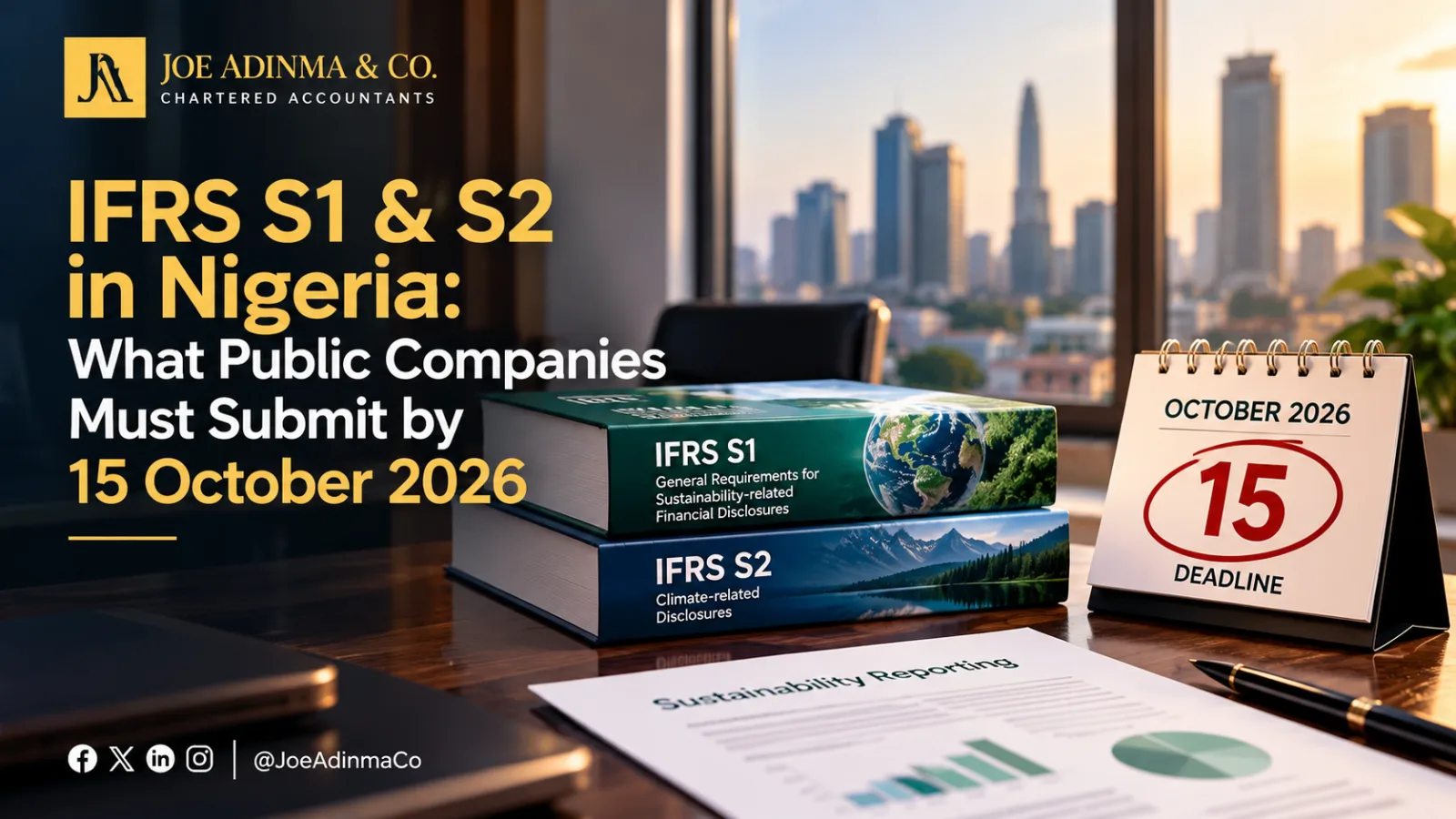
Two years on, that early move looks less like goodwill and more like good timing. As of 23 September 2026, every public company in Nigeria — and the market infrastructure around it — has to tell the Securities and Exchange Commission how it plans to catch up. The deadline for that first submission is 15 October 2026 — days away, not months.
What IFRS S1 and S2 Actually Ask For
IFRS S1 sets the general rule: disclose the sustainability-related risks and opportunities that could reasonably affect your cash flow, your access to finance, or your cost of capital over the short, medium, and long term. IFRS S2 does the same job specifically for climate — emissions, physical risk, transition plans, the works.
Between them, they are to sustainability reporting what IFRS itself is to financial statements: one global rulebook, replacing a patchwork of voluntary, country-specific efforts. Nigeria adopted both in June 2023, becoming the first country in Africa to do so.
The Timeline FRC Re-Confirmed in February
On 23 February 2026, the FRC unveiled an amended version of its adoption roadmap, together with a new Sustainability Reporting Guideline (SRG 1). FRC's Chief Executive, Dr Rabiu Olowo, said the update was needed “to address areas of concern raised by adopting entities” — mainly around timelines, assurance, and who is actually qualified to do this work. The phases themselves didn't change; they were clarified.
Phase | Window | Who it covers | Status |
Phase 1 — Early adoption | Periods ending on or before 31 Dec 2023 | Any entity, after an FRC Readiness Test Assessment | Closed. Four companies used it. |
Phase 2 — Voluntary adoption | 1 Jan 2024 – 31 Dec 2027 | Any entity, after the same Readiness Test Assessment | Open now |
Phase 3 — Mandatory (companies) | From 1 Jan 2028 | Public Interest Entities (PIEs) | 15 months away |
Phase 3 — Mandatory (small business) | From 1 Jan 2030 | SMEs — full 8-point test, not just size (see below) | Further out |
Public sector — a different standard | From 1 Jan 2028 | Government & government organisations applying IPSAS, under IPSASB SRS 1 — not IFRS S1/S2. Commercial public-sector entities (CPSEs) report as PIEs | Related, not the same regime |
One correction worth making plainly: government and government organisations are not simply a fifth category of IFRS S1/S2 adopters. For this purpose, the roadmap means public-sector bodies that apply IPSAS, are funded mainly by taxes or transfers, and do not have profit as their primary objective. In January 2026 the International Public Sector Accounting Standards Board issued IPSASB SRS 1, Climate-Related Disclosures, for annual reporting periods beginning on or after 1 January 2028 — the same start date, but a distinct standard, built for the public sector rather than companies. A government-owned commercial company is different: the roadmap expressly places Commercial Public Sector Entities (CPSEs, formerly government business enterprises) among the PIEs reporting under IFRS S1 and S2 from 2028. If your work touches government accounts, check which side of that line the entity sits on before choosing the standard.
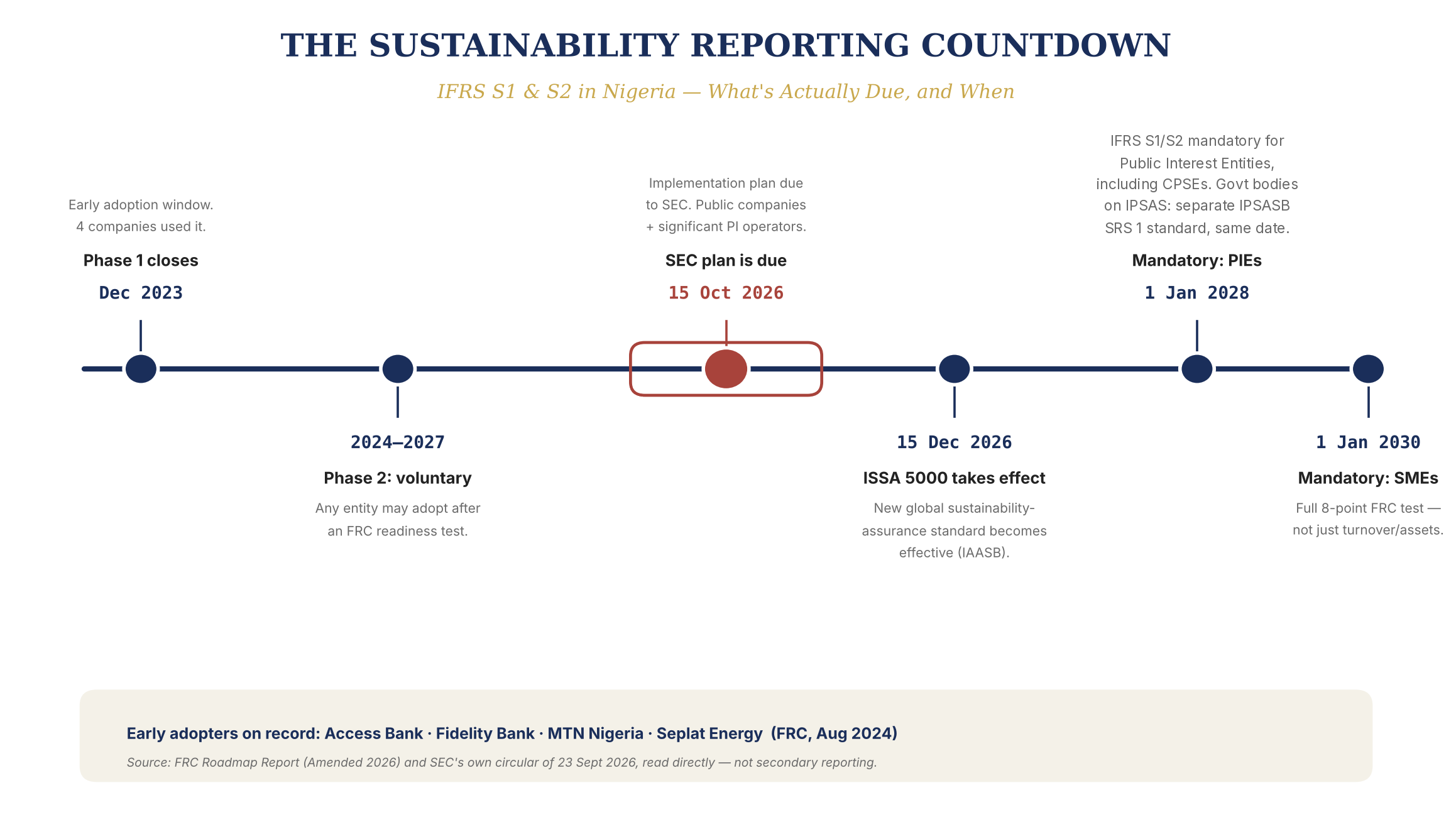
Fifteen months sounds like a long runway. But anyone in Port Harcourt who has waited for the light to go off before buying diesel knows the time to prepare is before you need it.
The Deadline That's Actually Due This Month
FRC's roadmap sets where the destination is. SEC's own circular — published directly on its website, dated 23 September 2026 and issued under the Investments and Securities Act 2025 — sets what's due right now. It applies, in its own words, to “all Public Companies and Significant Public Interest Capital Market Operators” — the latter being entities that facilitate clearing, settlement, trading or data functions, including exchanges, central securities depositories, clearing houses and trade repositories. Every one of them must submit an implementation plan to the SEC by 15 October 2026.
That plan isn't a formality. SEC's circular asks for, in writing:
Governance arrangements for sustainability reporting, including Board oversight
A gap assessment against the actual requirements of IFRS S1 and S2
An implementation roadmap, with real dates attached
How you intend to collect and report the underlying data
Internal control and assurance arrangements
A capacity-building and training plan for the staff who will do this work
The year you expect to publish your first sustainability report
The implementation challenges you're honestly expecting
The SEC circular itself does not specify a penalty for missing 15 October. That is not the same as there being no consequence. The circular says the Commission will monitor compliance with the implementation timelines as part of its oversight of financial reporting and corporate governance. FRC's Chief Executive also warned, when the roadmap was first launched in March 2024, that the Council “will not tolerate greenwashing”. A company with nothing on file when examiners start asking questions is in a weaker position than one that filed something, even an imperfect something, on time.
It's worth being precise about what this deadline is not. SEC is not asking companies for their sustainability numbers — nobody has those yet, and nobody is required to. It is asking them to show, in writing, that the governance, systems, controls, people, and assurance planning needed to produce those numbers later already exist, or have a credible plan behind them.
That's a harder test than it looks. A finance team can sometimes produce one good number under pressure. Named Board oversight, a genuine gap assessment, and an actual data-collection plan are harder to improvise in the last week of a filing season. Treat 15 October as evidence that Nigeria's sustainability-reporting transition has moved from policy discussion into entity-level supervision — not as a box to tick and forget.
None of this work is wasted. FRC's own Readiness Test Assessment asks for a Board resolution, a gap analysis and an implementation plan as its first-stage documents, so a well-built SEC plan is also the opening page of that file.
What Happened to the Earlier 2027 Date?
In July 2026, SEC's Director-General, Dr Emomotimi Agama, told a conference that mandatory ESG reporting would begin in 2027 for “large” Public Interest Entities, 2028 for other PIEs, and 2030 for SMEs — a three-tier schedule, reported identically by multiple outlets covering the same remarks.
SEC's own September circular — the formal instrument, issued under statute, that actually governs this process — doesn't repeat that 2027 tier. Read directly, it sets one PIE start date: accounting periods beginning on or after 1 January 2028, matching FRC's roadmap exactly, with no separate “large PIE” category anywhere in it.
A conference remark reported by newspapers and a formal regulatory circular issued under the Investments and Securities Act 2025 do not carry equal weight. Unless SEC issues another instrument changing this, 1 January 2028 is the date to plan around for every PIE — not just the ones outside whatever “large” meant in July.
Which SME Definition Applies to You?
Don't confuse this SME definition with the different “small company” tests used for tax or corporate-law purposes — they are separate tests, and a business can pass one and fail another. For sustainability reporting specifically, here is FRC's actual definition, in full. An SME is an entity that may not have public accountability, and:
Its debt or equity instruments are not traded in a public market
It is not in the process of issuing such instruments for trading in a public market
It does not hold assets in a fiduciary capacity for a broad group of outsiders as one of its primary businesses
Its annual turnover is not more than ₦500 million, or such amount as the Corporate Affairs Commission may fix
Its total asset value is not more than ₦200 million, or such amount as the Corporate Affairs Commission may fix
No Board member is an alien
No member is a government, a government corporation or agency, or its nominee
Its directors hold not less than 51 percent of its equity share capital
All eight conditions apply together. The ₦500 million / ₦200 million figures are necessary but not sufficient — a business that clears both numbers but fails any of the other six tests is not an SME for this purpose.
Where does that leave a company that is neither an SME nor a PIE? The roadmap makes mandatory reporting from 1 January 2028 the rule for “all entities” other than government, then names only two categories within it: PIEs (2028) and SMEs (2030). It does not expressly place a company that is neither. If that describes you, plan to the 2028 date and ask FRC to confirm in writing, rather than assume you have until 2030.
The Assurance Clock Is Already Running
Reporting comes first; being checked on it comes sooner than most finance teams assume. FRC's roadmap builds assurance in stages — and there's a genuine gap in the regulation itself, worth flagging rather than quietly filling in ourselves:
Years 1–2 of mandatory reporting: no assurance required
Year 3: assurance/verification becomes mandatory — FRC's roadmap states this in its narrative text, but its accompanying assurance table starts at Years 4–5 without separately specifying Year 3's exact scope or level. If Year 3 affects you, ask FRC for clarification rather than assuming the Year 4–5 scope applies early.
Years 4–5: limited assurance on S1 and S2 disclosures, excluding Scope 3 emissions, scenario analysis, and transition plans
Year 6: limited assurance extended to Scope 3, scenario analysis, and transition plans; reasonable assurance on everything else
Year 7 onward: reasonable assurance across the board
Reasonable assurance is the high level of confidence familiar from a financial-statement audit — but sustainability assurance isn't your statutory audit wearing a green hat. It's a distinct engagement, with its own subject matter, evidence, and technical standard.
That standard now has a name and a date. The IAASB's new ISSA 5000 becomes effective for assurance on sustainability information reported for periods beginning on or after 15 December 2026 (or as at a specific date on or after 15 December 2026), and FRC's roadmap adopts it directly, for both limited and reasonable assurance. That date lands barely two months after the SEC's October deadline — the assurance architecture a company commits to in its implementation plan will shortly be measured against a brand-new global standard, not a stopgap.
Getting from no assurance to reasonable assurance, on data nobody in your finance team has had to collect, verify, or defend before, takes years of groundwork, not months. The ramp looks gentle from Phase 3; it will not feel gentle if you start building the underlying data systems in Year 5.
Who's Actually Allowed to Do This Work
FRC restricts who can prepare or assure this reporting to those registered with FRC, drawn from five categories: members of the Institute of Chartered Accountants of Nigeria, the Institute of Chartered Secretaries and Administrators of Nigeria, the Association of National Accountants of Nigeria, the Chartered Institute of Directors, and sustainability specialists — reporting trainers, environmentalists, energy or climate experts, carbon-accounting experts, and similar. Each must additionally hold a sustainability qualification FRC accepts, though verifiable practical experience can substitute for the qualification.
The practical point for any business: FRC's guideline puts an obligation on you too. It expressly requires entities engaging a sustainability professional or firm to request evidence of that person's FRC registration before the engagement, not after. A chartered accountant doesn't get a free pass into this work by virtue of the designation alone, and neither does whoever you hire to help you with it.
A Ten-Question Readiness Check
One term worth defining precisely first: FRC's “Readiness Test Assessment” is not an informal gut-check. It is a defined, three-stage process tied to your financial year — a Board resolution, gap-analysis report, and implementation plan three months before your financial year starts; sustainability policies, a materiality assessment, and evidence of governance and training within three months after it starts; and, within six months after, evidence of FRC registration, your risk-management framework, scenario-analysis models, sustainability metrics and targets, and internal control over sustainability reporting. It is compulsory before your first sustainability report, not an optional warm-up.
Have you performed an internal readiness/gap assessment — and, where it applies to you, started preparing for FRC's formal three-stage Readiness Test Assessment?
Does your Board have a named person or committee with sustainability-reporting oversight — on paper, not just in practice?
Have you mapped your actual exposures against IFRS S1 and S2's specific disclosure requirements, line by line, rather than against a generic ESG checklist?
Do you know, with certainty, whether your business is a Public Interest Entity under the FRC Act's Section 77 definition — and, if it is neither a PIE nor an SME, have you asked FRC to confirm which date applies?
If you believe you are an SME, have you checked all eight conditions in FRC's definition — not just the ₦500 million turnover / ₦200 million asset figures?
Do you have a system, even a spreadsheet, for collecting emissions and other sustainability data consistently, period to period?
Have you identified which staff would need training before Year 1 of mandatory reporting, let alone before Year 3's assurance requirement begins?
Does anyone on your team, or any adviser you use, hold FRC registration to prepare or assure this reporting — and have you asked to see it?
If an SEC examiner asked for your implementation plan today, could you produce one that matches what the 15 October submission actually requires?
Have you budgeted — in money and in partner time — for ISSA 5000 and the jump from limited to reasonable assurance in Year 6, rather than discovering both in Year 6?
How Joe Adinma & Co. Can Help
If you'd like a second, qualified set of eyes on your SEC implementation plan before 15 October, or on where your business genuinely sits across these thresholds, we're glad to help.
Access Bank, Fidelity Bank, MTN Nigeria, and Seplat Energy did not have a mandate behind them when they filed early — only a bet that the standard was coming regardless. The mandate has since arrived, and on 15 October it starts asking a harder question than “what are your numbers?” It asks whether the governance behind those numbers exists yet at all.
This article is for general information only and does not constitute tax, audit, or legal advice. Please consult us or another qualified professional about your specific circumstances, particularly in classifying your entity under the PIE/SME tests above or in scoping your assurance obligations.
How We Sourced This
FRC's roadmap text — including the full SME definition, the PIE scope (including CPSEs), the eligible-professionals list, the third-year assurance statement, the IPSASB SRS 1 reference, the ISSA 5000 effective date, and the three-stage Readiness Test Assessment — is quoted directly from FRC's own amended Roadmap Report (Feb 2026), read in full rather than taken from secondary summaries.
The SEC's implementation-plan requirement and 15 October 2026 deadline are drawn directly from SEC's own published circular on home.sec.gov.ng, not from press coverage; Guardian, Nairametrics, and Lawyard's reporting was used only to confirm the press read the circular the same way we did.
The July 2026 “2027 for large PIEs” statement was reported in the same terms by several outlets, including The Guardian and Businesspost cited below, covering the same conference remarks by SEC's Director-General. We have not found a primary SEC document stating or repeating that 2027 date, and SEC's own later circular does not mention it either — which is why we treat the circular, not the conference remark, as the current authority.
ISSA 5000's 15 December 2026 effective date is confirmed independently through the IAASB's own publication, not only through FRC's citation of it.
FRC's roadmap states assurance is required “from the third year of reporting” but its assurance table begins at Years 4–5 without separately specifying Year 3's scope. We've flagged that as a gap in the regulation itself rather than guessing at an answer.
FRC's roadmap does not expressly say which date applies to an entity that is neither a PIE nor an SME. We have said so plainly rather than guessing, and recommend written confirmation from FRC.
Sources
Nairametrics — “FRCN warns companies against greenwashing in reporting sustainability” (25 Mar 2024)
Related Reading
“Your Business Has Been Breaking the Law Since January 2026 — And You Probably Don't Know It” (a different ₦50m/₦100m small-company threshold — for tax, not sustainability)
“Is Your Auditor Even Allowed to Sign Your Accounts?” (the FRC's Public Interest Entity definition, Section 77 FRC Act)
“IFRS 18: The 2027 Standard That Is Already a 2026 Problem” (IFRS 18 transition)