
Inside Nigeria's New FRC Audit Register — and the Checks Every Board Should Make Before Relying on an Audit Opinion
By Joe Adinma, FCA, FCTI — Managing Partner, Joe Adinma & Co. (Chartered Accountants)
Somewhere in Nigeria this reporting season, a board will approve annual accounts carrying a clean, unqualified audit opinion — and no one in the room will have checked whether the audit itself was even legally valid.
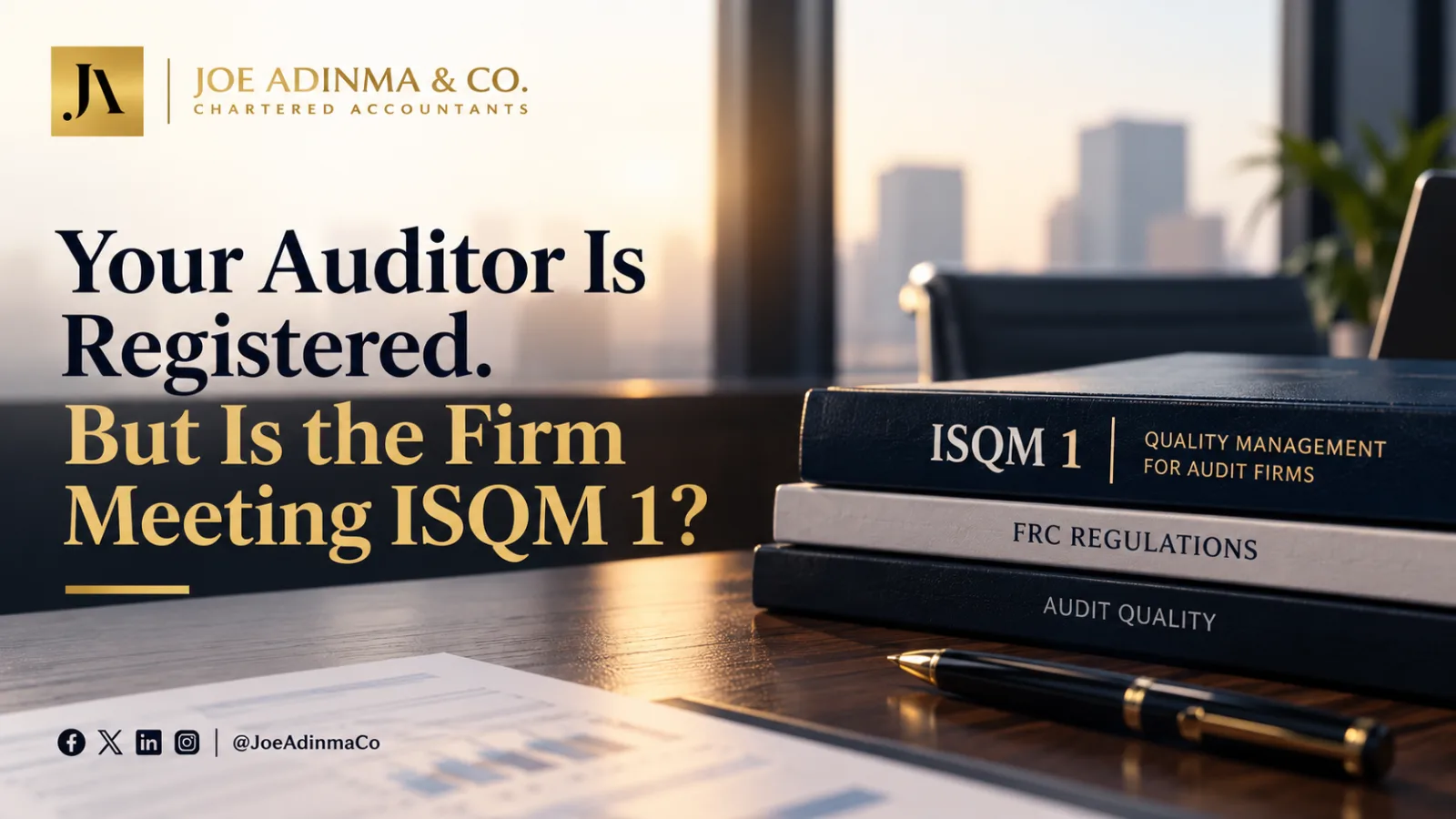
That is not a hypothetical anymore. In 2026, the Financial Reporting Council of Nigeria (FRC) moved on two connected fronts. The first decides who is legally entitled to call themselves your auditor. The second decides whether the work behind their signature can actually be trusted. Most businesses have heard about neither — and the two are not equal or interchangeable questions. The first has to be answered before the second is even worth asking.
Registration Stopped Being a Formality
The requirement itself is not new. In December 2023, the FRC issued a public notice reminding “professional accountants, audit firms, professionals engaged in the financial reporting process, and Public Interest Entities” of a registration and annual-dues obligation that had existed in the Financial Reporting Council of Nigeria Act No. 6, 2011 (as amended) all along — specifically Sections 33(1)(a)–(d), 41(2) and 77, read with Regulations 3 and 14 of the Audit Regulations 2020.
What changed in 2026 is enforcement. The FRC first flagged the deadline in a public statement in February, then confirmed — in its own announcement dated 19 April 2026 — that “the Register became fully operational with effect from April 1, 2026, and now serves as the only authoritative list of audit and assurance service providers legally permitted to operate in Nigeria.” Firms that had not registered, or updated their registration, by 31 March 2026 simply do not appear on it and, in the FRC's own words, “are therefore barred from practice until duly registered.” The FRC traces this to Sections 33, 51, 60, 61 and 77 of the Act, read with the Audit Regulations 2020 — the same Section 77 that defines who counts as a Public Interest Entity in the first place, which matters for reasons we come back to below.
That deadline has now passed, and enforcement is not a one-off event. The Register itself is live at frcnigeria.gov.ng, refreshed weekly — it showed itself as current “as at 5th July, 2026” the last time we checked it for this article, with a standing invitation for firms to report any listing errors within the following week's update cycle. The FRC's own April notice also states it “shall commence active monitoring, inspections, and enforcement to ensure full compliance” — enforcement, in other words, is described as ongoing and active, not a single launch date now behind us.
The Consequence Lands on the Client, Not Just the Auditor
Here is the part most business owners have not clocked. The FRC's own confirmation notice does not equivocate: “Any audit or assurance engagement conducted by a firm not listed on the Register is invalid, unlawful, and constitutes a violation of Nigerian law.” And the sanction is not confined to the firm: “Any reporting entity that engages an unregistered firm shall be liable to regulatory sanctions, including penalties against the entity and its responsible officers, in accordance with applicable laws and regulations.”
Read that twice. If your external auditor turns out not to be on the Register — or the specific partner who signed your report is not — the exposure is not confined to the audit firm's practising certificate. It extends to your company and, by name, to whichever of your officers engaged them. The FRC has told reporting entities, in terms, that they are “legally required to: verify the registration status of any audit or assurance service providing firm before appointment and throughout the duration of the engagement; and ensure that both the firm and the signing audit professional appear on the National Register.” Build re-verification into every audit cycle — and before the audit report is signed — rather than treating a registration check performed at initial appointment as permanently sufficient.
We should be precise about what has and has not been confirmed publicly. Nothing in the FRC's own notices, or in the reporting we reviewed for this piece, spells out whether the Corporate Affairs Commission, the Securities and Exchange Commission, the Nigerian Exchange, or lending banks will, as a matter of practice, reject financial statements audited by an unregistered firm. The FRC's own language stops at “invalid, unlawful … a violation of Nigerian law” and “regulatory sanctions”; it does not name a specific downstream filing consequence at any of those other regulators. That gap does not make the risk smaller — an audit opinion that the FRC itself considers invalid is not a comfortable position for a board to discover after the fact — but we are not going to overstate a consequence the FRC has not itself spelled out.
The Five-Minute Check: What Your Own Audit Report Already Tells You
Before you go anywhere near the FRC's website, pull out your most recently signed audited financial statements. The Audit Regulations 2020 (Regulation 11) already require the audit report itself to carry the information you need — most people just have never been told to look for it.
On the signature page, identify:
1. The audit firm's name.
2. The engagement partner who signed it. Regulation 11(4)(a) requires the report to be “signed and dated by the Engagement Partner with the FRC Registration number affixed” — so the signature and the number should sit together.
3. The FRC registration number printed against that signature. No number next to the signature is, on its own, worth asking about.
4. Whether that firm and that specific number currently appear on the National Register at frcnigeria.gov.ng.
One more thing worth knowing, because it changes what “registered” actually guarantees: Regulation 11(7) states that “no Auditor shall affix FRC Registration number to any audited report if, as at the date of signing the report, the Auditor is indebted in any form to the Council, failure of which shall attract appropriate sanctions.” A firm can be registered in principle and still be barred, at the moment of signing a specific report, from using its own number if its dues to the Council are in arrears. The safeguard here is not only “is the firm on a list somewhere” — it is built directly into the report sitting in your file, if you know what to check.
Who Gets Watched Most Closely: The Ten Routes Into “PIE” Status
Section 77 is sometimes treated as though PIE status were principally a question of size: “is my business big enough to count?” That seriously understates the regime.
The 2023 amendment to the FRC Act expanded Section 77 into ten separate categories of “Public Interest Entity,” and any one of the ten is independently sufficient on its own — an entity does not need to meet several of them at once. Under the amended Act, a PIE is:
1. a government or government organisation;
2. an entity listed on any recognised exchange in Nigeria;
3. a non-listed entity that is nonetheless regulated;
4. a public limited company;
5. a private company that is a holding company of a public or regulated entity;
6. a concession entity;
7. a privatised entity in which government retains an interest;
8. an entity engaged by any tier of government in public works, with an annual contract sum of ₦1 billion or more, settled from public funds;
9. a licensee of government; or
10. any other entity with annual turnover of ₦30 billion or more.
Read that list again with a specific business in mind. A private company turning over ₦8 billion a year — nowhere near the ₦30 billion catch-all in category 10 — is still a PIE if it happens to be a regulated entity, a public limited company or its holding company, a licensee of government, or a concession entity. Turnover is the tenth door into this regime, not the only one — and it is probably the door most businesses assume is the whole test, precisely because it is the easiest one to check against their own numbers.
PIE status matters for more than the registration regime this article opened with — it also determines how much a firm or entity pays the Council each year, and that dues formula is itself worth being precise about. It is a separate mechanism from the Section 77 categories above, and the two should not be conflated. Section 33 of the Act prescribes annual dues by formula, not flat fee. For publicly quoted companies, three market-capitalisation bands apply: 0.1% of market capitalisation or ₦250,000, whichever is lower, where market capitalisation is ₦1 billion or below; 0.04% of market capitalisation or ₦2,000,000, whichever is lower, above ₦1 billion up to ₦500 billion; and a flat ₦5,000,000 above ₦500 billion. Every other PIE instead pays against a graduated turnover schedule — running from as little as ₦5,000 for entities with turnover between ₦25 million and ₦50 million, up through several intermediate bands, to a flat ₦1,000,000 for any PIE with annual turnover above ₦10 billion.
Notice that this ₦10 billion figure — the top of the annual-dues schedule — is not the same as the ₦30 billion turnover catch-all in category 10 above. One governs how much an entity that is already a PIE pays each year; the other is only one of ten separate ways an entity becomes a PIE in the first place. What we have not been able to verify is a distinct, separately published registration or administrative processing fee sitting alongside this statutory dues formula — if one exists, it would sit beside the Section 33 bands rather than replace them, and is worth confirming directly with the FRC or its payment portal rather than assuming either way.
Independence Is the Older Problem — AI Just Raises the Stakes
Registration answers whether your auditor is legally entitled to act at all. It says nothing about whether the work behind the opinion is any good. That is a separate question, and — unlike the Register — it is not a 2026 invention. The Audit Regulations 2020 already built substantial infrastructure for it, years before anyone was discussing AI in an audit context.
Regulation 14(1) requires the Council itself to “adopt the Code of Ethics for Professional Accountants including International Independence Standards as issued by the International Ethics Standards Board for Accountants (IESBA)” as the governing standard. Regulation 8(1)(f) requires that “the Engagement Partner and Engagement Team are independent of the client” and approach their work “with due care and high level of objectivity.” And Regulation 7 caps how much non-audit work a Public Interest Entity's statutory auditor can be paid for alongside the audit itself, at “not more than 80% of the annual audit fees” for the preceding year — a limit that, by the Regulation's own terms, applies “to statutory auditor of Public Interest Entities (PIEs) only.”
None of that is new law prompted by anything that happened in August 2026. What the FRC's Audit and Assurance Leadership Summit did was point out that a familiar problem gets sharper edges when AI tools enter the picture. The technology is new. The ethical threat is not. If an auditor becomes materially involved in producing the financial information that the same firm later examines, AI does not eliminate the self-review threat the Regulations were already written to guard against — it may simply make that threat faster to create, less visible, and easier to scale.
That is the backdrop against which the summit itself should be read. On 13 August 2026, the FRC hosted the event at the Lagos Marriott Hotel, Ikeja, under the theme “Audit Integrity in the AI Era: Independence, Accountability and Reliable Financial Reporting.” It drew the FRC, the Federal Ministry of Industry, Trade and Investment, the Office of the Auditor-General for the Federation, and the Association of National Accountants of Nigeria (ANAN) onto the same platform — a genuinely cross-institutional statement about an existing obligation, not the announcement of a new one.
FRC Executive Secretary Dr Rabiu Olowo did not mince words:
“Audit integrity cannot exist where independence is compromised. Technology must never become an excuse for weakening the fundamental ethical principles of the profession.”
— Dr Rabiu Olowo, Executive Secretary/CEO, FRC
His specific concern was not AI in the abstract, but a narrower and more familiar risk that AI can make worse: practices that “blur the professional boundaries between preparing financial statements and independently auditing them” — the classic self-review threat, now amplified by tools that can do both jobs faster.
Representing the Office of the Auditor-General for the Federation, the response put the accountability question as plainly as we have seen it put anywhere:
“Technology may support the evidence; it cannot assume accountability for the judgement.”
— Office of the Auditor-General for the Federation
The point generalises well beyond audit — it is the sentence every professional using AI-assisted tools should be able to finish for their own work — but the Auditor-General's office was explicit that the risks are concrete and current: “algorithmic bias, data integrity, cybersecurity, confidentiality, transparency and explainability of AI-generated outputs,” and a warning about “excessive reliance on systems whose underlying assumptions, datasets or decision processes may not be fully understood by the auditor.”
ANAN's president, Zuwairat Talatu Kishimi, went a step further and put a specific, testable proposal on the table: that the Audit Regulations 2020 themselves be revisited to build an actual framework for AI adoption in audit practice — an acknowledgement that “use good judgement” is not, on its own, a sufficient regulatory answer to a genuinely new set of risks.
The Line That Connects Both Stories
A month later, at ANAN's 31st Annual Conference in Abuja (8–10 September 2026), Dr Olowo's own paper — delivered on his behalf by the FRC's Mr Stanley Aniagbaoso — put a name to what both tracks are really about:
“Nigeria does not have a standards problem. Nigeria has an implementation problem.”
— Dr Rabiu Olowo, Executive Secretary/CEO, FRC
His point was that Nigeria has, by and large, already adopted the global financial reporting and auditing standards it needs; the gap is in “strong institutions, professional competence, effective regulatory oversight, accountability and ownership by relevant stakeholders” — the machinery that makes a standard mean something in practice, rather than the standard's text itself.
Seen that way, the Register and the independence/AI agenda are not two unrelated news items. They are the same institutional project, aimed at two different points of failure — one recent, one much older. The Register is 2026's implementation infrastructure for the question “is this person legally entitled to sign an opinion?” Independence, judgement and audit quality are the older, ongoing infrastructure for the question “can the work behind that signature actually be relied on?” The credibility of an audit opinion therefore rests on two different foundations: the auditor must be legally entitled to undertake the engagement, and the work itself must satisfy the professional requirements of independence, judgement and audit quality. On the FRC's own account, the entity relying on that opinion is the one left holding the exposure if it does not check the first — and it is the one left carrying the consequences if the second was never really there.
Figure: FRC's two-track crackdown on audit quality, 2026
What This Should Change at Your Next Audit Committee Meeting
A short, practical checklist for boards, audit committees and finance leaders. Items 1–4 and 8 track direct statutory obligations; items 5, 6, 7 and 9 are our own recommended governance practice, not an FRC-mandated disclosure — we have labelled each item as such, because the two should not be blurred together.
1. Has your current audit firm's FRC registration been checked against the National Register — not at appointment three years ago, but within the last audit cycle? (Statutory verification duty.)
2. Was the individual signing partner checked, separately from the firm? The FRC's own language treats these as two distinct things to verify. (Statutory verification duty.)
3. Does your organisation fall within any of the ten Section 77 categories of a “Public Interest Entity” — not just the ₦30 billion turnover catch-all, but also regulated status, being a public limited company or the holding company of one, a government licence, a concession, or a qualifying government public-works contract? If any apply, expect closer scrutiny of both your own reporting and your auditor's registration. (Statutory classification.)
4. Does your latest audit report itself show the engagement partner's signature with an FRC registration number affixed, per Regulation 11(4)(a) — and does that number currently appear on the National Register? (Statutory requirement, verifiable in five minutes.)
5. Is the verification documented — a dated screenshot or printout of the Register entry — rather than something someone remembers doing? (Our recommended practice, not an FRC requirement.)
6. If the same firm (or an affiliated firm) has ever helped prepare parts of your financial statements, has anyone assessed the self-review threat that Regulations 7, 8 and 14 already exist to guard against? (Our recommended practice, grounded in an existing statutory obligation.)
7. Does your engagement letter or audit committee minutes record which AI-assisted tools, if any, the audit team used, and how professional scepticism over AI-generated output was maintained? (Our recommended practice — we have not found an FRC rule mandating this specific disclosure.)
8. Who, by name or title, is your organisation's “responsible officer” for the purpose of the FRC's sanctions language — and do they know that role exists? (Statutory exposure worth naming internally.)
9. Is re-verification built into every audit cycle — and before the audit report is signed — rather than treating a registration check performed at initial appointment as permanently sufficient? (Our recommended practice.)
A Note for Port Harcourt and the Oil & Gas / Energy Sector
For oil-and-gas and EPC businesses working out of Port Harcourt, turnover is not the only route into PIE status, and the public-works limb is narrower than it might first appear. A company can fall within Section 77 because it is a government licensee — an NUPRC licence, for instance — a concession entity, or a regulated entity, quite apart from its turnover. But the specific ₦1 billion public-works limb applies to contracts with a tier of government that are settled from public funds; a large commercial contract with an international oil company does not, by itself, automatically satisfy that particular limb merely because it crosses ₦1 billion. The practical implication is that a Port Harcourt business should not conclude that it falls outside the PIE regime merely because its turnover is below ₦30 billion; its regulatory, licensing, concession or government-contract status may independently bring it within Section 77.
Where audited financial statements are being relied upon for a loan covenant or as a condition precedent — the same audience we wrote to in “Borrowing at 30%+” — discovering that the FRC regards the underlying audit engagement as invalid creates an obvious governance and lender-relations risk, even though we have not identified a published industry-wide position from Nigerian banks on how such financial statements will be treated.
How Joe Adinma & Co. Can Help
If you would like us to verify your external auditor's current FRC registration status — firm and signing partner both — work through whether your organisation falls within any of the ten Section 77 categories, or review your audit committee's governance protocols against these expectations, we are glad to help.
Related Reading
“NRS Desk Review vs Tax Audit vs Tax Investigation: Why the Difference Matters”
“Why 2026 Is Already the Year Nigerian Companies Need to Act” (on IFRS 18)
“Borrowing at 30%+: When Does a Business Loan Stop Creating Value and Start Destroying It?”
(Titles only — not hyperlinked here, as their live joeadinma.com URLs are not yet on file.)
A Note on This Article
This article is for general information and does not constitute audit, legal or professional advice specific to any entity. Annual dues are prescribed in the FRC Act itself, by formula rather than flat fee, and we have set out the bands we could verify; what we have not been able to verify is a distinct registration or administrative processing charge separate from that statutory formula. Nor does anything we reviewed spell out how the CAC, SEC, NGX or lending institutions treat financial statements audited by an unregistered firm as a matter of practice — we have said so rather than estimating. Section 77's ten Public Interest Entity categories and Section 33's dues bands are summarised here for orientation, not reproduced as a substitute for the Act itself; an entity should confirm its own classification and dues against the current legislation and FRC guidance directly. The National Audit and Assurance Firms Register is updated weekly; readers should verify current status directly at frcnigeria.gov.ng rather than relying on any snapshot, including ours.
Sources
FRC — National Audit and Assurance Firms Register launch announcement (19 Apr 2026)
FRC — National Register of Audit Firms (as at 5 July 2026)
FRC — Public Notice on Registration of Auditors, Audit Firms, Audit Committee Members and Other Assurance Services Providers (Dec 2023)
FRC — Audit Regulations 2020 (Official Gazette, S.I. No. 36)
FRC — Financial Reporting Council of Nigeria Act No. 6, 2011 (as amended)
FRC — 2026 Audit and Assurance Leadership Summit recap
KPMG Nigeria — Impact Analysis of the Financial Reporting Council of Nigeria (Amendment) Act (Nov 2023)
Banwo & Ighodalo — “Amendment of FRCN Act: Changes to Financial Reporting and Corporate Governance in Nigeria” (Nov 2023)
The Guardian — “Unregistered audit firms will cease to operate from April, FRC warns” (16 Feb 2026)
BusinessDay — “FRC sets April 1 deadline for compulsory Audit, Assurance Firms Register” (17 Feb 2026)
ThisDay — “FRC Reads Riot Act to Unregistered Audit, Assurance Firms” (16 Feb 2026)
The Guardian — “FRC to convene audit summit on AI, financial reporting” (3 Aug 2026)
The Guardian — “FRC warns auditors against compromising independence” (14 Aug 2026)
ThisDay — “FRC, Auditor General, FMITI Urge Auditors to Adopt AI with Responsibility, Governance, Professional Ethics” (14 Aug 2026)
The Economic Times (Nigeria) — “Nigeria Has No Standards Problem, Implementation Is the Challenge – FRC” (10 Sept 2026)