Nigeria Tax Act 2025: Taxing Profits, or Chasing Away the Next Factory?
Published October 15, 2026

Its new incentives and new tax costs cut both ways. The real test is what they do to the next commercially viable project — not how the headline rates look.
By Joe Adinma, FCA, FCTI — Managing Partner, Joe Adinma & Co. (Chartered Accountants)
The next investment is the real test
Picture a board meeting in Trans-Amadi, Port Harcourt. On the table is a proposal for a new production line: ₦10 billion of plant and machinery. Before anyone mentions tax, the directors will ask whether the market can absorb the output, whether power can be secured without diesel generators running round the clock, and whether the bank will lend at a rate the project can carry.
Tax comes later on the agenda. But it matters, because investors commit capital against the cash they expect to keep — not the relief shown in an incentive announcement. And since 1 January 2026, the Nigeria Tax Act 2025 has changed that calculation in several ways at once.
For new applicants, the Act replaces the Pioneer Status Incentive with a credit linked to capital expenditure. It broadens input VAT recovery, folds earmarked levies into a single Development Levy and changes the tax on exit. These provisions must be read as a system: a measure that raises tax on existing profits can sit beside one that makes new machinery cheaper. [1]
Research published by the IMF on 5 October 2026 makes the question timely. Across the countries studied, a one-percentage-point rise in a country’s corporate income tax rate relative to others was associated with a cumulative fall in inward foreign direct investment of about 0.5% of GDP over three years. Anti-avoidance rules have made reported profits less sensitive to tax differences, while real investment has become more sensitive. These are cross-country findings — not a forecast for Nigeria, and not evidence that its reforms have already reduced investment. [2]
A flood of capital — but little recorded direct investment
Nigeria’s capital importation reached US$10.37 billion in Q1 2026, up 83.83% year on year. The composition matters more than the headline. Portfolio investment made up 95.09% of the total; foreign direct investment (FDI) was just 1.30%. In value terms, FDI fell from US$357.80 million in Q4 2025 to US$135.08 million. [3]
Q1 2026 capital importation by type | Amount | Share |
Portfolio investment | US$9,862.34m | 95.09% |
Other investment | US$374.48m | 3.61% |
Foreign direct investment | US$135.08m | 1.30% |
Total | US$10,371.90m | 100.00% |
Source: National Bureau of Statistics, Nigeria Capital Importation Q1 2026.
Classified by receiving sector instead, banking took about US$7.55 billion, or 72.79% of the total. That is a different classification from investment type, so the two sets of percentages should not be combined. Capital-importation data also leave out domestic investment and reinvested earnings, so they are not a full measure of factories being built. [3]
The first quarter of the new regime coincided with lower FDI, but coincidence is not causation. Financing costs, exchange rates, security, infrastructure and the long lead time of major projects all matter. Money that comes for yield can leave on the next tide; a factory cannot. The figures sharpen the real question: can Nigeria turn financial inflows into durable productive investment?
What the law gives — and what it takes
Four provisions change the economics of an investment most directly. How much each matters depends on the company’s size, sector, taxable activities, financing and expected holding period.
1. Development Levy: usually 3% becomes 4%, but the bases matter
Section 59 imposes a 4% Development Levy on the assessable profits of companies within its scope; small companies and non-resident companies are excluded. It replaces the 3% Tertiary Education Tax and the old sector levies rather than sitting on top of them: its proceeds are shared among seven beneficiaries, with 50% going to TETFund and shares to the IT, science-infrastructure and other funds the old levies supported. For a company that previously paid only the education tax — the usual case — the headline rate moves from 3% to 4%, assuming comparable bases. A company that paid several sector levies needs its own comparison. [1]
The bases differ too. The levy is charged on assessable profits; Companies Income Tax is charged on total profits, after deductions such as capital allowances. Adding the two rates and calling the result an effective tax rate can misstate the cash liability. The right comparison is a full old-law and new-law computation.
2. Recoverable input VAT can cut the cost of capital spending
Under the former VAT regime, input VAT on fixed assets and services generally could not be deducted from output VAT; it was capitalised or expensed instead. Section 155(4) now allows a registered taxpayer to deduct VAT on services and fixed assets to the extent they are used to make taxable supplies. VAT attributable to exempt or other non-taxable supplies is not recoverable, and mixed-use inputs must be apportioned. The deduction must be claimed within five years after the tax period in which the VAT was incurred, and applies only to supplies made from commencement. [1]
Take ₦800 million of VAT-bearing plant and eligible services. At 7.5%, the input VAT is ₦60 million. If fully recoverable, it no longer sits permanently in the cost of the project. But recovery comes through offset against output VAT or a refund request under Section 155(2), so it is not necessarily ₦60 million of cash on day one. And because recoverable VAT is excluded from the capitalised cost, depreciation and capital allowances must be computed on the net figure.
3. EDTI: a five-year credit is not a five-year cash payment
The Economic Development Tax Incentive (EDTI) replaces Pioneer Status for new applicants. Under Section 176, it gives a credit of 5% a year for five years on each item of eligible qualifying capital expenditure acquired within five years of the production date. The credit can offset tax in any year of the priority period, but not additional tax under Section 57. Unused credits can be carried forward for five years after the priority period ends; whatever remains then lapses. Companies already enjoying Pioneer Status keep that relief for the unexpired period (s.182(2)). [1, 4]
Suppose a certified priority project spends ₦10 billion on qualifying assets and can use the full ₦500 million credit at the end of each of five years. The headline benefit is ₦2.5 billion. Discounted at an illustrative 25% hurdle rate, its present value is about ₦1.345 billion — before application and certification fees of up to ₦5 million each (ss.167(4) and 172(6)), utilisation delays, insufficient tax capacity or credits that lapse unused.
Year | Credit used | Discount factor at 25% | Present value |
1 | ₦500.0m | 0.8000 | ₦400.0m |
2 | ₦500.0m | 0.6400 | ₦320.0m |
3 | ₦500.0m | 0.5120 | ₦256.0m |
4 | ₦500.0m | 0.4096 | ₦204.8m |
5 | ₦500.0m | 0.3277 | ₦163.8m |
Total | ₦2,500.0m | ₦1,344.6m |
Credits assumed used at each year-end. The 25% rate is a project-appraisal assumption, not a statutory rate or market forecast; a lower rate raises the present value.
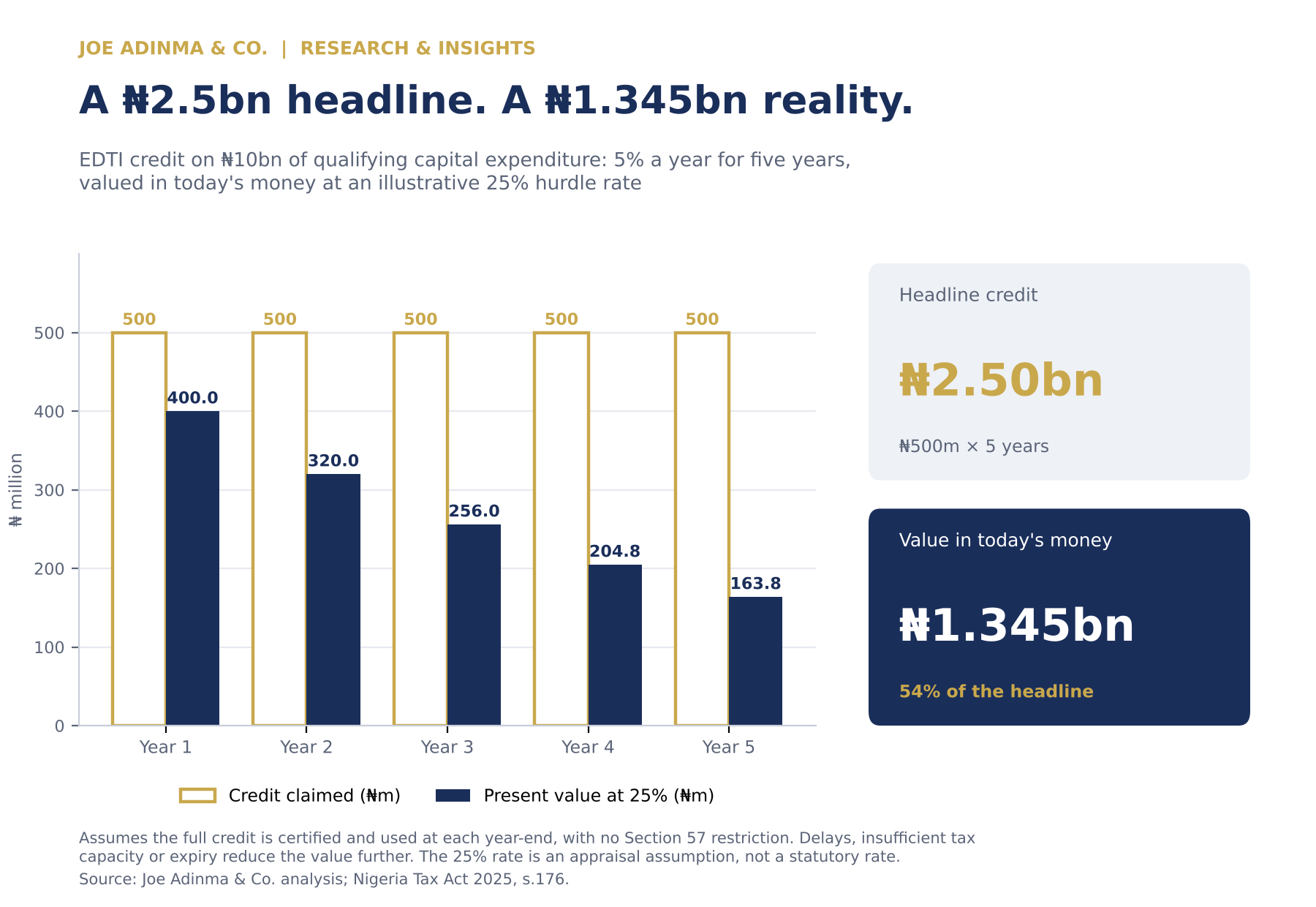
A headline incentive is not an investible return until it reduces actual cash tax, at the time the model assumes.
There is a records condition too. A priority company that also runs non-priority business must keep separate, auditor-certified books for each. If the NRS finds it has not, all its income is treated as non-priority and the credit is refused (s.178).
4. The tax at exit changes the price of entry
Investors value what they can take out of a project as well as what it earns along the way. The new framework brings companies’ chargeable gains into the Companies Income Tax computation, so a non-small company now faces the 30% rate on gains instead of the former standalone 10% capital gains tax. (Section 56 lets the President cut that rate to 25% by order, but no such order should be assumed in a model.) Section 47 also reaches certain indirect transfers by non-residents involving Nigerian companies or assets. Exemptions, treaties and the facts of each transaction still have to be tested. [1]
This does not mean 30% of the sale price: the base is the chargeable gain. But a higher expected tax on exit lowers what an investor will pay to enter. Part of a construction-stage credit can be given back on disposal.
Average tax versus the tax on the next project
The tax rate on a company’s existing profits and the tax on its next project can move in different directions. For illustration only, take a company that paid 30% Companies Income Tax plus 3% Tertiary Education Tax, with identical assessable-profit and total-profit bases and no other deductions. Under a 30% rate plus the 4% Development Levy, its pre-credit headline burden moves from 33% to 34%. That is the levy change, not a claim about every company’s effective tax rate.
Now suppose a certified priority project earns ₦100 million of additional taxable and assessable profit from ₦400 million of eligible expenditure, giving a usable ₦20 million first-year EDTI credit. The example assumes the sector’s minimum qualifying expenditure is no more than ₦400 million, all approval conditions are met, the project would not have qualified for Pioneer Status under the old law, and Section 57 does not apply.
Illustrative first-year tax on the new project | Old law | New law |
Companies Income Tax before credit | ₦30m | ₦30m |
Tertiary Education Tax / Development Levy | ₦3m | ₦4m |
Usable EDTI credit | — | (₦20m) |
Cash tax on ₦100m of incremental profit | ₦33m | ₦14m |
The same company can face a higher rate on existing profits and a lower first-year tax on this project. That does not prove a better net present value: the capital outlay, VAT treatment, timing of relief, capital allowances, funding and any Section 57 top-up still have to be modelled. The point is that the next project — not the company-wide tax ratio — shows whether an incentive works.
The minimum-tax and IFRS questions
Section 57 sets a 15% minimum effective tax test for covered companies: constituent entities of qualifying multinational groups, and companies with annual turnover of ₦50 billion or more. It compares covered taxes with net income, defined as profit before tax in the audited financial statements, excluding franked investment income and unrealised gains or losses. It is not a flat 15% charge on every covered company: only a company whose effective rate falls below 15% pays the difference. [1]
Its interaction with the EDTI matters. Section 57 counts the “priority sector tax credit” among covered taxes, which suggests that using the credit should not, by itself, drag a company below 15%. That reading is untested, and Section 176(2) still bars the credit from offsetting any top-up that does arise, so covered companies should model both. [1]
For IFRS reporters, the IAS 12 temporary exception for deferred taxes arising from legislation that implements the OECD Pillar Two model rules (IAS 12.4A and 88A–88D) should not be applied automatically to every domestic tax with a 15% rate. Whether Section 57 falls within it requires analysis of the enacted legislation and the entity’s circumstances, documented as part of the IAS 12 judgement. [5]
Certainty is itself an investment incentive
In its 18 August 2026 update, NIPC said the PSI Steering Committee’s 10 November 2025 deadline for new Pioneer Status applications triggered an influx of over 139 applications. Processing takes a minimum of 25 weeks, so some applications were unresolved when the regime ended on 1 January 2026. NIPC then held a tripartite meeting with the NRS and the Industrial Inspectorate Department to manage the transition. [4]
The EDTI carries its own timetable. A certificate needs the President’s approval, on the recommendation of NIPC and the Minister, and it cannot be issued with a retroactive date (ss.167(7) and 171(2)). None of this shows how efficiently the EDTI will run, but it shows why approval timing belongs in the investment model.
A credit that is uncertain at financial close may be worth less than a smaller benefit confirmed in time to shape the decision. Clear eligibility rules, reliable approvals, consistent assessments and workable refund and credit-utilisation procedures belong in any serious discussion of investment competitiveness.
The Joe Adinma & Co. Investment Tax Reality Test
Before recommending a new Nigerian investment, a CFO or investment committee should be able to answer six questions:
Test | What management must establish |
1. Commercial baseline | Does the project earn an acceptable return before any incentive? |
2. Correct tax bases | Are income tax, the levy, VAT, minimum tax and tax on exit each computed on its own statutory base? |
3. Valid eligibility | Does the project meet the Tenth Schedule minimum, the certification steps and the separate-records rule? |
4. Usable cash benefit | When will credits and VAT recoveries actually reduce cash payments, and what could delay or limit them? |
5. Downside resilience | Does the NPV survive weaker demand, dearer funding, FX pressure and the loss of some relief? |
6. Actual results | After approval, did the project happen, deliver output and jobs, and earn its projected after-tax return? |
Government should apply a parallel test to the tax it forgoes. Success is additional productive investment, jobs and future tax capacity — not the number of certificates issued or the value of projects announced. The hard counterfactual remains: would the project have gone ahead anyway? A concession that rewards an investment already certain to happen is not the same as one that makes a viable but marginal project possible.
A balanced verdict
Nigeria has legitimate reasons to broaden its tax base, reduce overlapping charges and protect public revenue. Reliable revenue pays for the electricity, roads, security, education and institutions investors need. The IMF cautions that tax cuts financed by more borrowing can raise financing costs, while forgone revenue can weaken public investment. The lowest possible corporate tax rate is not necessarily the best investment policy. [2]
The new regime contains genuine pro-investment measures, notably wider input VAT recovery and the move to capital-expenditure credits. It also raises the earmarked levy rate for many ordinary companies, changes the tax cost of exit and imposes a minimum-tax constraint on covered businesses. Some investments will be better off; others worse. It is too early to say the reform caused Nigeria’s weak FDI share, or to declare it an investment success.
Back in that Trans-Amadi boardroom, the question is not whether Nigeria’s tax rates sound high or low. It is whether the production line still earns its keep once every tax, credit, delay and financing cost is in the cash-flow model. That is the test the reform will ultimately be judged by.
BOARD TAKEAWAY |
How Joe Adinma & Co. can help
We help boards and CFOs model the after-tax cash flows of proposed investments, including EDTI eligibility, input VAT recovery and Section 57 exposure.
Related reading on joeadinma.com
› The 4% Development Levy: Your CIT Can Be Zero. Your Levy Won’t Be.
› Input VAT Recovery in Nigeria: Why Your Business May Still Be Treating Recoverable VAT as a Cost
› Nigeria’s 15% Minimum Effective Tax Rate: What Replaced the Old Minimum Tax?
› Borrowing at 30%+: When Does a Business Loan Stop Creating Value and Start Destroying It?
HOW WE SOURCED THIS |
Sources
[1] Federal Republic of Nigeria, Nigeria Tax Act 2025 (Act No. 7), gazetted copy issued by the Nigeria Revenue Service, Official Gazette No. 117 — ss. 47, 56, 57, 59, 155, 166, 167, 171, 172, 176–178 and 182, each checked against the printed text.
[2] International Monetary Fund, “Policies to Curb Tax Avoidance Are Changing How Countries Court Global Business”, 5 October 2026, and World Economic Outlook, October 2026, Chapter 3. https://www.imf.org/en/blogs/articles/2026/10/05/blog-policies-to-curb-tax-avoidance-are-changing-how-countries-court-global-business
[3] National Bureau of Statistics, Nigeria Capital Importation, Q1 2026, June 2026. https://microdata.nigerianstat.gov.ng/index.php/catalog/143/related-materials
[4] Nigerian Investment Promotion Commission, “From PSI to EDTI: Managing the Transition”, 18 August 2026. https://nipc.gov.ng/news/2026/08/18/from-psi-to-edti-managing-the-transition
[5] IFRS Foundation, IAS 12 Income Taxes, including the 2023 amendments, International Tax Reform — Pillar Two Model Rules. https://www.ifrs.org/issued-standards/list-of-standards/ias-12-income-taxes/
This article is general policy analysis for information only. It is not tax, legal or investment advice for any particular company; specific decisions should be based on the company’s own facts, the statutory text and current NRS guidance.