Presumptive Tax: The Real Risk Isn't Your Turnover. It's Your Records.
Published October 9, 2026

Inside Nigeria's New Presumptive Tax Regulations — the ₦12 Million Line, the 1% (and 2%) Math Most Businesses Haven't Done, and What Your Books Need to Prove
By Joe Adinma, FCA, FCTI — Managing Partner, Joe Adinma & Co. (Chartered Accountants)
Last updated: 28 September 2026
For years, the tax collector most Nigerian traders knew stood at the roadside. He had an outstretched hand, took cash at the kerb, gave no receipt and no reference, and left no one to complain to. That hand has now been lawfully withdrawn: roadblock collection and cash collection of tax are banned nationwide.
But a banned roadblock is not a cancelled tax.
In its place stands something quieter: a 1% tax on turnover for any business whose records cannot show what it actually earned, plus a matching charge on assets sold without proof of what they cost. A ₦12 million line decides who is protected from it outright. Most owners have heard about the roadblock ban. Few have done the arithmetic on what replaced it.
What Actually Changed
On 4 March 2026, Minister of Finance Wale Edun signed the Presumptive Tax Regulations at a ceremony in Abuja, alongside the National Tax Policy Implementation Committee and the Joint Revenue Board. The Regulations were gazetted later — Official Gazette No. 85 of 13 May 2026 — and, by that gazette's own account, took effect from 1 January 2026, matching the wider Nigeria Tax Act's own start date. The law behind them is Section 29 of the Nigeria Tax Act, 2025, a short provision sitting among the rules for taxing individuals.
Section 29 lets the Minister, advised by the Joint Revenue Board, decide how to assess someone whose income cannot be pinned down — because it cannot be ascertained, or because the records kept don't allow a proper assessment. That is the whole engine of presumptive tax, in one sentence.
"With the signing of these regulations, we are transiting from legislation to structured implementation of the tax reforms."
"We are moving from intention to implementation."
Presumptive tax is not a tax on smallness. It is a tax on murky water. |
Who Is Exempt: The ₦12 Million “Nano” Line
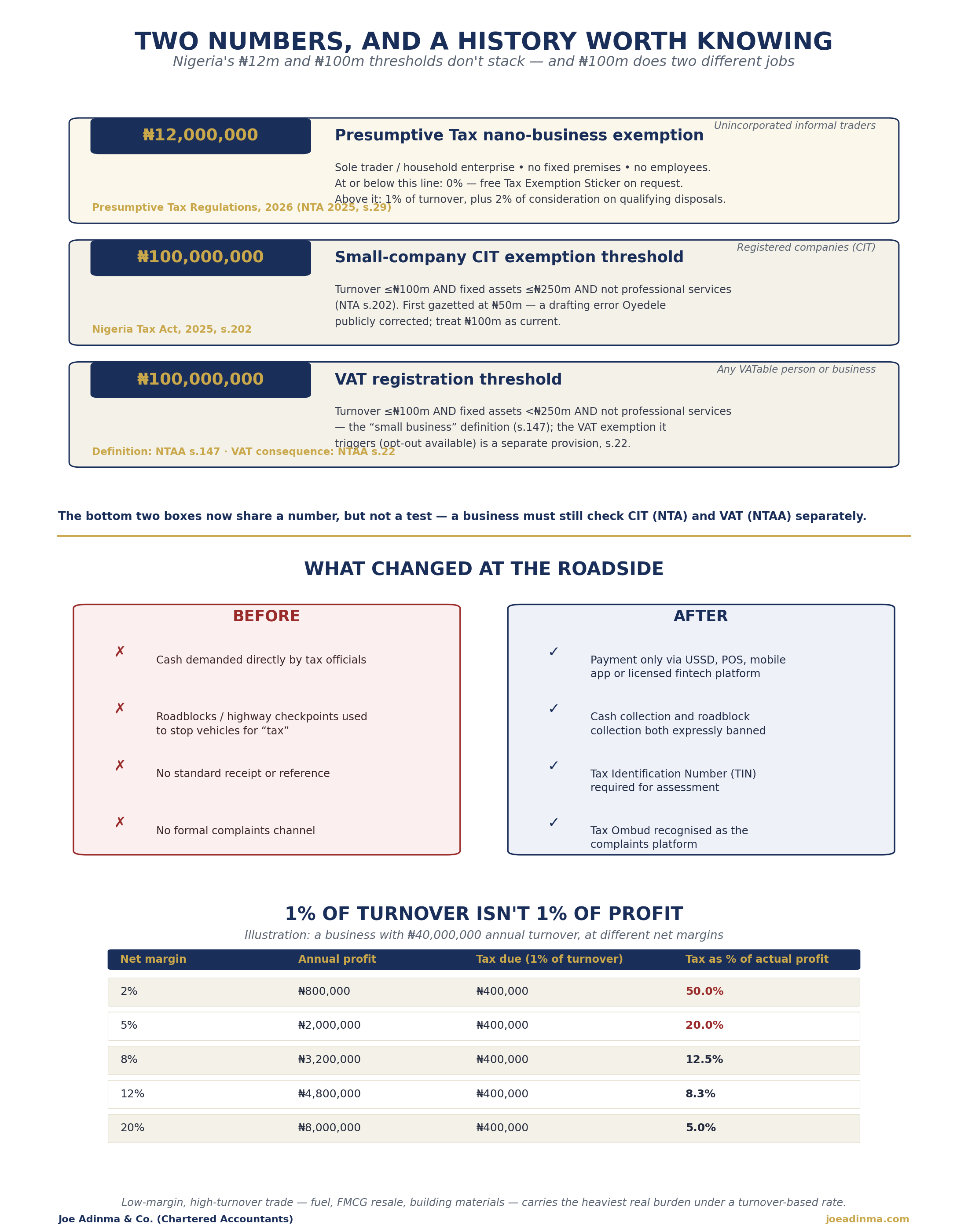
A woman selling a single basket of pepper at Mile One does not need an accountant; the regulations already assume she is too small to chase. They call this a “nano business” — a sole trader or household enterprise with no fixed premises, no employees, and turnover under ₦12 million, roughly ₦40,000 a day across a 300-day year. A nano business owes nothing, and can request a free Tax Exemption Sticker, valid a year and renewable.
Reported examples read like a market roll call: roadside food vendors, mobile barbers, tailors on manual machines, cobblers, newspaper vendors, sachet water hawkers, wheelbarrow pushers. A separate exemption, independent of turnover, covers co-operatives, religious and educational bodies, trade unions, and government agencies not trading for profit — set out in section 163 of the Nigeria Tax Act.
Who Pays: 1% of Turnover, 2% of Consideration on Disposals
Above ₦12 million, a business in the regime pays a flat 1% of its turnover, actual or estimated — using “business activity, location, transaction patterns and other economic indicators” where records don't settle the figure (Regulation 10(1)). Where only a daily figure can be estimated, the law annualises it over a maximum of 300 working days, not 365. A separate 2% applies to the gross amount received when a qualifying asset is sold (Regulation 7(1)), due within 30 days of the sale. A business with records solid enough for ordinary self-assessment stays out of the regime altogether, or can leave it once its books are good enough (Regulation 4(4)–(5)).
A tax on turnover is a net cast over the whole catch, not just the fish sold for profit. On its own, 1% sounds like a light net. It rarely is.
1% of Turnover Isn't 1% of Profit
Take a business turning over ₦40 million a year — comfortably inside the regime. The tax is a flat ₦400,000, whatever the business actually keeps. What changes is how much of its real profit that ₦400,000 represents:
Net margin | Annual profit | Tax due (1% of turnover) | Tax as % of actual profit |
2% | ₦800,000 | ₦400,000 | 50.0% |
5% | ₦2,000,000 | ₦400,000 | 20.0% |
8% | ₦3,200,000 | ₦400,000 | 12.5% |
12% | ₦4,800,000 | ₦400,000 | 8.3% |
20% | ₦8,000,000 | ₦400,000 | 5.0% |
The formula is worth keeping on hand: tax as a share of profit equals 1% divided by net margin. At a 20% margin that's 5% of profit; at 5% it's 20%; at a 1% margin — not unusual in high-volume fuel or FMCG resale — the net comes up heavier than the boat that carried it out. Model it against your own margin before assuming the headline rate is cheap.
2% of the Sale Price Isn't 2% of the Gain |
Presumptive Tax Isn't Necessarily Where You Want to Stay
A business turning over ₦40 million with records good enough to prove its taxable income should ordinarily sit under normal self-assessment, not presumptive tax — though proving those records are adequate to the tax authority is a real hurdle, not a formality. A ledger kept well is a lamp a trader lights for himself, not one the tax office lights for him.
Whether making that case is worth it is a genuine cost comparison. Presumptive tax on ₦40 million is a flat ₦400,000; a business with, say, ₦2 million in real profit might owe more or less than that under self-assessment, depending on its actual position. Self-assessment isn't always cheaper, especially at thin margins. But the cost of keeping proper accounts is a number a business controls, and the cost of being estimated is not.
Two Numbers, and a History Worth Knowing
Two roads that once forked at ₦50 million and ₦100 million have folded back into one. Nigerian businesses now carry two thresholds in their heads once they're past the nano line — ₦12 million and ₦100 million — but the ₦100 million figure does two different jobs under two different Acts:
Threshold | What it tests | Statutory basis | Who it applies to |
₦12,000,000 | Nano-business exemption from presumptive tax | Presumptive Tax Regulations, 2026 (NTA 2025, s.29) | Unincorporated informal traders |
₦100,000,000 | Turnover ≤₦100m AND fixed assets ≤₦250m AND not professional services — “small company” exemption from CIT. First gazetted at ₦50m — a drafting error, since corrected | Nigeria Tax Act, 2025, s.202 | Registered companies (CIT) |
₦100,000,000 | Turnover ≤₦100m AND fixed assets <₦250m AND not professional services — “small business” definition, which then triggers a VAT exemption regime (opt-out available) | Definition: NTAA 2025, s.147 · VAT consequence: NTAA 2025, s.22 | Any VATable person or business |
The Nigeria Tax Act's own words define a “small company” as one earning turnover of ₦100,000,000 or less with fixed assets under ₦250,000,000, excluding professional-services firms (s.202). The Nigeria Tax Administration Act's “small business” definition, in its own interpretation section (s.147), uses almost the same words for its own VAT exemption — the VAT consequence itself sits in a different provision again, s.22.
That figure wasn't always ₦100 million on the CIT side. As first gazetted, Section 202 read ₦50,000,000 — a genuine drafting error. Taiwo Oyedele, who chairs the presidential fiscal policy and tax reforms committee, said so publicly: “N100m is the correct amount; the N50m in the NTA is an error.” Every government communication and piece of professional commentary we've found from November 2025 onward states the small-company CIT threshold as ₦100 million, with no ₦50 million figure appearing anywhere.
We couldn't locate a single, clearly dated certified copy that explicitly relabels Section 202 at ₦100 million — some older gazette copies still in circulation show ₦50 million. Given the weight of everything published since, we'd treat ₦100 million as the figure to rely on today. A business sitting near the boundary should still confirm against its own current certified gazette copy, not against any one secondary source, including this one.
A business still has to check both tests separately — CIT under the NTA, VAT under the NTAA — even now that they share a number; passing one says nothing about the other. We covered this discrepancy's origin in more depth in “Your Business Has Been Breaking the Law Since January 2026,” and the VAT threshold's own complications in “Is Your Business Even Supposed to Charge VAT?”
No More Cash, No More Roadblocks
Cash changed hands in the dark; a USSD code leaves a trail in daylight. The regulations ban “all forms of cash collection by tax authorities” and “the mounting of roadblocks for the collection of taxes.” Adesokan put it more bluntly: the framework “makes the mounting of road blocks for the collection of any form of tax illegal.”
Payment now runs through USSD, POS, mobile apps and licensed fintech platforms. A business without a Tax ID can be registered and assigned one by the tax authority, so missing paperwork is no longer a reason compliance stalls. The regulations also recognise the Tax Ombud as a place to complain about how tax administration itself was handled.
Does It Actually Work Yet?
The rain has been announced; the roof has not yet been fixed everywhere it leaks. The Manufacturers Association of Nigeria's own Q2 2026 survey ranked multiple taxation as the sixth-largest challenge facing manufacturers — an improvement on second place in Q1, but still very much present.
"While the government has enacted the Nigeria Tax Act 2025, which was in part aimed at forestalling multiple taxes and levies, manufacturers complained that they were still met with multiple tax collectors and regulators in Q2 2026."
The Central Bank's July 2026 survey recorded a constraint score of 70.8 for high and multiple taxation, ahead of insecurity (69.7) and high interest rates (66.3). Together, the two surveys point the same way: the roadblock ban has outlawed a specific abuse, but outlawing it is not the same as it disappearing — and the deeper complaint, businesses visited by multiple collectors demanding multiple levies, hasn't yet caught up with the law.
Worth separating out: informal-sector anxiety about the wider 2025 reform predates these specific regulations. Traders were uneasy about the new tax law as early as January 2026, months before the presumptive regime took its current shape — useful context for how reform lands on the ground, not evidence about this regime specifically.
What If the Tax Authority Overestimates Your Turnover?
Where records are thin, an assessment is necessarily a guess — built from business activity, location, transaction patterns and other signs the law allows, rather than a set of accounts. That leaves real room for a tax authority to overshoot. Here is what that guess is usually built from.
Bank Inflows Are Evidence — Not Automatically Turnover |
A taxpayer who disagrees with an assessment has 30 days to object in writing, rather than simply pay. The tax authority then has 90 days to respond to a valid objection; if it doesn't, the objection succeeds automatically, under the Nigeria Tax Administration Act (s.41). Where the objection doesn't resolve the dispute, the taxpayer's route is a statutory appeal to the Tax Appeal Tribunal — the Tax Ombud is a separate avenue, for how a taxpayer was treated, not a substitute for that appeal.
Presumptive Tax Does Not Mean… |
A Seven-Question Presumptive Tax Check
Is your annual turnover ₦12 million or below, with no fixed business premises and no employees? You may qualify for the nano exemption — request your free Tax Exemption Sticker or Certificate rather than assume it applies automatically.
Are you a registered co-operative, or a religious, educational or charitable body, a trade union, or a public institution not trading for profit? You're exempt under section 163 of the Nigeria Tax Act, independently of your turnover.
Is your turnover above ₦12 million, and are your records inadequate to let your income be reliably ascertained? That combination — not turnover alone — is what pulls you into the 1% presumptive turnover tax, plus the 2%-of-consideration presumptive charge on qualifying disposals.
Do you have a Tax Identification Number? It's required for correct assessment and for paying through the approved digital channels. If you don't have one, the relevant tax authority can register and assign you one as part of bringing you into the regime — but it's worth getting ahead of that rather than waiting to be assigned.
Do you actually know your net margin? If it's materially thin, 1% of turnover may be costing you far more than 1% of profit — model it before treating the headline rate as automatically cheap.
Could you keep proper books and move to self-assessment instead? The regulations allow a voluntary transition once your records are adequate — worth costing out as turnover grows, rather than assumed to be automatically cheaper.
Has an official demanded cash from you, or tried to stop you at a roadblock, for tax? Both are now expressly banned — you have a route to the Tax Ombud if it happens, and to a written objection if you think an estimate is simply wrong.
The roadblock is gone, and few will mourn it. But the tax it collected so badly has not gone with it; it has simply moved from the roadside into the ledger.
The real dividing line was never the roadblock, and it was never ₦12 million either. It is the water a business's records run in: clear enough to be assessed on facts, or muddy enough to be estimated. The most useful tax-planning tool under the new regime may be the oldest one in accounting — proper records.
The threshold confusion this article walks through is exactly the kind of thing that costs a growing business real money — the wrong assumption, made once, tends to compound. If you need help working out where your business actually sits, whether your records would hold up to an estimate, or whether staying presumptive still makes sense as your turnover grows, Joe Adinma & Co. can help.
How We Sourced This |
Sources
Primary legislation and official gazette
Nigeria Tax Act, 2025 — Official Gazette copy (Nigerian Investment Promotion Commission)
Nigeria Tax Act, 2025 — Arrangement of Sections (National Assembly of Nigeria)
Government, regulatory and industry evidence
Professional technical commentary
KPMG Nigeria — "Nigeria's Presumptive Tax Regulations, 2026" (July 2026)
Andersen Nigeria — "Understanding Nigeria's Presumptive Tax Regime 2026" (7 April 2026)
Press reporting
Nigeria Housing Market — "Federal Government Bans Roadblocks for Tax Collection Nationwide"
TechCabal — "Under Nigeria's new tax law, you have 30 days to object or pay" (19 January 2026)
Techpoint Africa — "Nigerian Tax Reform Acts 2026 Explained for Small Businesses" (5 May 2026)
This article is for general information only and does not constitute tax or legal advice. Businesses should seek advice specific to their circumstances before acting on any point raised here.