
Input VAT Recovery in Nigeria: Why Your Business May Still Be Treating Recoverable VAT as a Cost
Published October 11, 2026
Nigeria’s new input VAT regime can release cash tied up in services and fixed assets — but only for businesses that can prove the claim
By Joe Adinma, FCA, FCTI — Managing Partner, Joe Adinma & Co. (Chartered Accountants)
Last updated: 5 October 2026
At a Trans-Amadi plant or an Onne service yard, the pattern is familiar. A company buys accounting software, pays lawyers and engineers, repairs equipment and acquires a new production machine. Every supplier adds 7.5% VAT. The company pays it, posts the VAT to expense or to the cost of the asset, and moves on.
That treatment made sense under the old rules. From 1 January 2026, it may be costing the business real money.
Section 156 of the Nigeria Tax Act 2025 materially widens input VAT recovery. VAT paid on services and fixed assets can now be deducted, to the extent it was incurred for the purpose of making taxable supplies. The reform does not reduce the 7.5% VAT rate. It changes something more important for many businesses: whether VAT paid to suppliers remains a cost or becomes recoverable value.
The opportunity is substantial. So is the risk of getting it wrong. A payment bearing the label “VAT” is not automatically recoverable. Eligibility, business use, the nature of the company’s outputs, timing, invoice quality, allocation and fiscalisation all matter.
Board Takeaway
The new regime can improve cash flow, reduce operating costs and lower the recorded cost of qualifying fixed assets. But the benefit will not arise merely because the law changed. Management must identify eligible 2026 transactions, obtain legally compliant invoices, separate taxable from non-taxable use, reconcile claims to the VAT return and preserve an audit trail. Businesses that continue using their pre-2026 accounting configuration may underclaim VAT, overstate expenses and assets, and then pay more VAT than the law requires.
What Changed on 1 January 2026
Under section 17 of the repealed Value Added Tax Act, deductible input VAT was generally limited to goods bought for resale and goods forming stock-in-trade used directly to produce a new product on which output VAT was charged. VAT on services, overheads and general administration was ordinarily expensed, while VAT on capital items and assets was capitalised.
The old position was not as narrow as some summaries suggest. In Chi Limited v FIRS (TAT, 10 February 2022), the Tribunal held that stock-in-trade was not limited to raw materials and accepted input VAT on natural gas, diesel, short-term spares and other manufacturing consumables used in direct production.
Section 156(4) of the Nigeria Tax Act 2025 replaces that narrow approach with a broader rule. Input VAT incurred by a registered person on any taxable supply, including services and fixed assets, may be deducted from VAT payable — but only to the extent that the input tax was incurred for the purpose of consumption, use or supply in the course of making taxable supplies.
The change brings items such as qualifying professional fees, repairs, software services, rentals, consultancy, security services and plant or equipment into the recovery conversation. It does not mean every item in those categories qualifies in every business.
Issue | Old VAT treatment | Position from 1 January 2026 |
Goods for resale or direct production | Generally deductible, subject to conditions; Chi confirmed that qualifying direct-production consumables could be stock-in-trade. | Continues to be potentially deductible where used in making taxable supplies. |
Services and overheads | Generally expensed; input VAT deduction was prohibited. | Potentially deductible where the statutory taxable-purpose test is met. |
Fixed assets | VAT was generally capitalised as part of the asset cost. | Potentially deductible; recoverable VAT should not remain in the asset’s accounting cost. |
Mixed taxable and non-taxable use | Recovery was already narrow. | Only the proportion attributable to taxable supplies may be deducted. |
Pre-2026 transactions | Governed by the repealed rules. | The new expanded deduction does not revive previously blocked VAT. |
The Test Is Not What You Bought but What You Used It For
The decisive words in section 156(4) are “to the extent”, “for the purpose of” and “in the course of making taxable supplies”. The test looks at why the VAT was incurred, so the claim needs evidence of intended and actual taxable use. A valid VAT invoice is necessary, but it does not establish that connection by itself.
A manufacturer buying a machine used wholly to produce standard-rated goods has a strong recovery case. A business that uses the same service partly for taxable operations and partly for exempt or other non-taxable activities must apportion the VAT. A director’s personal expenditure does not become recoverable merely because the invoice carries the company’s name. VAT connected exclusively with non-taxable supplies remains outside the deduction.
Zero-rated supplies must be distinguished from exempt supplies. Section 186 zero-rates exported goods other than oil and gas, exported services and exported incorporeal property, together with specified domestic supplies. Section 185, by contrast, exempts oil and gas exports, crude petroleum oil and feed gas for processed gas, as well as land and buildings and other listed supplies.
For an upstream producer, this distinction is decisive: input VAT attributable exclusively to exempt crude or gas exports is generally blocked, while an oilfield service company making taxable supplies to an IOC may be able to recover qualifying input VAT — subject to the withholding point discussed below.
The Input VAT Recovery Map
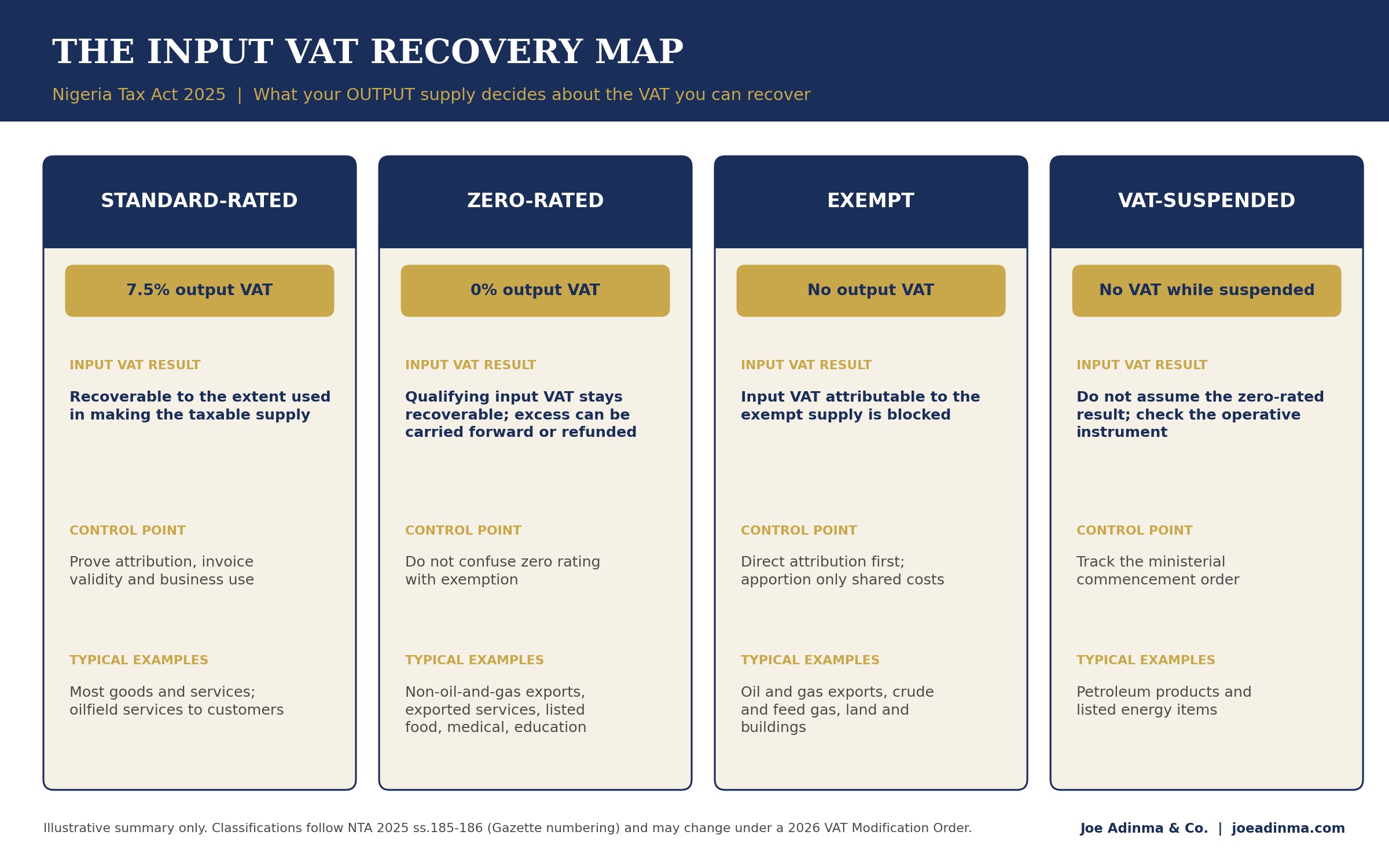
Classifications can move. In 2026 the Federal Government set up an inter-ministerial committee to prepare a VAT Modification Order revising the exempt and zero-rated lists. Check the operative list at the date of supply before relying on any line in this map.
Seven Questions Before Claiming Input VAT
Was the underlying supply made on or after 1 January 2026?
Is the claimant properly registered and within the VAT compliance system?
Was VAT legally chargeable on the purchase in the first place?
Was the VAT incurred for the purpose of consumption, use or supply in making taxable or zero-rated supplies?
If there is mixed use, is the recoverable proportion reasonable, consistent and documented?
Does the invoice contain the information required by section 152?
Can the amount be reconciled through the purchase ledger, payment evidence, fiscal record and VAT return?
The Invoice Is Now Part of the Tax Control System
Section 152 requires sequential invoice numbering and specified particulars, including the supplier’s Tax ID, name and address, incorporation or business registration number, date of supply, customer name, gross transaction amount, VAT charged and the applicable rate. The Act also allows the NRS to direct a taxable person, on at least 30 days’ notice, to adopt electronic invoicing.
Section 157 goes further: a taxable person making taxable supplies must implement the fiscalisation system deployed by the NRS. Section 23 of the Nigeria Tax Administration Act requires every person making a VAT taxable supply to record and report all supplies through the Electronic Fiscal System, and requires the NRS to specify the system, its transition arrangements and implementing regulations. The input VAT schedule should therefore stop being a spreadsheet prepared at filing time and become the output of a controlled procure-to-pay process in which vendor identity, invoice validity, business purpose, tax classification, approval, payment and fiscalisation can be traced to one transaction.
Fiscalisation is not merely an IT project. Section 104 of the Nigeria Tax Administration Act imposes an administrative penalty of ₦200,000, plus 100% of the tax due and interest at the prevailing Central Bank of Nigeria Monetary Policy Rate per annum, where a taxable person fails to process a taxable supply through the fiscalisation system.
A technically eligible purchase supported by a defective invoice is an avoidable dispute. The commercial team that appoints the supplier, the employee who receives the service, accounts payable and the tax function now share responsibility for protecting the claim.
Import VAT requires a different evidence trail. The claim file should include the relevant customs entry and assessment documents, proof of import VAT paid, shipping or clearing records and the link to the asset, inventory or service used in the taxable activity. A domestic section 152 supplier invoice is not a substitute for customs evidence.
For the wider operational context, see The Death of Backdated Invoice and The 31 July Deadline: What Every Nigerian Business Needs to Know About E-Invoicing Before It’s Too Late.
The Forensic Lens: What a Claim Review Should Test
Fiscalisation and electronic invoicing make the buyer’s claim increasingly capable of being compared with the supplier’s identity and output declaration. Finance teams should investigate, not merely reconcile, the following red flags:
a vendor that is fictitious, inactive, deregistered or not validly within the VAT system;
duplicate invoice numbers, altered documents or a supplier identity that does not match the payment beneficiary;
round-sum professional or technical services without a contract, deliverable, timesheet, acceptance record or other evidence that the service was received;
an unusual spike in input claims immediately before a refund request;
a buyer claim that does not match the supplier’s fiscal record or output declaration;
related-party invoices whose pricing, business purpose or actual delivery cannot be independently demonstrated; and
a refund schedule containing fictitious invoices or supplies.
The last item carries the heaviest consequence. Under section 122 of the Nigeria Tax Administration Act, a person who receives a VAT refund through a false or fictitious claim is, in addition to recovery of the amount received, liable to a penalty of 100% of that amount, plus interest at the prevailing CBN Monetary Policy Rate.
A Worked Example: What the Old Configuration Can Cost
Assume a Nigerian manufacturing company makes only standard-rated taxable supplies. In one month it records ₦200 million of taxable sales and therefore ₦15 million of output VAT. Its purchases generate the following input VAT:
Input category | VAT incurred | Deductible under old rule | Potentially deductible under new rule |
Production inputs and goods | ₦4.50m | ₦4.50m | ₦4.50m |
Professional and software services | ₦1.50m | Nil | ₦1.50m |
New production equipment | ₦3.00m | Nil | ₦3.00m |
Mixed-use overheads: 80% taxable use | ₦0.75m | Nil | ₦0.60m |
Private or non-business expenditure | ₦0.30m | Nil | Nil |
Total deductible input VAT | ₦4.50m | ₦9.60m |
If the company’s accounting system still applies the old rule, it remits ₦10.50 million: output VAT of ₦15 million less ₦4.50 million. Under the new rule, assuming the services, equipment and apportioned overhead satisfy all conditions, the liability is ₦5.40 million. The immediate VAT cash difference is ₦5.10 million for one month.
That ₦5.10 million is not the after-tax economic gain. Under the old treatment, the ₦2.10 million VAT expensed on services and overheads would have produced an assumed ₦714,000 income-tax and Development Levy shield at 30% and 4%.
The ₦3 million capitalised VAT would, assuming full use of capital allowances, produce a ₦900,000 company income-tax shield over time. That calculation uses 30%, not 34%, because capital allowances reduce total profits for company income tax but do not reduce the Development Levy base, which is assessable profits before capital allowances.
On those assumptions, the approximate lifetime after-tax gain is ₦3.49 million. The approximate first-year cash benefit is ₦4.21 million, applying the 20% Class 2 rate for plant expenditure in Table I of the First Schedule to the Nigeria Tax Act. These figures are illustrative: they assume a non-small company, sufficient taxable profits, no allowance restriction and no timing discount.
The distinction matters. The VAT return shows a ₦5.10 million cash movement; the financial decision should recognise the tax deductions and capital allowances surrendered when recoverable VAT is removed from expense and asset cost.
A Mixed-Supply Example: Direct Attribution Comes First
Consider a Port Harcourt group that earns ₦600 million from taxable oilfield logistics and maintenance services and ₦200 million from an exempt outright sale of land. During the period it incurs ₦6 million VAT directly on the taxable service line, ₦1.5 million directly on the land-sale activity and ₦2.4 million on shared administration.
Input pool | VAT incurred | Recoverable | Reason |
Direct taxable-service costs | ₦6.00m | ₦6.00m | Wholly attributable to taxable outputs. |
Direct exempt land-sale costs | ₦1.50m | Nil | Wholly attributable to the exempt land sale. |
Shared administration | ₦2.40m | ₦1.80m | Illustrative 75% taxable turnover ratio. |
Total | ₦9.90m | ₦7.80m | ₦2.10m remains blocked. |
The sequence is critical: identify directly attributable VAT first; apportion only the residual shared pool. The 75% turnover ratio is an illustration, not a statutory safe harbour. Management should use a fair, consistent and documented method that reflects actual consumption — for example floor area, headcount, machine hours or transaction volumes where turnover would distort use.
Two Clocks That Should Not Be Confused
Paragraph (b) of the proviso to section 156(4) of the Nigeria Tax Act permits deduction of qualifying input VAT within five years after the end of the tax period in which it was incurred. However, section 56(2) of the Nigeria Tax Administration Act requires a VAT refund request within 12 months after the transaction giving rise to it, otherwise the request lapses; NRS Information Circular No. 2026/17 describes the right as forfeited. For a valid request, section 56(3) requires the NRS, within 30 days, to refund the tax or make the amount available for set-off against any tax liability.
Within its VAT-specific procedure, the Circular adds that a request is valid only when all prescribed information and required supporting documents have been accurately provided; only a valid application triggers the statutory 30-day period. Under the Circular’s general refund procedure, an applicant is also expected to have filed all returns that have become due, and the application must include a declaration by the individual applicant or a director, principal officer or authorised officer that the claim is true, correct and complete in every material respect. Prudent VAT claimants should satisfy both the VAT-specific and the general procedural requirements.
The phrase “transaction giving rise to the refund” is not precise enough for every cumulative-credit fact pattern. A business should identify and age the transactions supporting each refund tranche rather than assume that the clock starts only when management decides to apply. Nor should 30 days be treated as a guaranteed treasury date: an incomplete or challenged application may not qualify as a valid request.
Under the Circular’s general refund-payment provisions, the NRS will recover every outstanding tax liability from the refundable amount, irrespective of the tax type that generated the refund. Only the balance is paid or carried forward for future set-off. A VAT refund should therefore be forecast net of known tax exposures, not at its gross ledger amount.
A credit carried against future VAT liabilities and a cash-refund request are not operationally identical. A business should not interpret the five-year deduction window as permission to postpone a refund application for five years. Exporters, zero-rated suppliers, businesses undertaking heavy capital expenditure and suppliers to MDAs or other appointed VAT-withholding agents are particularly exposed, because credits can accumulate faster than usable output VAT.
The Withholding Trap for Service Companies
NRS Circular 2026/17 illustrates an engineering company that supplies a government agency. The agency withholds the full ₦4 million of output VAT on the company’s invoice and remits it to the NRS, while the company has incurred ₦4.8 million of input VAT on its own purchases. The Circular computes an ₦800,000 excess, and its note confirms that the ₦4 million withheld is credited to the supplier’s NRS account.
Read together, those two statements give the supplier’s full position. The ₦4 million withheld has already settled the output VAT on that invoice, so it stands as a payment made on the supplier’s behalf:
Supplier’s VAT position | ₦m |
Output VAT on the invoice | 4.00 |
Less: qualifying input VAT | (4.80) |
Net VAT position — the Circular’s ₦800,000 | (0.80) |
Less: output VAT withheld and remitted by the customer | (4.00) |
Total credit standing to the supplier | (4.80) |
Nothing is counted twice: the supplier paid ₦4.8 million of VAT to its own vendors and collected none from its customer, so ₦4.8 million is what it is out of pocket until the credit is used or refunded.
The cash-flow lesson follows directly. Where most customers withhold, expanded input recovery does not reduce a monthly VAT payment, because little or no payment is left to reduce. The input VAT becomes a credit that can be used only against output VAT on non-withheld supplies, carried forward, or claimed as a refund. Oilfield service companies should forecast it that way. Under section 154(1), government bodies and any other person appointed by the NRS must withhold, so each customer’s status should be confirmed; this article does not assume that every IOC has been appointed.
What the Law Promises and What Treasury Should Assume
The statute and the Circular create enforceable timelines, but a treasury forecast should distinguish a legally supportable receivable from cash available on a fixed date. Budget the claim only after testing registration, filing status, attribution, invoice or customs evidence, supplier compliance, outstanding tax liabilities and the validity of the application. That is risk management, not a prediction that the NRS will delay a particular compliant claim.
Do Not Reach Back into 2025
Section 156(5) limits the expanded deduction to taxable supplies made as from the commencement of the Act, which was 1 January 2026. The stronger reading is that VAT on a service or fixed asset supplied before commencement does not become deductible merely because the asset remains in use or the amount remains in the ledger after that date. A broader reading could argue that the phrase points to post-commencement output supplies, but it sits uneasily with the prospective transition framework and should not be used for a claim without specific authority.
The governing date is not always the payment date. Under section 146 of the Nigeria Tax Act, a supply takes place when an invoice or receipt is issued, goods are delivered or made available, or payment is due or received, whichever occurs first. Special rules apply to connected persons, to rental and other periodic supplies, to progressive construction, assembly or repair contracts paid in instalments, and to instalment credit agreements; periodic and progressive supplies are treated as made successively, broadly as each instalment is invoiced, falls due or is paid. The federal transition guidance also treats the underlying transaction — not simply eventual settlement — as central to determining which regime applies. Long-term contracts and milestone invoices crossing 31 December 2025 therefore require transaction-by-transaction analysis: under a progressive or periodic contract, an instalment first invoiced, due or paid in 2026 may be a 2026 supply even though the contract began in 2025.
The Financial Statements Must Change Too
The reform does not stop at the VAT return. Recoverable VAT is ordinarily separated from the cost of the related purchase. IAS 16 includes non-refundable purchase taxes in the cost of property, plant and equipment; the implication is that VAT which is recoverable should not be embedded in that cost. IAS 2 similarly excludes taxes subsequently recoverable from the taxing authority from inventory purchase cost.
A business that continues capitalising recoverable VAT on new equipment may overstate property, plant and equipment and future depreciation. A business that expenses recoverable VAT on professional fees or overheads may understate profit and omit a recoverable balance. The tax ledger and the general ledger must therefore change together.
Where a 2026 transaction was incorrectly recorded earlier in the same reporting period, it should be corrected before the financial statements are authorised. If a material error survives into issued financial statements and is discovered later, IAS 8’s requirements on prior-period errors may become relevant. The answer is not to create a blanket VAT receivable: management must first establish that the amount remains legally recoverable and supported.
A VAT receivable arises from statute rather than a contract with the NRS. It therefore does not meet IAS 32’s contractual definition of a financial asset and is outside IFRS 9’s financial-instrument model. Classification as current or non-current requires judgment under the presentation requirements in force for the reporting period, including the operating cycle and expected realisation. A statutory deadline is not, by itself, proof that cash will be realised within the forecast period.
That is different from a contractual trade receivable subject to IFRS 9. For the latter, see Receivables on the Balance Sheet Look Like Money. IFRS 9 Says: Prove It. The distinction prevents a statutory VAT balance from being placed mechanically inside an IFRS 9 expected-credit-loss model.
The blocked portion follows the underlying item. Non-recoverable VAT on a qualifying asset remains part of its IAS 16 cost; non-recoverable VAT on inventory is treated under IAS 2; and non-recoverable VAT on a period service is generally expensed with that service. Circular 2026/17 says input VAT on exempt items should be expensed in the income statement, but that is best read as administrative shorthand for non-deductibility — not as an IFRS measurement rule overriding IAS 2 or IAS 16. Capitalised non-recoverable VAT may enter qualifying capital expenditure where the statutory conditions, including paragraph (b) of the proviso to section 27(2), are satisfied. A later change in use or disposal should trigger a fresh VAT review.
The VAT and Company Income Tax Systems Must Agree
The new recovery opportunity also raises the cost of poor supplier compliance. Section 21(p) of the Nigeria Tax Act disallows an expense on which VAT was due but was not charged. For capital expenditure, paragraph (b) of the proviso to section 27(2) — not section 21(p) — denies qualifying-capital-expenditure status where VAT due was not charged or applicable import duty or levy was not paid. Procurement and fixed-asset controls must therefore test VAT compliance before the income-tax return and capital-allowance schedule are prepared.
Imported taxable services require separate mechanics. Under section 150, a Nigerian recipient of a taxable supply from a non-resident generally withholds and remits the VAT. Failure to collect, deduct or withhold where the obligation exists attracts the 40% administrative penalty in section 105 of the Nigeria Tax Administration Act.
For a domestic invoice issued without VAT, section 154(2) permits the NRS to direct the recipient to self-account. That is not an automatic rule that every purchase from every exempt small business must be self-charged. Where self-accounting is required but not done, section 107(2) of the Nigeria Tax Administration Act makes the person liable for the tax not self-accounted for, an administrative penalty of 10% per annum of that amount, and interest at the prevailing CBN Monetary Policy Rate. VAT properly accounted for and remitted may still qualify for deduction under section 156 if the taxable-purpose and evidence tests are met, but timing can prevent the process from being perfectly cash-neutral.
What Management Should Do Now
Extract every VAT-bearing purchase from 1 January 2026 and classify it as goods, services, fixed assets or mixed-use expenditure.
Map each input to the output stream it supports: standard-rated, zero-rated, exempt, other non-taxable or private use.
Review the tax codes in the accounting system. A configuration inherited from 2025 may still automatically expense or capitalise recoverable VAT.
Validate supplier Tax IDs, invoice sequencing and mandatory invoice particulars before payment or before the filing cut-off.
Create and approve a documented apportionment method for shared costs. Do not invent percentages after an NRS query arrives.
Reconcile the VAT control account monthly to the purchase ledger, sales ledger, customs records, fiscalised invoices, withholding or self-accounted VAT schedules and the return filed.
Track VAT withheld by customers as a separate credit, and forecast its use against non-withheld output VAT or a refund.
Separate credits intended for carry-forward from refund claims; diarise the 12-month deadline and verify that all due returns, supporting documents and authorised declarations are complete.
Correct qualifying underclaims promptly, but do not sweep pre-2026 blocked VAT into the new regime.
Assess the financial-statement effect on expenses, property, plant and equipment, inventory, depreciation, profit and VAT receivables.
Retain contracts, evidence of receipt, business-purpose support, allocation workings, approvals and payment evidence as one claim file.
Questions Finance Teams Are Already Asking
Can we recover VAT on legal, audit, consulting and engineering fees?
Potentially, yes. A service is no longer an automatic bar, but the business must show that VAT was properly charged and that the service was acquired for the purpose of making taxable supplies. Professional fees connected exclusively with exempt, non-taxable, private or otherwise ineligible activity do not qualify merely because they were commercially necessary.
Can we claim VAT on a vehicle, generator or production machine?
Potentially, yes, because fixed assets are expressly included. The strength and extent of the claim depend on the taxable business purpose and use of the asset. Mixed business and private use requires allocation; a purely private asset does not satisfy the statutory test. The invoice, ownership, deployment and business-purpose evidence should tell the same story.
Can we recover input VAT if our supplier has not properly fiscalised the invoice?
The consequence of each supplier-side defect will depend on the facts and the operative NRS requirements, but claiming against an invoice that cannot be validated creates an obvious evidential risk. Purchasers should treat supplier compliance as part of procurement control, not as somebody else’s problem.
Can a business below ₦100 million turnover claim?
A qualifying small business — broadly, annual turnover of ₦100 million or less and total fixed assets below ₦250 million — is not required to register, charge or collect VAT, remit it or file monthly VAT returns. Under section 22(5) of the Nigeria Tax Administration Act, it may opt out of that exemption by written notice. Professional-service businesses are excluded from the small-business classification. These are the Gazette thresholds; some pre-Gazette copies of the Act in circulation show ₦50 million, so check the Gazette edition. A business near the thresholds should not charge VAT or assume an input claim until its status and any election are documented.
The Real Reform Is Operational
The headline change is easy to state: input VAT on qualifying services and fixed assets can now be recovered. The harder truth is that many businesses will lose part of that benefit without ever receiving an assessment. Their systems will expense it, capitalise it, misclassify it or leave it unsupported until the refund clock closes.
The new rule rewards disciplined accounting. It requires the invoice, the business purpose, the output classification, the apportionment, the fiscal record, the VAT return and the general ledger to agree. Where those records align, VAT becomes what it was designed to be for the business — a tax collected through the supply chain, not an avoidable cost trapped inside it.
Back at the Trans-Amadi plant or the Onne yard, the software, the lawyers and the machine have not changed. What has changed is the legal answer to a practical question: should the VAT remain buried in cost? From 2026, a properly evidenced claim can release it. A weakly classified or unsupported claim can still leave it trapped — or turn it into an assessment.
How We Sourced This
Legislation citations follow the approved Nigeria Tax Act 2025 published in Official Gazette No. 117, Lagos, 26 June 2025, and the approved Nigeria Tax Administration Act 2025. Some earlier or widely circulated versions number certain provisions differently; readers should check the Gazette edition before relying on a section number. The NRS’s own Circular 2026/17 cites section 156(2), consistent with the Gazette numbering used here.
Nigeria Tax Administration Act 2025 — especially sections 22, 23, 56, 104, 105, 107, 122 and 147
Nigeria Revenue Service, Information Circular No. 2026/17, Guidelines on Tax Refund, 29 June 2026
Federal Ministry of Finance, General Transition Guidelines for the Tax Acts 2025
TheCable, FG sets up committee to develop 2026 VAT Modification Order
About the Author
Joe Adinma is the Managing Partner of Joe Adinma & Co. (Chartered Accountants), a partner-led practice based in Port Harcourt. He is a Fellow of the Institute of Chartered Accountants of Nigeria and the Chartered Institute of Taxation of Nigeria. His professional work includes Nigerian tax advisory and compliance, audit and assurance, IFRS financial reporting, forensic accounting and the reconstruction of accounting records.
Professional Note
This article provides general professional information and does not constitute tax, accounting or legal advice for any particular taxpayer. Input VAT recovery depends on the nature and timing of the supply, the claimant’s VAT status, the relationship of the input to taxable activities, applicable apportionment, documentary evidence and operative NRS requirements. Businesses should evaluate their specific facts before filing or amending a return or requesting a refund.