
The 4% Development Levy: Your CIT Can Be Zero. Your Levy Won't Be.
Published October 14, 2026
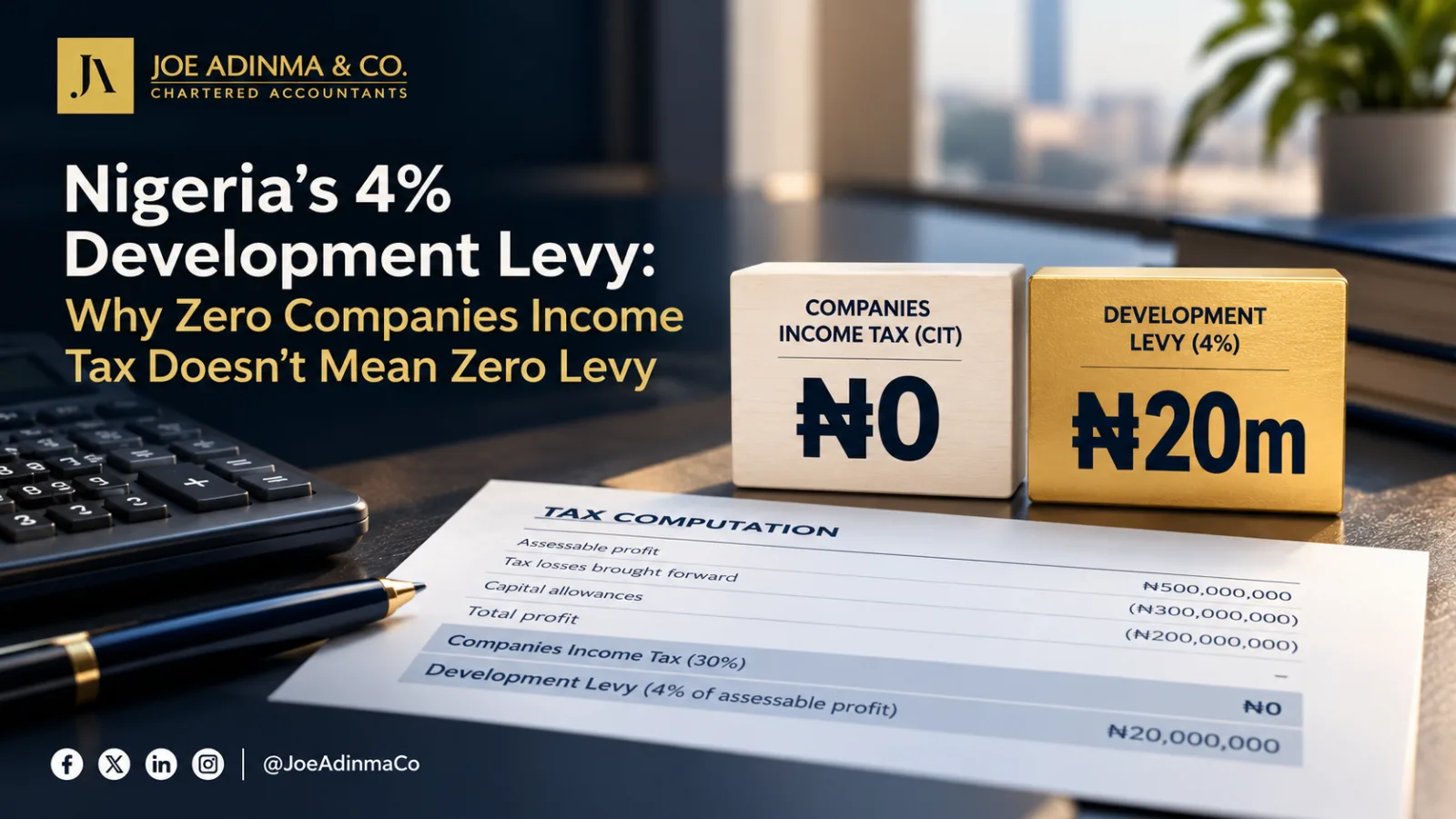
Why the Nigeria Tax Act 2025 charges the Development Levy before losses and capital allowances — and what that means for your 2026 tax provision
By Joe Adinma, FCA, FCTI — Managing Partner, Joe Adinma & Co. (Chartered Accountants)
Last updated: 7 October 2026
The new bottling line in Trans-Amadi was commissioned in March. By September the managing director had his first 2026 tax computation on his desk, and the last line made him smile. After capital allowances on the new plant and losses carried forward from two hard years, his Companies Income Tax (CIT) was nil.
Then he turned the page. One line sat beneath the nil: Development Levy, ₦20 million. Nothing had gone wrong. Section 59 of the Nigeria Tax Act 2025 (NTA) charges the 4% levy on assessable profit — the figure before losses and capital allowances are deducted. The reliefs that cleared his CIT never touched it.
That one design choice is the subject of this article. It affects every finance team closing a 2026 tax provision, budgeting for 2027, or appraising a new plant.
1. What Section 59 Actually Charges
Section 59(1) imposes “a development levy of 4% … on the assessable profits of all companies chargeable to tax under Chapters Two and Three of this Act, other than small companies and non-resident companies.” Chapter Two covers ordinary income tax; Chapter Three, petroleum operations.
Three facts follow. The rate is a flat 4%. The base is assessable profit. And small companies and non-resident companies are outside the charge. Section 59(4) adds a fourth for oil producers: the levy does not apply to assessable profits computed for hydrocarbon tax.
The Nigeria Revenue Service (NRS) collects the levy into a special account (s.59(2)) and splits it seven ways under s.59(3). One tank, seven pipes:
Beneficiary (s.59(3)) | Share |
Tertiary Education Trust Fund | 50% |
Nigerian Education Loan | 15% |
Defence and Security Infrastructure Fund | 10% |
National Information Technology Development Fund | 8% |
National Agency for Science and Engineering Infrastructure | 8% |
National Cybersecurity Fund | 5% |
National Board for Technological Incubation | 4% |
Total | 100% |
2. Where the Levy Bites
Section 27(1) defines a company’s total profits as “the amount of its total assessable profits from all sources, including chargeable gains …, less the amount of any loss … and capital allowance.” Read the order carefully: it is the whole story.
Assessable profit — trading profit plus chargeable gains — comes first. Losses and capital allowances are then deducted to reach total profit. The levy is struck at assessable profit; CIT at 30% is struck at total profit (s.56, which also lets the President cut the rate to 25% by order). Loss relief and capital allowances reduce the CIT base without reducing the Development Levy base.
This is not only our reading. The NRS’s own Information Circular No. 2026/01 of 29 June 2026 sets out the same ladder. In its worked example, ABC Ltd has assessable profit of ₦16.6 million, including a ₦1.2 million chargeable gain. After ₦5.5 million of losses and capital allowances, its total profit is ₦11.1 million and its CIT ₦3.33 million — but its levy is ₦664,000, a full 4% of the ₦16.6 million.
Think of the first meter on a pipeline: it measures the full flow before any of it is diverted. The infographic below shows the ladder, using the figures from the opening.
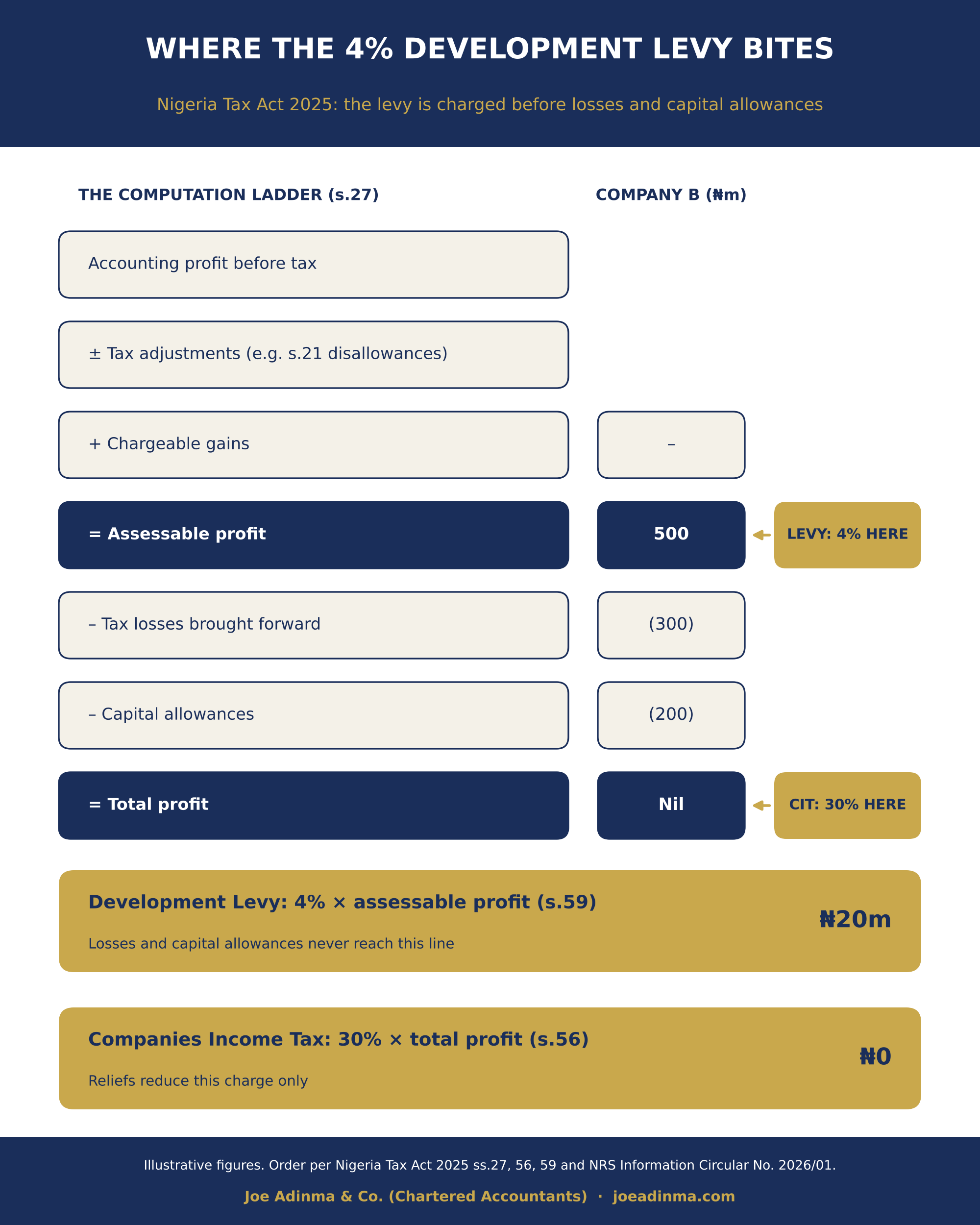
Figure 1: The computation ladder under s.27 and NRS Circular 2026/01 — where each charge is struck.
3. Two Companies, One Levy
Take two companies, each with assessable profit of ₦500 million. Company A has modest reliefs. Company B — the bottling plant — has enough to clear its CIT entirely.
₦ million | Company A | Company B |
Assessable profit | 500 | 500 |
Tax losses brought forward, utilised | (150) | (300) |
Capital allowances | (100) | (200) |
Total profit | 250 | Nil |
CIT at 30% of total profit | 75 | Nil |
Development Levy at 4% of assessable profit | 20 | 20 |
CIT and levy combined | 95 | 20 |
Combined, as % of assessable profit | 19.0% | 4.0% |
Company A has halved its CIT base, and its levy has not moved. Company B has no CIT at all and still owes ₦20 million. So “30% plus 4%” is not a rate either company pays: the two charges sit on different bases.
The new law also makes Company B’s position easier to reach. The old CITA rule capping capital allowances at two-thirds of assessable profit, which applied to most non-manufacturing companies, has gone. Paragraph 22 of the First Schedule now subtracts allowances from the whole “remainder of the assessable profits” after loss relief, and carries any shortfall forward “until fully utilised”. The old minimum tax has been abolished too. For a company outside s.57 (see Section 7), the levy is now the main profit-based charge left standing when CIT is nil.
One more point for Company B. If it pays a dividend in a year with no total profits, s.9 can tax the dividend itself at the CIT rate, unless it comes from already-taxed retained earnings or another listed exception.
4. Three Questions About the Base
Are chargeable gains inside it? On the NRS’s view, yes. Circular 2026/01 adds chargeable gains — on virtual assets and on other assets — to trading profit to arrive at assessable profit, and charges the 4% on the total. That tracks s.27(1), which describes total assessable profits as “including chargeable gains”. A contrary argument exists: that “assessable profits” in s.59 means trading profits alone, leaving gains to CIT. But it now runs against the administering authority’s published practice, so a company taking it should quantify the exposure and document the position.
Is the levy deductible? For CIT and hydrocarbon tax, no: s.21(e) disallows “taxes on profit or incomes levied in Nigeria or elsewhere”, and s.69(k) names the development levy expressly for hydrocarbon tax. Petroleum profits tax is the one exception — s.91(1)(n) allows “development levy paid under section 59” as a deduction. Everywhere else, model the 4% as a full cash cost with no tax shield.
Is it a levy or a tax? The Act settles that itself: s.59(4) calls it “the tax imposed under this Part”. The NRS administers it under s.3(1)(a)(v) of the Nigeria Tax Administration Act 2025 (NTAA), so expect the NTAA’s penalty and interest rules for unpaid tax to apply.
5. Better or Worse Than the Old Levies?
The levy replaced three earmarked charges: Tertiary Education Tax (TET) at 3% of assessable profit, the NITDA levy at 1% of profit before tax, and the NASENI levy at 0.25% of profit before tax. The last two applied only to specified sectors. Professional summaries also count the 0.005% Police Trust Fund levy, whose 2019 Act carried a six-year life.
Adding the old rates to get 4.255% and declaring a saving is tempting, and wrong. The charges did not fall on the same companies or on the same base.
For an ordinary company that paid only TET, the comparison is clean, because TET used the same assessable-profit base:
₦ million, assessable profit ₦500m | Rate | Charge |
Former Tertiary Education Tax | 3% | 15 |
Development Levy | 4% | 20 |
Increase | +1 point | 5 (+33.3%) |
For a bank, telecoms operator or other company that also paid the NITDA and NASENI levies, the answer turns on its own figures. Run it company by company.
6. Who Is Outside the Levy
Small companies. Section 201 defines a small company as “a business that earns gross turnover of ₦100,000,000 or less per annum with total fixed assets not exceeding ₦250,000,000.” Both conditions must be met. A company over either line pays the levy.
Note what the definition does not say. Unlike the “small business” test for VAT in s.147 of the NTAA, it contains no exclusion for professional services. A law or accounting firm under both thresholds is a small company for the levy and for CIT, even though it cannot be a small business for VAT — a distinction we unpacked in Is Your Business Even Supposed to Charge VAT?
Companies near the lines should test them each year: “gross turnover” has its own wide definition in s.201, covering interest, rents, royalties and dividends as well as sales.
Non-resident companies are excluded outright by s.59(1).
Petroleum companies need care. Section 59(4) excludes only the assessable profits computed for hydrocarbon tax, while s.65(6) makes upstream operations subject to Chapter Two as well. An upstream company therefore remains within the levy on profits assessed for income tax. Midstream and downstream companies have no carve-out, and Port Harcourt’s oilfield-services companies, which earn ordinary Chapter Two profits, gain nothing from s.59(4).
7. Large Companies: The Levy and the 15% Floor
Section 57 requires a company whose effective tax rate is below 15% to recompute and pay a top-up. It applies to a constituent entity of a multinational group with aggregate group turnover of at least £750 million or its equivalent, and to any other company with turnover of ₦50 billion or more. (The gazette prints the pound sign; the comparable OECD global minimum tax threshold is €750 million.) The NRS may raise the ₦50 billion threshold by regulation (s.57(4)). Three points matter for the levy.
The levy counts towards the 15%. Section 57(1)(b) lists the covered taxes as companies income tax, petroleum profits tax and hydrocarbon tax paid or payable, development levy, and the priority sector tax credit.
The measure is accounting profit, not assessable profit. The rate is covered taxes as a percentage of “net income” — profit before tax in the audited accounts, excluding franked investment income and unrealised gains or losses (s.57(1)(c)).
So the levy is not ignored in the 15% test. If Company B were large enough to fall within s.57, its ₦20 million levy would count as a covered tax and could reduce any top-up its nil CIT would otherwise trigger. How much depends on the full s.57 computation, so run the two calculations together.
Our article Nigeria’s 15% Minimum Effective Tax Rate: What Replaced the Old Minimum Tax? covers the s.57 mechanics in full.
8. In the Financial Statements
Current tax. IAS 12 applies to taxes “based on taxable profits”. In our view, because the levy is calculated by reference to assessable profit — a net profit measure — it falls within the scope of IAS 12. It should ordinarily be presented within tax expense and reflected in the tax-rate reconciliation, not in operating costs. The Act’s own description of the levy as a tax, and its treatment as a covered tax under s.57, are consistent with that view. Document the conclusion as an accounting judgement.
Deferred tax. A blanket 34% rate is a shortcut, not a policy. Capital allowances and tax losses reduce only the CIT base. So temporary differences driven by them — accelerated allowances on property, plant and equipment, or a deferred tax asset on unused losses — generally carry the 30% CIT rate alone. Differences that sit inside assessable profit itself, such as provisions disallowed until paid, can affect both bases.
This is not new ground. TET was also charged on assessable profit, so a company that treated TET correctly in its deferred tax workings can carry the same analysis forward at 4%.
9. Timing: Transition and Filing
The NTA took effect on 1 January 2026. The Federal Ministry of Finance’s Transition Guidelines of 18 June 2026 state that returns for accounting periods ending before 1 January 2026 are filed under the old laws, and periods ending from 1 January 2026 under the new framework.
Under the Ministry’s Guidelines, therefore, a company with a 31 March 2026 year-end is administered under the new framework and is subject to the Development Levy rather than TET for that year — notwithstanding that nine months of the accounting period fell in 2025. The NRS earlier took a different, filing-based view, a conflict we analysed in Nigeria’s 2026 Tax Transition: Old Tax Law or New Tax Acts — Which Applies to Your Business? Companies with non-calendar year-ends should confirm which position is being applied.
Build the levy into the CIT self-assessment, which for an established company is due within six months of its year-end (NTAA s.11(5)(a)). Unpaid tax attracts a 10% penalty plus interest at the Central Bank’s monetary policy rate plus a spread set by the Minister (NTAA s.65(1)) — see Late Tax Just Got Cheaper in Nigeria. Not as Cheap as You Think.
10. Seven Questions Before You Sign Off the 2026 Provision
Is the company inside the charge — or genuinely a small company (turnover of ₦100 million or less and fixed assets of ₦250 million or less) or a non-resident?
What is its assessable profit, before losses and capital allowances?
How far apart are assessable profit and total profit, and how much levy does that gap carry?
Have chargeable gains been included in the levy base, as NRS Circular 2026/01 requires — and if not, is the contrary position quantified and documented?
Has the levy been modelled as a non-deductible cash cost in budgets and capital-expenditure appraisals?
Is the company within s.57 — and if so, has the levy been counted as a covered tax in the 15% test?
Is the levy in IAS 12 tax expense, with deferred tax measured class by class rather than at a blanket 34%?
The Bottom Line
Back in Trans-Amadi, the bottling line is running two shifts. The capital allowances it earned are real, and so is the CIT saving. What has changed is how the managing director reads his computation: from assessable profit down, not from the last line up.
The levy is struck before losses and capital allowances arrive. Read it there, budget for it there, and the ₦20 million line stops being a surprise.
If you would like a second pair of eyes on your 2026 Development Levy and CIT computations, Joe Adinma & Co. can help.
How We Sourced This |
Related Reading
Nigeria’s 15% Minimum Effective Tax Rate: What Replaced the Old Minimum Tax?
Nigeria’s 2026 Tax Transition: Old Tax Law or New Tax Acts — Which Applies to Your Business?
Is Your Business Even Supposed to Charge VAT?
Late Tax Just Got Cheaper in Nigeria. Not as Cheap as You Think.
Sources
Nigeria Tax Act, 2025 — Official Gazette No. 117, Vol. 112, Act No. 7, pp. A387–A596 (NRS-issued edition)
Nigeria Tax Administration Act, 2025 (Official Gazette No. 117, Vol. 112, Act No. 5)
Federal Ministry of Finance — Federal Government Issues Transition Guidelines for Tax Acts 2025
Voice of Nigeria — Nigeria to Institutionalise Police Trust Fund
This article provides general information only and is not tax, legal or investment advice. The application of the Nigeria Tax Act 2025 depends on each taxpayer’s facts. Statutory interpretation points flagged above remain open pending NRS guidance or judicial decision.