
Interest on Late Tax Just Got Cheaper in Nigeria. Not as Cheap as You Think.
Published September 30, 2026
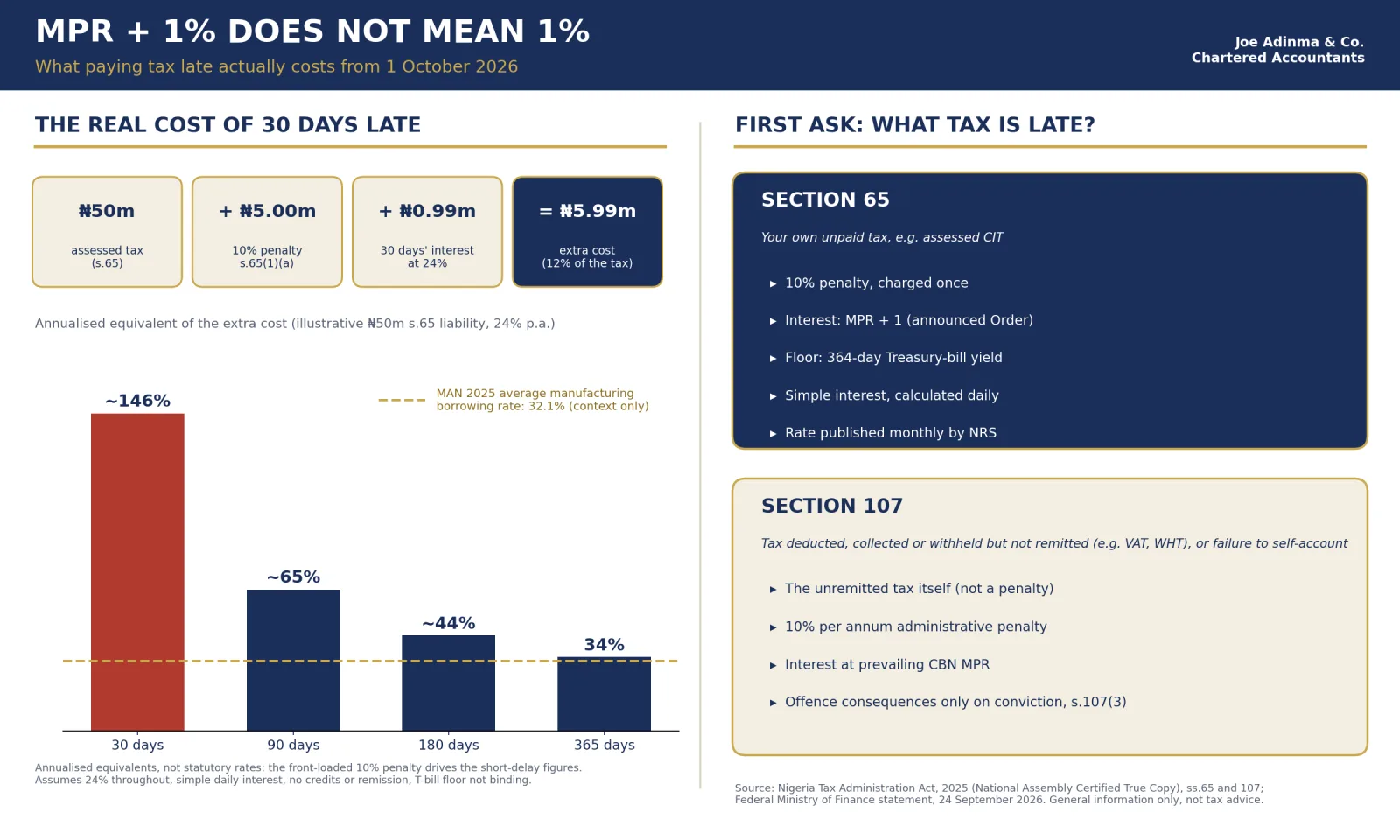
From 1 October 2026, interest on late tax falls from MPR + 5 to MPR + 1. But MPR + 1% does not mean 1%: with the separate 10% penalty, a 30-day delay on a ₦50 million bill can still cost about 12% of the tax, and VAT and WHT follow different rules altogether
By Joe Adinma, FCA, FCTI — Managing Partner, Joe Adinma & Co. (Chartered Accountants)
Last updated: 28 September 2026
Picture a finance director in Trans-Amadi at month-end. She has ₦50 million in the bank and two claims on it: the company's ₦50 million income tax bill, due today, and a supplier who will not release the next shipment until he is paid.
Then she reads the headline. Interest on late tax is now just MPR plus 1%. She pays the supplier and decides the tax can wait a month.
From 1 October 2026, a new Order made under section 65 of the Nigeria Tax Administration Act, 2025 (NTAA) cuts the interest charged under that section on late naira tax from five percentage points above the Central Bank of Nigeria's Monetary Policy Rate (MPR) to one. At today's 23% MPR, that is still about 24% a year. And it sits on top of a separate 10% penalty that the Order does not touch, so her one-month “loan” from the tax authority will cost about ₦5.99 million.
The cheapest-sounding money in the headline may be the dearest money in her month.
The Short Version |
What Changed on 1 October
According to a Federal Ministry of Finance statement of 24 September 2026, the Minister of Finance and Coordinating Minister of the Economy, Taiwo Oyedele, has issued the Nigeria Tax Administration (Interest on Late Payment of Tax) Order, 2026, with effect from 1 October 2026. As announced:
Naira liabilities: CBN MPR + 1 percentage point, subject to a floor equal to the yield on 364-day Nigerian Treasury Bills.
Foreign-currency liabilities: SOFR + 6 percentage points, with an officially recognised successor rate if SOFR is discontinued.
Monthly rate-setting: one rate for each calendar month, set on the last business day of the preceding month and published by the Nigeria Revenue Service (NRS) by the third business day of the month.
Method: simple interest, calculated daily from the due date until payment.
Transition: the new rate covers interest arising from 1 October 2026, including on tax that fell due earlier; interest that arose before then remains governed by the rules then in force, where those rules specifically provide for it.
What it leaves alone: the Order supersedes the 2017 ministerial notice on interest on unpaid taxes, but does not change the 10% late-payment penalty or the tax authority's section 66 power to remit penalty and interest.
One caution belongs here rather than in the footnotes. These details come from the Ministry's announcement, because the gazetted Order was not publicly available at the time of writing. If the instrument differs, the detail may change.
Why “MPR + 1%” Means About 24% Today
The CBN cut the MPR by 350 basis points to 23% on 22 September 2026, a move we examined in CBN Cut the MPR by 350 Basis Points. How Much Will Your Business Actually Save? On that basis, MPR + 1 gives 24% a year.
But 24% should not be hard-coded into anyone's tax model. The rate resets every month, so an unpaid tax balance behaves like a floating-rate loan: when the benchmark moves, so does the cost of staying in default. A rate that resets every month is a tide, not a price.
The Treasury-bill floor is not biting today. The 364-day bill cleared at a stop rate of 15.89% at the 23 September 2026 auction, well below 24%. It would matter only if monetary easing pushed MPR + 1 below the bill benchmark.
From MPR + 5 to MPR + 1
The old spread dates from 2017, when the then Minister of Finance set it at five percentage points over the CBN's benchmark rate from 1 July 2017, replacing the flat 15% the tax authority had been charging. Had that notice continued, today's rate would be 28% (23% + 5%).
On ₦50 million outstanding for a full year, the four-point cut saves about ₦2 million in interest. That is real relief. But interest is only one layer of the cost.
The 10% Penalty Did Not Disappear
Section 65(1)(a) of the NTAA adds 10% of the tax payable when tax is not paid within the prescribed period. Section 65(1)(b) separately charges interest on naira liabilities. The new Order changes the second and leaves the first alone.
The penalty is the toll at the gate; the interest is the fare for every day on the road. Because the toll is charged in full on day one, short delays cost the most for every day they last.
Take, purely for illustration, ₦50 million of assessed tax within section 65; interest at 24% throughout; the Treasury-bill floor not binding; and no payments, credits or remission.
Days late | 10% penalty | Interest at 24% | Total extra cost | % of the tax | Annualised equivalent |
30 | ₦5.00m | ₦0.99m | ₦5.99m | 12.0% | ~146% |
90 | ₦5.00m | ₦2.96m | ₦7.96m | 15.9% | ~65% |
180 | ₦5.00m | ₦5.92m | ₦10.92m | 21.8% | ~44% |
365 | ₦5.00m | ₦12.00m | ₦17.00m | 34.0% | 34% |
Interest computed as simple interest: ₦50m × 24% × days ÷ 365. Interest runs on the tax, not on the penalty.
Thirty days late costs about ₦5.99 million. Mechanically annualised, that is roughly 146%, against the 32.1% average manufacturing borrowing rate the Manufacturers Association of Nigeria (MAN) reported for 2025, which we discussed in Borrowing at 30%+: When Does a Business Loan Stop Creating Value and Start Destroying It?
Keep two caveats in view. The 146% is an annualised equivalent driven by the upfront penalty, not the statutory interest rate. And the MAN figure is a sector benchmark, not a universal lending rate.
Still, the direction is clear. On this illustration, the annualised cost only approaches that borrowing benchmark as the delay nears a year; for a short delay, the upfront penalty makes the effective cost disproportionately high. Unpaid tax is not cheap working capital.
First Ask: What Tax Is Late?
Money you hold for someone else is never yours to borrow. Section 107 of the NTAA sets a separate regime for tax a business deducts, collects or withholds on the government's behalf, and for tax it is required to self-account for.
Under section 107(1), a person that deducts, collects or withholds tax and fails to remit it by the 21st day of the month following the deduction or collection must pay (a) the amount not remitted, (b) an administrative penalty of 10% per annum of that amount, and (c) interest at the prevailing CBN Monetary Policy Rate. Section 107(2) applies the same three parts where a person required to self-account fails to do so within the time the Act prescribes.
Three differences from section 65 follow.
The penalty is time-based. Under section 107 it is 10% per annum, not a one-off 10%.
The interest rule is different. Section 107 specifies the prevailing MPR, without the ministerial spread found in section 65. The Order is announced as made under section 65, so until its text is available we would not assume that MPR + 1 overrides section 107's own rule.
Paragraph (a) is not a penalty. Some commentary reads it as an extra charge equal to the tax. It is simply the tax that should have been remitted. The Act does contain a 100% charge, but in section 104, for failing to process a supply through the fiscalisation system.
For many SMEs the recurring default is VAT collected from customers or WHT deducted from suppliers, not an annual CIT balance. The section 65 example above should not simply be applied to them; our article Withholding Tax Is Not a Cost of Doing Business covers the remittance mechanics.
Section 107(3) adds that a person convicted of an offence under the section is liable to imprisonment for up to three years, a fine of not less than the principal amount due plus a penalty of up to 50%, or both. That follows prosecution; it is not an automatic charge. But it underlines how seriously the law treats tax collected and not paid over.
Identify the tax, and the provision that governs it, before calculating anything.
Figure: The real cost of 30 days late, and the two regimes for late tax under the NTAA.
The Clock May Start Earlier Than You Think
Desk-review and audit adjustments. If a self-assessment return under-declares tax, section 34(5) makes the outstanding tax payable from the due date of the return, and section 34(6) applies penalty and interest from that same date. A 2026 return adjusted in a 2028 desk review may therefore carry charges from 2026, not from the date of the assessment. That is one reason the procedural points in NRS Desk Review vs Tax Audit vs Tax Investigation: Why the Difference Matters carry real money.
Missed extensions. Section 49(1) allows tax to be paid in instalments, with the last one due by the filing date, and section 49(2) lets the tax authority, at its discretion, extend the time for paying an assessment. But under section 49(6), if the taxpayer misses an extension, penalty and interest run from the original due date as if no extension had been granted. An extension is a deadline, not a holiday.
No relief for what you pay. Section 65(3) provides that penalty and interest are not treated as tax paid for the purpose of claiming relief under the NTAA or any other tax law. Cash spent on them buys no tax relief.
Debts That Cross 1 October
The new rate covers interest arising from 1 October, including on older debts. Interest that arose earlier stays under the rules then in force, so a debt that fell due in July 2026 has two interest periods. MPR + 1 should not simply be applied back to the original due date.
The earlier period has a further complication. Two versions of section 65 are in circulation, and only one provides for compound interest on debts unpaid at commencement. We rely on the National Assembly's Certified True Copy, which does not; the “How We Sourced This” box at the end explains the difference.
For material January–September 2026 arrears, ask before paying: which provision was applied, at what rate, simple or compound, and over what period? A figure produced by a tax platform is a calculation, and it can be checked. Our piece You Tried to File. The Portal Failed. Who Pays the Penalty? looks at what happens when the system, rather than the taxpayer, is the problem.
Remission Is Possible — But Do Not Budget on It
Section 66 allows the relevant tax authority, for any good cause shown, to remit all or part of any penalty or interest due under the NTAA or any other tax law. It must report monthly to the Minister responsible for finance on the taxpayers, circumstances and amounts waived.
Remission is discretionary. A credible application sets out the facts, the chronology, the reconciled liability, payments made and the specific relief sought, with evidence.
Arrears Do Not Stay in the Finance Department
Section 60 lets the tax authority appoint anyone holding the taxpayer's money, typically a bank, as its agent to pay the tax. Section 68 allows qualifying debts, once statutory recovery steps are exhausted, to be assigned to accredited third parties, including banks and debt-recovery practitioners.
And section 72 requires a tax clearance certificate to show tax outstanding for the last three years. That is the document banks and government agencies ask for before contracts, licences and approvals.
Use Credits Before Cash — But Only Real Ones
Section 49(2) makes assessed tax payable after deducting amounts to be set off for collection purposes. Before funding a liability with new cash, reconcile withholding-tax credits and other recognised credits against both your own records and the NRS platform; every naira properly offset stops attracting charges.
But verify certificates, counterparties, Tax IDs and periods first. A credit that cannot be substantiated is not a payment.
The Accounting Question
For IFRS reporters, the starting point is the IFRS Interpretations Committee's September 2017 agenda decision. There is no accounting-policy choice between IAS 12 and IAS 37 for interest and penalties related to income taxes: if an entity considers a particular amount to be an income tax, IAS 12 applies; otherwise IAS 37 does. Where that judgement is among those with the most significant effect on the financial statements, it should be disclosed.
The disclosures follow the standard applied: the major components of tax expense under IAS 12 paragraph 79, or the provision reconciliation and related information under IAS 37 paragraphs 84–85. Penalties and interest on VAT, and on withholding tax an entity deducts from others, are not income taxes of the entity and need their own analysis.
With IFRS 18 effective for annual periods beginning on or after 1 January 2027, entities should also consider how these amounts are classified in the new statement of profit or loss, rather than assume that anything called “interest” belongs in the financing category. We explore that question in Why 2026 Is Already the Year Nigerian Companies Need to Act.
Five Things To Do Now
Identify the tax before calculating the cost. Section 65 and section 107 impose different consequences; late CIT and unremitted VAT or WHT should not be modelled the same way.
Reconcile every liability to its original due date, especially audit and desk-review adjustments, where section 34 can take charges back to the return date.
Treat any payment extension as a hard deadline. Missing it takes penalty and interest back to the original due date under section 49(6).
Apply verified credits before cash, and settle undisputed balances promptly so they stop accumulating charges.
Recompute material penalty and interest yourself, particularly for pre-1 October arrears, rather than accepting a system-generated figure.
One date for the diary: 1 October 2026 is a Thursday and a public holiday, so NRS's first published rate under the Order should appear in the first working days of October. Check it rather than assuming 24%.
The Bigger Lesson
Back in Trans-Amadi, the shipment has landed and the supplier is paid. The tax bill is still there, a month older and about ₦6 million heavier.
The headline she read was true: the spread has been cut from five points to one. But MPR + 1% does not mean 1%. It means about 24% today, a 10% penalty that makes the first month the dearest, a different regime for VAT and WHT, a clock that can run back to the original due date, and enforcement tools that reach bank accounts and tax clearance certificates.
Next month-end, the number she should read first is not in the headline. It is in her own ledger.
Joe Adinma & Co. can help businesses reconcile outstanding tax positions and independently recompute penalty and interest exposure before engaging the tax authority.
How We Sourced This |
Related Reading
CBN Cut the MPR by 350 Basis Points. How Much Will Your Business Actually Save?
Borrowing at 30%+: When Does a Business Loan Stop Creating Value and Start Destroying It?
Withholding Tax Is Not a Cost of Doing Business — So Why Do Nigerian Companies Keep Paying It Like One?
You Tried to File. The Portal Failed. Who Pays the Penalty?
NRS Desk Review vs Tax Audit vs Tax Investigation: Why the Difference Matters
Is Your Business Even Supposed to Charge VAT?
The Tax Reform Isn't Finished — the Government Just Admitted It
Why 2026 Is Already the Year Nigerian Companies Need to Act (IFRS 18)
Sources
Nigeria Tax Administration Act, 2025 — National Assembly Certified True Copy (“Approved Copy to Print”), sections 34, 49, 60, 65, 66, 68, 72, 104 and 107: Certified True Copy (PDF)
Federal Ministry of Finance statement, 24 September 2026, as reported by The Guardian: FG tightens late tax payment rules, introduces market-linked interest
BusinessDay: FG cuts interest spread on late tax payments to MPR plus 1%
BusinessDay (January 2026): Tax reform: National Assembly releases certified true copies showing major differences with gazetted laws
Nairametrics, Treasury Bills primary market auction of 23 September 2026 (MPR cut to 23%; 364-day stop rate 15.89%): NTB stop rates crash across tenors after CBN's 350bps rate cut
Deloitte via Proshare (May 2017), on the 2017 interest regime for unpaid taxes: FG introduces new interest rate regime for outstanding tax payments
IFRS Interpretations Committee agenda decision, September 2017: IAS 12 — Interest and penalties related to income taxes
Manufacturers Association of Nigeria, 2025 average manufacturing borrowing rate (32.1%), as cited in our article Borrowing at 30%+.
This article is for general information only and does not constitute tax, accounting or legal advice. The finance director described is an illustrative example, not a client. The applicable treatment depends on the nature of the tax, the relevant due date and the taxpayer's circumstances.