

The Missing Boundary in Nigeria's Self-Assessment System — and Why the Line Should Be the Face of the Return
By Joe Adinma, FCA, FCTI — Managing Partner, Joe Adinma & Co. (Chartered Accountants)
Last updated: 24 September 2026
A company files its audited financial statements and self-assessment return. Some months later, a letter arrives headed “Desk Review” or “Desk Examination.” (This article uses the two terms interchangeably, as NRS correspondence does.)
The letter reclassifies expense lines, applies assumed tax treatments to broad cost categories, reconstructs profit using an industry benchmark, computes additional liabilities across several tax heads, and asks for breakdowns and documentary evidence within a short deadline. Even after the matter is resolved, the same year may still be selected for audit.
Is that still a desk examination? This article argues that it is not — and that the answer does not depend on a new theory. It depends on taking seriously the boundary the revenue authority itself published in 2023: a desk examination is a check of the return on its face. Anything that cannot be resolved there belongs to audit.
Nothing in this argument questions NRS's power to obtain information, raise additional assessments or audit any taxpayer. Those powers are substantial, and self-assessment is not immunity from scrutiny. The argument is about which procedure applies when those powers are used — and the safeguards that should come with it.
Self-Assessment Does Not Mean No Scrutiny
Under self-assessment, the taxpayer carries primary responsibility for determining its tax position, filing and paying. The revenue authority retains extensive powers to verify, challenge, assess, audit and investigate. What changes is the allocation of effort: returns should be capable of light-touch processing, and intensive scrutiny should follow identified risk.
That allocation can erode quietly. In a 2014 IMF Working Paper, Andrew Okello put the point bluntly: “Reviewing all tax returns undermines the very essence of a self-assessment system.” He reported that Nigeria was then one of three countries — with Botswana and Ghana — in which all tax returns were subject to some form of desk audit or review, and warned that universal manual review risked a quiet reversion to administrative assessment, with staff who had previously assessed returns applying undue scrutiny to each one. (The paper states that its views are the author's and not necessarily those of the IMF.)
Section 34 of the Nigeria Tax Administration Act 2025 (NTAA) builds the same logic into law. A taxpayer that files a self-assessment return is deemed to have made an assessment of the tax payable, and section 34(4) allows the tax authority to accept it, accept it with an additional assessment, or reject it and assess to the best of its judgement. Whatever enquiries follow, the taxpayer should be able to tell which of those outcomes has occurred.
The Boundary the Revenue Service Already Drew
In October 2023, the then Federal Inland Revenue Service published guidelines on the nature and scope of its tax compliance enquiry processes, replacing earlier publications of October 2020 and April 2021. Professional summaries of those guidelines are consistent on the essentials.
Desk examination is carried out at NRS — in the tax office that administers the taxpayer's file, usually by its Returns, Payment and Processing unit — on the current year's self-assessed returns. Its scope is the return itself: completeness, arithmetical accuracy, obvious misapplication of tax law, reconciliation of balances brought and carried forward, and verification of tax computations, losses, capital allowances and minimum-tax computations. It does not involve visits to the taxpayer's premises or requests for source documents relating to revenue or expenditure. It should be concluded before any audit begins, and its findings should be considered by the audit team.
Tax audit is different in kind: a back-duty verification covering up to six preceding years, guided by an audit plan setting out its nature, scope and intensity, preceded by a pre-audit meeting, and involving visits to the taxpayer's premises and reconciliation discussions.
Tax investigation is reserved for suspected infractions — fraud, evasion and similar triggers — conducted by specially trained officers.
Every item in the desk-examination scope can be checked from the return package and the records NRS already holds. The guideline does allow desk examiners to request a narrow class of fundamental documents — such as evidence of tax payment or filing, and approvals or certificates on which a return position depends. But these are documents about the taxpayer's compliance status, not about its underlying transactions. That distinction is not an accident. It is the design.
The guidelines group desk reviews with “monitoring exercises.” Separately, the revenue authority's periodic national VAT and withholding tax monitoring exercises have involved field visits, and advisers have asked where those exercises sit in the framework. They are not the subject of this article, which concerns the desk examination of filed returns.
Section 57: The Power Is Not the Procedure
The strongest objection to this reading is section 57 of the NTAA, and it must be conceded in full. Section 57 allows NRS, for the purpose of obtaining full information about a person's tax liability, to require returns, books, documents, records and information, to require a person to attend for examination, and to require access to electronically stored and cloud-based records, on at least seven days' notice (with extensions available on written application before the deadline). The power is not tied to any stage of the compliance process. No guideline can cut it down: section 145 makes the Act prevail over any inconsistent instrument.
But the existence of a broad power was never the question. The Federal Inland Revenue Service (Establishment) Act 2007 gave FIRS an equally broad power in section 26 — to call for returns, books, documents and information, and to require a person to appear personally for examination. It was with that power already in hand that FIRS published, in 2023, a desk-examination scope confined to the face of the return. The guideline was never a limit on the power. It was the revenue authority's own statement of how it would exercise the power at each level of enquiry.
The distinction therefore has three layers:
The power — section 57 (and, for pre-2026 periods, its predecessor under the repealed regime). NRS can obtain the information. That is not in dispute.
The procedure — the 2023 guideline today, and in future rules under section 144(4) of the NTAA, which expressly allows the Board of the relevant tax authority, with the Minister's approval, to make rules prescribing the procedure for obtaining any information required under the Act.
The classification — once NRS uses its power to require information about the transactions underlying a return, it is doing audit work, whatever the letter is called. The exercise should then carry audit safeguards.
Section 57(3) points the same way. It provides that the tax authority is not precluded from verifying matters relating to returns and books by tax audit or investigation, including electronic records as may be specified in guidelines by the relevant tax authority. That wording is permissive rather than exclusive, and should not be overstated. But the statute consistently associates the verification of books and records with audit and investigation — and contemplates published guidelines governing how it is done.
In short: section 57 answers whether NRS can obtain the information. The boundary answers which procedure applies once it asks. The two do not conflict. And as the Tax Appeal Tribunal's approach to tax notices shows (discussed below), it is the substance of an exercise, not its label, that determines what it is.
Which Law Governs a Desk Review Conducted in 2026?
The Minister of Finance's General Transition Guidelines for the Tax Acts 2025, issued on 18 June 2026 under section 144 of the NTAA, provide that tax liabilities, assessments, audits, investigations, disputes and enforcement actions relating to periods before 1 January 2026 are to be treated under the repealed tax laws. The relevant accounting or basis period — not the date on the letter — determines which regime applies. (The wider dispute is discussed in The Tax Law Says One Thing. The NRS Portal Says Another.)
A desk review issued in September 2026 of a December 2025 year is therefore conducted against the repealed regime — the very regime under which the 2023 guideline was issued. For those periods, the guideline is not a historical footnote; it is the published framework for the exercise. For later periods, section 146 of the NTAA contains savings provisions, and the Transition Guidelines state that earlier regulations and circulars give way to the new Acts only to the extent of any inconsistency. Correspondence should say which regime it applies. One of the letters examined for this article cited repealed Companies Income Tax Act provisions alongside Nigeria Tax Act 2025 provisions in the same letter.
What Two Recent Desk Reviews Show
For this article, I examined two 2026 desk-review letters issued by two different NRS offices in Port Harcourt, both concerning 2025 accounts. The companies are not identified. Measured against the published desk-examination scope, the letters went well beyond it. Between them, they:
reclassified accounting expense categories and disallowed items on factual grounds;
applied assumed VAT and withholding tax treatments across broad cost categories;
applied an industry cost-to-revenue benchmark to reconstruct profit;
computed additional liabilities across several tax heads, in one case with penalty and interest; and
required breakdowns of cost of sales and documentary evidence within short deadlines.
None of those steps can be performed from the face of the return. Each requires facts about underlying transactions — which is audit work. There may be lawful explanations for individual adjustments, and this article does not determine either taxpayer's liability. Two letters from one city cannot establish national practice. But they show that the published boundary is not being consistently observed.
The Boundary: The Face of the Return
The rule this article proposes is simple, and it is drawn from the 2023 guideline rather than invented:
A desk examination may use anything the taxpayer has filed and anything NRS already holds. It may ask the taxpayer to clarify the return itself, and request the fundamental compliance documents the guideline permits. It may not require information about the transactions underlying the return. Whatever cannot be resolved on that basis is referred for audit.
Three points of definition make the rule workable:
NRS's own records count — but only as a flag. Comparing this year's opening balances with last year's closing balances is desk work, and a mismatch on the face of the returns can be corrected. Comparing income tax revenue with VAT returns or withholding tax schedules already filed is also legitimate — but a difference proves nothing on its own. Exempt, zero-rated and out-of-scope supplies, timing differences and other legitimate factors routinely separate income tax revenue from VAT turnover. Such a difference can justify a referral for audit. It can never, by arithmetic alone, found an assessment.
“Obvious misapplication of tax law” means obvious on the face of the return — a wrong rate, an arithmetically incorrect capital allowance, a disallowable item that the return itself identifies as such. Disallowing or reclassifying an expense because NRS doubts its nature is not obvious misapplication. It is a factual question, and it belongs to audit.
Estimates belong to audit. A section 38 deemed-profit assessment requires a factual judgement that profit is lower than expected from the business. Applying industry ratios is therefore not a desk-examination function, however lawful it may be after audit.
Within desk examination | Belongs to tax audit |
Checking arithmetic and tax computations on the return | Requiring breakdowns of cost of sales or expense categories |
Comparing opening balances with the prior year's closing balances | Requiring reconciliation schedules prepared by the taxpayer |
Noting differences from VAT and WHT filings NRS holds — as a referral flag | Requesting invoices, contracts, ledgers or bank statements |
Correcting a wrong rate or allowance evident on the return | Reclassifying or disallowing expenses on factual grounds |
Asking how a figure on the return was computed | Applying industry benchmarks to reconstruct profit |
Requesting evidence of tax payment or filing, or a certificate or approval a claim relies on | Requesting customer, supplier or payment listings |
Suspicion of fraud or deliberate evasion has no place at desk stage at all. It belongs to investigation, with investigation-level safeguards.
Clarification Meetings — Within the Remit
A desk examiner may reasonably invite a company representative, or the company's tax adviser, to the NRS office to explain the return. What matters is not the method — letter or meeting — but the subject. Questions about how a computation was built, why a figure sits under a particular heading, or how a loss brought forward was derived are within the remit. Questions about what made up cost of sales, who the suppliers were, or whether tax was deducted on particular payments are not.
Four safeguards keep such meetings within bounds:
a written invitation listing the specific items on the return to be clarified;
a short written record of the explanations given, agreed by both sides;
no source documents requested, during or after the meeting, beyond the fundamental compliance documents the guideline permits; and
no assessment based on new facts stated orally — if an explanation reveals something that changes the tax position beyond a face-of-the-return correction, the matter is referred for audit.
What the Taxpayer May Choose to Do
The rule binds NRS, not the taxpayer. A taxpayer may, on its own initiative, offer a document to settle a point quickly and avoid a referral. Experienced tax advisers know both what the law requires and how practice works, and can judge when that is sensible and when to insist on the proper procedure.
Three safeguards should attach: volunteering material is not consent to an audit and does not open the file to further requests; volunteered material is limited to the point it addresses and recorded as taxpayer-initiated; and declining to volunteer carries no adverse inference — the only consequence is referral to audit, which is the proper route anyway.
The risk is greatest for taxpayers without professional advisers, particularly smaller businesses, for whom an “optional” request may feel compulsory. That makes the NRS-side rule more important, not less.
Answering the Efficiency Objection
The obvious objection is that a strict boundary will flood audit capacity. It will not, for three reasons. First, most desk findings — arithmetical slips, computation errors, balance mismatches — are resolved and corrected on the face of the return, as the guideline intends. Second, a referral is not an automatic audit; it enters NRS's risk-based selection, and NRS audits the referrals that justify it. Third, the current practice is the inefficient one: de facto audits conducted as desk reviews produce disputed assessments, objections and appeals that cost both sides far more than a clean referral.
The Other Side: Powers, Assessments and Case Law
Nothing here limits NRS's substantive powers. Section 36 permits additional assessments within six years — without limit where there is deliberate misstatement — and section 36(5) requires relevant facts to be considered even if unknown when an earlier assessment was made. Section 38 permits deemed-profit assessments where its conditions are met. The argument is only that these powers, where they rest on facts beyond the return, should be exercised through audit.
The case law confirms how wide those powers can be. In BJ Pumping Services SA Panama v FIRS, the revenue authority rejected a foreign company's actual-profit returns and assessed it on a deemed percentage of turnover under section 30 of the repealed Companies Income Tax Act. The Tax Appeal Tribunal upheld the assessment in 2021, and in 2024 the Federal High Court affirmed that the law did not require the authority to justify the particular percentage chosen, provided it acted fairly and reasonably. Estimation, in other words, is a lawful tool. The question this article raises is not whether such powers exist, but where the facts that trigger them should be established — and the answer the 2023 framework gives is audit.
A Cautionary Tale from South Africa
South Africa's Tax Administration Act 2011 distinguishes selection for “inspection, verification or audit.” SARS verification routinely requests supporting documents, and a verification ends with a written outcome — finalisation, a revised assessment, or a Referral for Audit Letter. Where an audit identifies material adjustments, section 42 requires SARS to set out the grounds in writing and give the taxpayer at least 21 business days to respond before assessing.
But South Africa's Constitutional Court observed in 2025 that the verification process is not further regulated by the Act; the detailed protections attach to audits. The result is that verification — which may collect documents — operates without audit-level safeguards. Nigeria's 2023 guideline is, on this point, better designed. The lesson is to hold the line it drew, not to soften it.
A Review Finding Is Not an Assessment
A second boundary sits between an enquiry, a proposed adjustment, an assessment, a disputed assessment and an enforceable debt. Under the NTAA, a notice of assessment must be served and must state where payment is to be made and the taxpayer's rights (section 40). A valid objection must be delivered within 30 days of service, and NRS must respond within 90 days or the objection shall be upheld (section 41(2) and (6)). Where an objection or appeal has been given, collection of the disputed tax is held in abeyance, with the undisputed amount still payable (section 49(3)). Section 42 is the counterweight: an assessment is not invalidated for want of form where its substance conforms to the Act.
A letter that combines a documentary deadline with computed “additional” liabilities and payment language leaves the taxpayer unsure whether it is answering an information request, a proposal, or an assessment that has started the objection clock. I call this procedural compression. The Tax Appeal Tribunal has already shown how seriously it takes the problem. In Ponticelli Upstream v FIRS (Appeal No. TAT/LZ/CIT/029/2017, 27 September 2019), a notice of additional assessment was worded so that it also operated as a refusal to amend, foreclosing the taxpayer's statutory right to object. The Tribunal looked at the substance of the document rather than its title, held that the taxpayer's right to fair hearing had been breached, and set the assessments and demand notices aside. What a document does matters more than what it is called — and the same principle, by analogy, applies to desk examinations. The remedy is clear communication: every desk examination should close with one of three written outcomes —
the return has been accepted;
the return has been accepted, with an additional assessment limited to arithmetical or obvious legal errors evident on its face; or
the matter has been referred for audit.
Section 34(4) also permits NRS to reject a return and assess to the best of its judgement. That remains a lawful outcome — but because it rests on facts beyond the return, it should follow audit rather than desk examination. Where an assessment is made, the statutory notice and objection rights should be unmistakable.
A Four-Stage Compliance Enquiry Framework
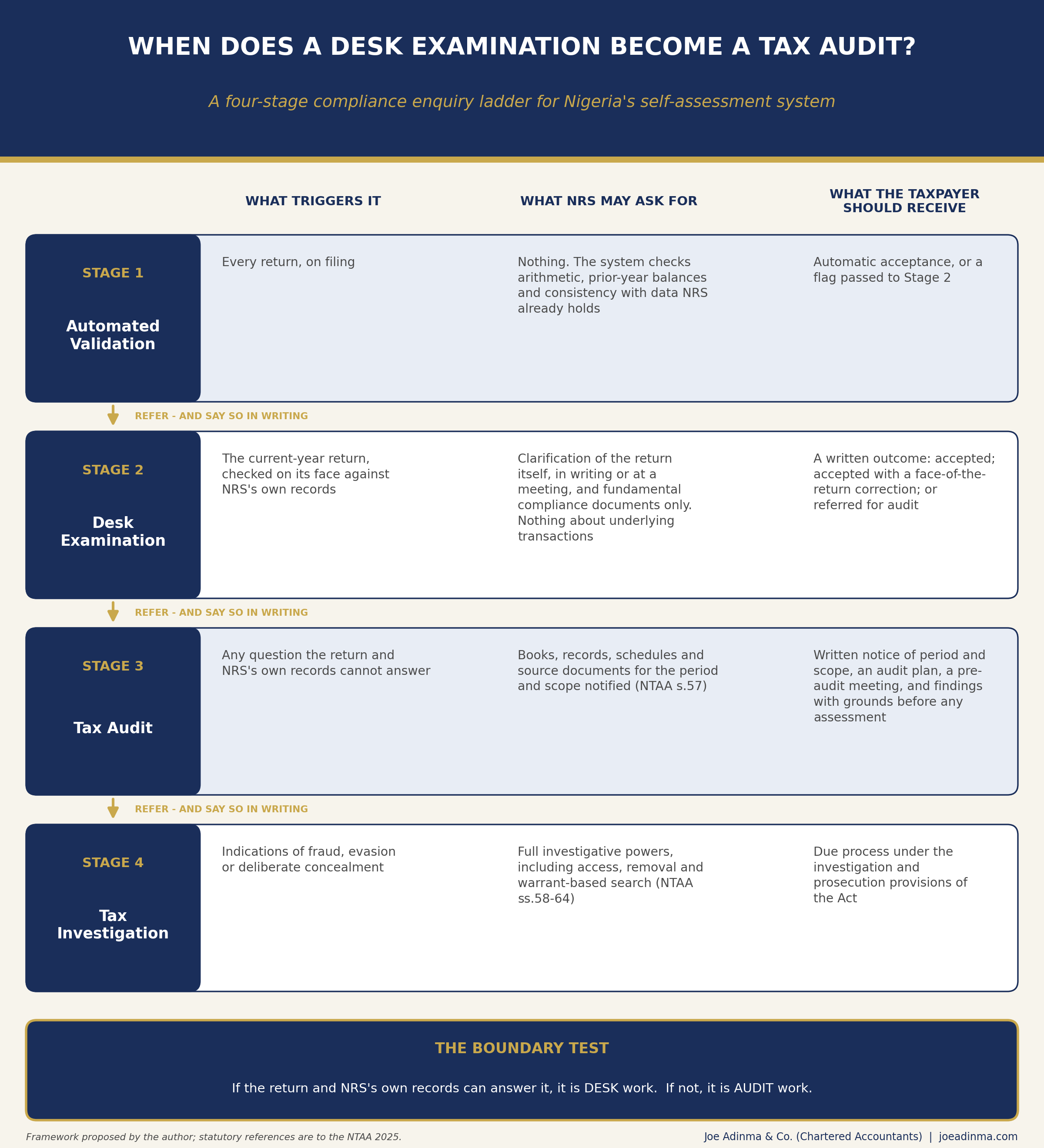
Figure: A four-stage compliance enquiry ladder (framework proposed by the author).
Stage 1 — Automated validation. Arithmetic, cross-return consistency, prior-year balances and third-party data matching, with minimal human intervention. NRS's e-invoicing and Electronic Fiscal System, now in compliance monitoring for large taxpayers, should make this stage increasingly data-driven.
Stage 2 — Desk examination. Carried out at the NRS tax office: the return on its face, checked against NRS's own records, with clarification of the return in writing or at a meeting, and fundamental compliance documents only. No requirement for information about underlying transactions. Closes with a written outcome.
Stage 3 — Tax audit. Any examination of underlying transactions and records, with written notice of period and scope, an audit plan, a pre-audit meeting and findings with grounds before assessment.
Stage 4 — Tax investigation. Suspected fraud, deliberate evasion or other serious non-compliance, with investigation-level safeguards.
Avoid Duplication Without Creating Immunity
Desk examination should not bar a later audit, and the NTAA preserves wide reassessment powers. But documents already supplied should be available to later NRS teams — as the 2023 guideline contemplates — and issues already considered should not ordinarily be reopened on identical facts without a legitimate reason. That is not taxpayer immunity. It is administrative discipline.
The Legal Machinery Already Exists
Section 144(4) allows the Board of the relevant tax authority, with the Minister's approval, to make rules prescribing forms for returns and other information and the procedure for obtaining any information — the natural home for a published desk-examination scope.
Section 144(1) allows the Minister to give the tax authority directives of a general nature, with which it must comply. Section 144(2) bars directives about particular persons — which makes a general procedural framework exactly the right use of that power.
Section 57(3) contemplates guidelines on verification by the relevant tax authority; section 85 allows it to specify and simplify forms and notices, including standard desk-review, referral and outcome letters.
The Office of the Tax Ombud, under section 41 of the Joint Revenue Board of Nigeria (Establishment) Act 2025, can investigate complaints and systemic issues and recommend improvements. It has announced plans for a Taxpayers' Bill of Rights — a natural home for the right to know which procedure one is in.
ICAN and CITN can supply evidence from practice — an anonymised sample of desk-review correspondence across tax offices — and put it before the Technical Subcommittee on Fiscal Policy and Tax Reforms inaugurated in September 2026.
Received a Desk-Review Letter? Five Questions |
Conclusion
Nigeria's revenue authority has already told taxpayers what a desk examination is: a check of the return on its face, carried out at the NRS tax office, without source documents. It said so while holding information powers as broad as those it holds today. The task now is not to invent a new boundary, but to honour and codify the one already published — through rules under section 144(4), for the new era of digital tax administration.
If a question can be answered from the return and NRS's own records, it is desk work. If it cannot, it is audit work — and the taxpayer is entitled to know which one it is facing.
That would improve taxpayer certainty without weakening revenue enforcement. And the legal machinery to achieve it already exists.
Disclosure: Joe Adinma & Co. advises taxpayers on NRS desk reviews, objections and tax audits. The two letters described above were reviewed in that professional context and are discussed without identifying the taxpayers.
Source note: statutory references are to the Nigeria Tax Administration Act 2025 as published in the Official Gazette. Circulating reproductions of the Act contain some differences in cross-references and text; readers relying on a particular procedural provision should check the gazetted text.
This article is for general information and does not constitute legal or tax advice. The boundary and framework proposed are the author's policy proposals, not a statement of current NRS procedure.
Related Reading
NRS Desk Review vs Tax Audit vs Tax Investigation: Why the Difference Matters · The Tax Law Says One Thing. The NRS Portal Says Another. · The Tax Reform Isn't Finished — the Government Just Admitted It · You Tried to File. The Portal Failed. Who Pays the Penalty?
Sources and Authorities
Nigeria Tax Administration Act 2025, Act No. 5 (Official Gazette) — National Assembly
Federal Inland Revenue Service (Establishment) Act 2007, section 26 (repealed)
Forvis Mazars Nigeria — FIRS Guidelines on Tax Inquiry Processes
WTS Blackwoodstone — FIRS Tax Compliance: Guidelines for a Seamless Inquiry Process
KPMG Nigeria — FHC ruling in BJ Pumping Services SA Panama v FIRS (October 2024)
BusinessDay — The Transition Guidelines and section 144 NTAA
Mondaq — Overview of the General Transition Guidelines for the Tax Acts 2025
Mondaq — NRS e-invoicing / EFS compliance monitoring for large taxpayers (July 2026)
South African Revenue Service — Being audited or selected for verification
United Manganese of Kalahari (Pty) Ltd v CSARS and related cases [2025] ZACC 2
Economic Confidential — The Tax Ombud and the case for a fairer revenue system
Vanguard — Tax Ombud to launch Taxpayers' Bill of Rights (August 2026)