When the NRS Knocks: Your Rights and Preparation Guide Under the NTAA 2025
Published July 27, 2026
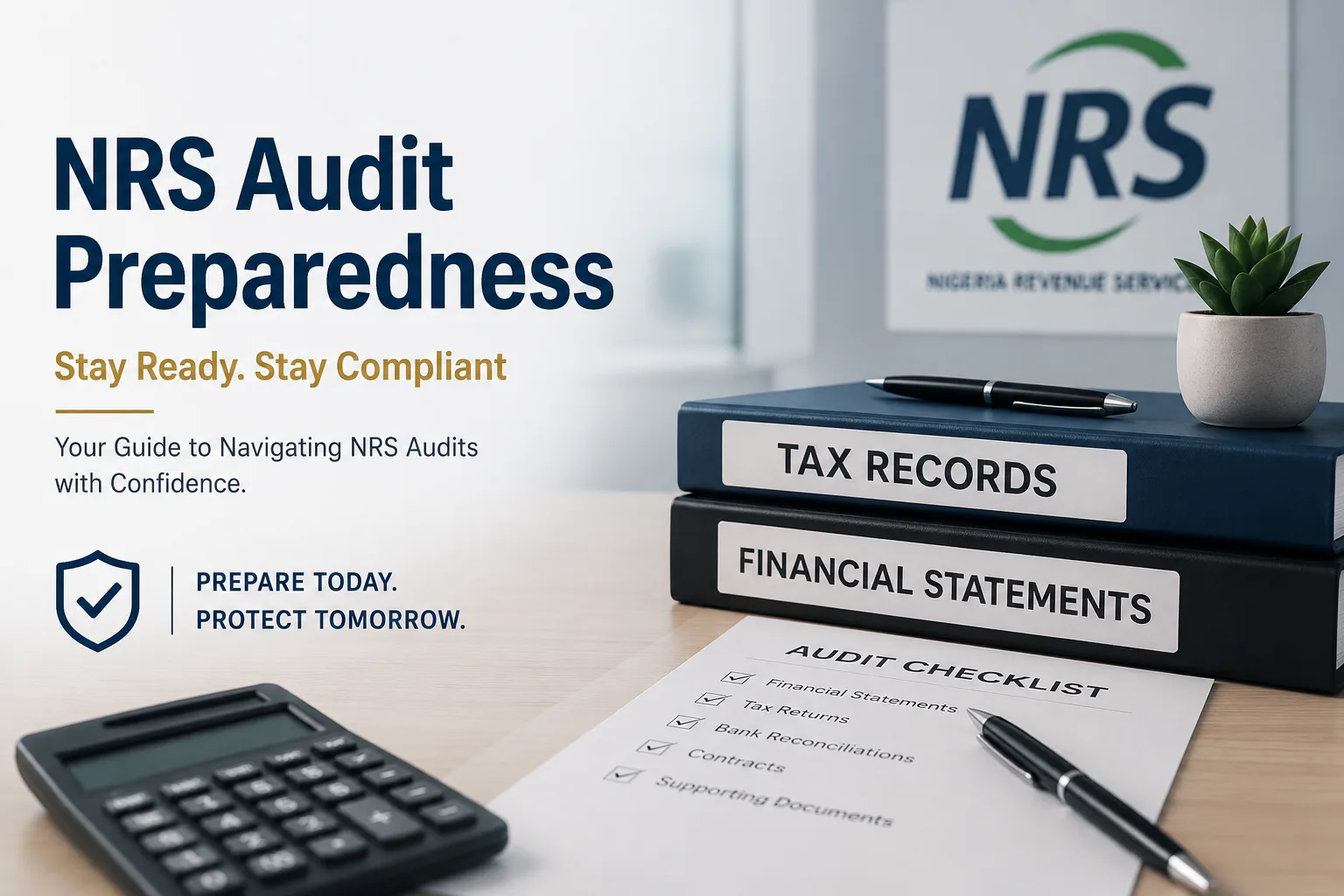
Let me describe a scene that plays out in Nigerian businesses every single week.
A letter arrives — or sometimes an unscheduled phone call. The Nigeria Revenue Service. They want to examine your tax records. They will be at your office on Monday.
The director's first instinct is panic. His second instinct is to call his accountant. His third instinct — the one that will determine the next eighteen months of his professional life — is either to prepare methodically, or to scramble desperately.
Most Nigerian businesses scramble. And most of them pay far more than they owe as a result.
This article is about the other choice.
"An NRS audit is not a verdict. It is a test. The question is not whether you are honest. The question is whether you are organised. Those are two different things — and only one of them protects you on the day the officers arrive."
I have spent over thirty years in Nigerian professional practice. I have seen businesses with completely clean tax histories disintegrate under an audit because their records were a mess. I have seen businesses with genuinely complex tax positions navigate multi-year audits and walk away with zero additional liability because everything was documented, reconciled, and professionally presented. The difference was never honesty. It was always preparation.
So let us talk about preparation. Let us talk about what the NRS is actually doing when they examine your business. Let us talk about your rights — the ones written into the NTAA 2025 that most businesses never use. And let us talk about the single document that will either save you or sink you when the auditors sit down at your conference table.
Your audited financial statements.
——— SECTION ONE ———
Three Visits. Three Very Different Situations.
Not all NRS engagements are the same. Before you do anything else, understand which type of engagement you are facing — because the appropriate response is completely different for each.
Here is what most businesses never tell their clients:
The NRS does not only come knocking when they suspect fraud. They come knocking for reasons as mundane as a filing discrepancy, a sector-wide compliance exercise, or an automated flag in their Rev360 system. Treating every NRS engagement like a fraud investigation is the first mistake most businesses make — and it makes everything worse.
Type | What It Actually Is | Risk Level | Your First Move |
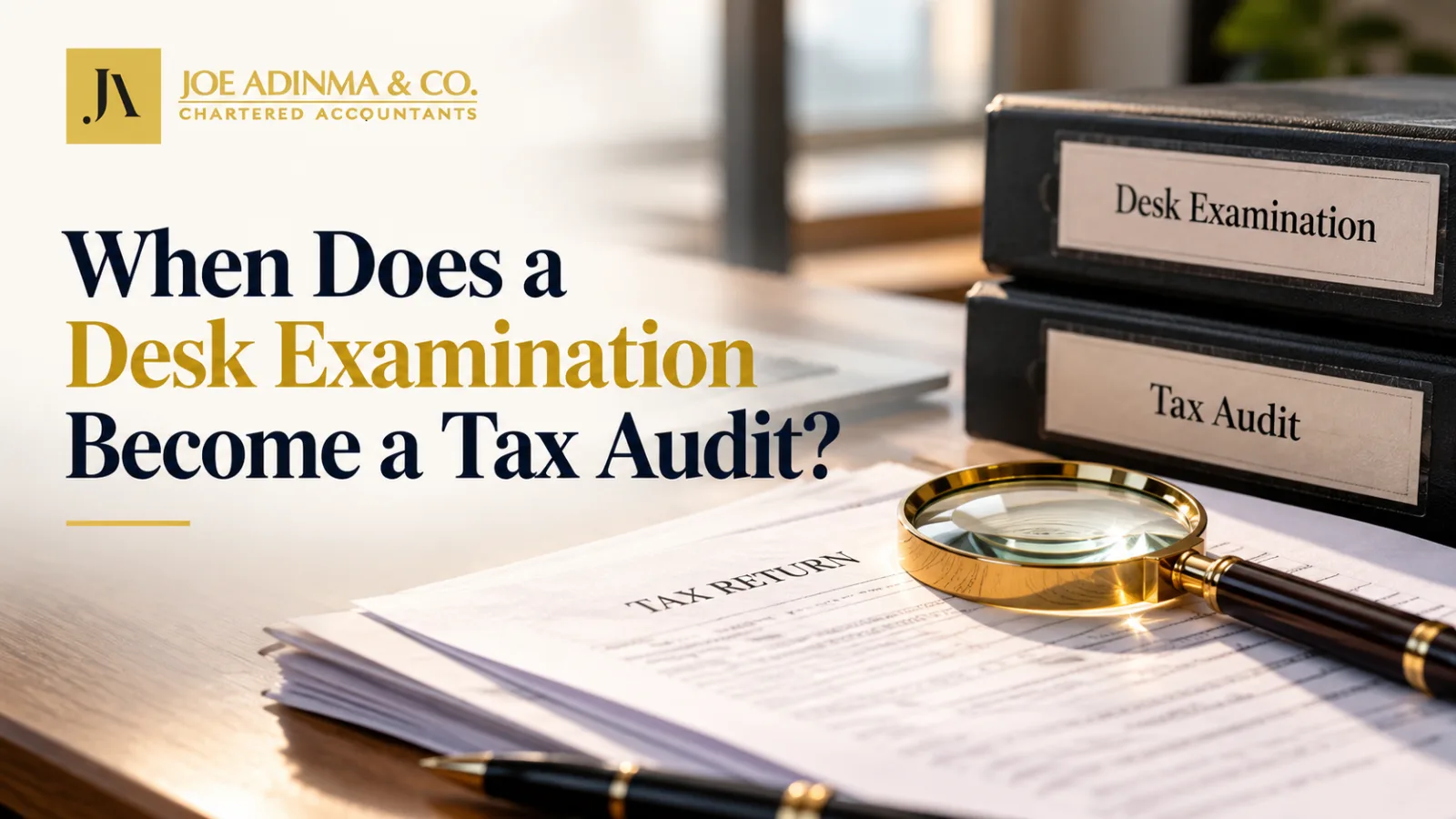
Desk Review | Remote review of your returns. No field visit. NRS sends letters requesting documents or clarification. | LOW | Respond clearly, promptly, and in writing. Do not over-explain. Answer what was asked. |
Field Audit | Officers visit your premises. They examine books, bank statements, contracts, payroll. Specific tax type and period. | MEDIUM | Engage a tax professional before Day 1 of the audit. Not during. Before. |
Tax Investigation | Triggered by suspected fraud, deliberate misstatement, or significant unexplained wealth. Criminal consequences possible. | CRITICAL | Say nothing until you have legal and professional representation. Nothing. |
The slide from a field audit into a tax investigation is a journey most businesses accelerate themselves — by being uncooperative, by producing documents that contradict each other, or by attempting to explain their way out of discrepancies that should never have existed. A field audit that is professionally managed rarely becomes an investigation. A field audit that is mishandled almost always does.
⚠ ️ IF THE ENGAGEMENT BECOMES A TAX INVESTIGATION |
Under the NTAA 2025, a tax investigation can lead to criminal prosecution and imprisonment of up to three years. Your accountant or tax adviser can be reported to their professional body (ICAN, CITN, or the NBA) for sanctions. The first and only rule: engage qualified professional representation before responding to anything. Not after. Before. The words you say in the first meeting cannot be unsaid. |
——— SECTION TWO ———
Why You? The Eight Reasons the NRS Is Looking at Your Business.
Here is something that will change how you think about tax compliance forever:
The NRS's Rev360 portal and its AI cross-referencing tools do not sleep, do not take leave, and do not need a tip-off. They run continuously — comparing your bank data against your VAT returns, your payroll records against your PAYE remittances, your WHT claims against your clients' deduction schedules. Every discrepancy is logged. Every anomaly is flagged. Every audit in 2026 Nigeria begins not when the letter arrives at your office — it begins weeks or months earlier, inside a server room, when an algorithm decides your numbers do not add up.
So the question is not 'why would the NRS look at me?' The question is: 'what has already been flagged, and do I know about it?'
Here are the eight most common triggers in the current enforcement environment:
1. Your bank credits do not match your declared revenue.
This is the most powerful tool the NRS has in 2026. Your bank reports your inflows. Your VAT return declares your taxable revenue. If those two figures are materially different — even after accounting for legitimate exclusions — the gap is flagged automatically. You will not receive a warning. You will receive a notice.
2. You filed late. Or not at all. Even once.
Automated systems flag habitual late filers and non-filers for closer scrutiny. A company that consistently files on time, pays on time, and communicates proactively is statistically less likely to attract audit attention. The NRS's resources are finite. They follow the signals.
3. Your VAT output is low relative to your sector peers.
The NRS benchmarks VAT output declarations against industry averages. A construction company declaring VAT output that implies a ₦300 million operation when its contracts suggest ₦2 billion in activity is not invisible. It is a priority.
4. Your WHT credits do not reconcile with your clients' filings.
Every company that deducts WHT from you files a schedule declaring what they deducted and from whom. The NRS cross-references that schedule against your own WHT credit claims. A mismatch of even ₦500,000 compounded across dozens of transactions is flagged. It adds up. And it lands on your desk.
5. You have declared losses for three or more consecutive years.
A business that is genuinely unprofitable for three years and still operating raises a legitimate question: how? If the answer is 'shareholder loans' or 'contract advances,' those need to be in your accounts. If the answer is 'we are not declaring everything,' the NRS's analytical tools will form that hypothesis independently.
6. Your related-party transactions are undisclosed or appear artificial.
Management fees paid to a director's personal company. Intercompany loans at non-commercial rates. Service contracts with affiliated businesses at prices that bear no relation to market rates. The NTAA 2025 empowers the NRS to disregard transactions it deems artificial and to assess tax on the economic substance of the arrangement. Undisclosed related-party transactions are both an audit trigger and an audit liability simultaneously.
7. Your e-invoicing is non-compliant but your VAT input claims continue.
As enforcement widens through 2026, the NRS's MBS platform creates a real-time record of validated invoices. If your VAT input credit claims reference invoices that do not appear in the MBS validation records, the discrepancy is traceable. Your supplier's non-compliance has now become your problem — and your flag.
8. Your sector has been selected for a compliance sweep.
Sometimes it is not about you at all. The NRS periodically selects entire sectors — oil and gas services, construction, professional services, real estate — for simultaneous review. Every business in the net gets examined. The ones that are prepared sail through. The ones that are not become case studies. In Port Harcourt, if you are in oil and gas services or a related sector, assume you are in the net.
——— SECTION THREE ———
The Document That Will Either Save You or Sink You.
When the NRS field audit team arrives at your office, they will sit down, open their briefcases, and ask for one thing first.
Not your bank statements. Not your contracts. Not your VAT schedules.
Your audited financial statements.
Under the NTAA 2025, every company filing a CIT return must attach IFRS-compliant audited accounts — prepared in accordance with International Financial Reporting Standards and signed by an ICAN-licensed auditor. Returns filed without them are treated as incomplete, which carries the same penalties as returns not filed at all. But that is the compliance angle. Let me tell you the practical angle.
Your audited financial statements are either the most powerful tool of defence you have, or the most catastrophic vulnerability the NRS will find. There is no middle ground.
"A set of financial statements that reconciles perfectly to your bank data, your VAT returns, your payroll records, and your WHT schedules is an auditor's worst nightmare — not because it hides anything, but because it leaves nothing to question. A set of statements that cannot be reconciled to anything is an auditor's best day of the year."
Five Things the NRS Reads in Your Accounts — That Your Accountant Probably Never Told You
1. Revenue vs VAT output — the first reconciliation test
The declared revenue in your income statement must be reconcilable — after legitimate exclusions — to the VAT output you declared across all twelve monthly VAT returns. An auditor does this calculation in the first fifteen minutes. If your income statement shows ₦850 million in revenue but your VAT returns for the same year imply ₦630 million in taxable sales, the ₦220 million gap needs an explanation. In writing. With documentation. Before they ask.
2. Payroll costs vs PAYE remittances
Your income statement shows total staff costs. Your PAYE remittances imply a salary bill. If those two figures are materially inconsistent, the auditor wants to know why. Owner-managed businesses that pay directors informally, that classify salary payments as 'management fees' to avoid PAYE, or that have staff on the payroll who are not actually employed present as a payroll discrepancy. Every one of those discrepancies is a separate liability.
3. Related-party transactions — disclosed or invisible?
IFRS requires disclosure of all related-party transactions in the notes to the financial statements. Every transaction between your company and any connected entity — director loans, management fees, intercompany services, shared costs — must appear. An auditor who finds a related-party transaction that is not disclosed does not assume it was an oversight. They assume it was intentional. The response to an undisclosed related-party transaction is a best-of-judgment assessment on the full value of the transaction at the highest applicable rate.
4. The quality of the notes to the accounts
Thin, generic, boilerplate notes to financial statements are a signal. They tell the auditor that the accounts were prepared quickly for compliance, not prepared carefully for accuracy. Notes that are specific, detailed, and internally consistent — accounting policies that match what the accounts actually do, disclosures that cross-reference to the primary statements, contingent liabilities that are honestly assessed — tell an auditor that this company is being managed professionally. That auditor moves faster and finds less.
5. The fixed asset register
An asset register that has not been reconciled to the balance sheet in three years. Assets that were disposed of but are still being depreciated. Assets that appear in the register but not in the accounts. These are not obscure technical issues — they are everyday realities in many Nigerian businesses. And they are one of the first things an experienced auditor looks for, because asset discrepancies often reveal cash flows that were never recorded.
I want to tell you a story. Not because it is unusual. Because it is ordinary.
PINNACLE RESOURCES LIMITED — THE COST OF DISORGANISATION |
Pinnacle Resources Limited is a Port Harcourt oil and gas services company with annual revenue of approximately ₦1.5 billion. Clean business. Legitimate contracts. No evasion. But their financial statements were prepared hurriedly every year — by a junior staff member in the weeks before the CIT filing deadline. They were not properly audited. The fixed asset register had not been reconciled since 2022. Related-party transactions with a sister company were not disclosed in the notes. The IFRS accounting policies were copied from a template and had not been updated in four years. When the NRS flagged a discrepancy between Pinnacle's VAT output and the payment records filed by their three largest clients, a field audit was initiated. The auditors could not rely on the financial statements as an accurate starting point. They had to reconstruct the company's financial position from raw records — bank statements, supplier invoices, employment contracts, fixed asset purchase receipts. The reconstruction took 18 months. The NRS issued a best-of-judgment additional assessment for ₦420 million covering four tax years. After an exhausting objection process and eventual settlement negotiation, Pinnacle paid ₦190 million — inclusive of penalties and interest. The legitimate tax liability for those same four years, had the accounts been properly prepared and filed, was approximately ₦68 million. The gap — ₦122 million — is the price of disorganisation. Not dishonesty. Disorganisation. Pinnacle Resources Limited is a fictional company. The ₦122 million gap is not. |
——— SECTION FOUR ———
Your Rights. Written Into Law. Almost Nobody Uses Them.
Here is what most Nigerian businesses do not know:
The NTAA 2025 is not only a tool of enforcement. It is also a framework of protection. It gives you specific, legally enforceable rights that the NRS is obligated to respect — and specific consequences for the NRS if they do not respect them. The problem is that most businesses never exercise these rights because they do not know they exist.
Right One: The Assessment Must Be Formally Served on You
Under Section 40 of the NTAA, every notice of assessment must be served in writing — by registered post, courier, or electronic means. It must state the amount charged, where payment should be made, and your rights. A phone call is not an assessment. A verbal threat by an NRS officer is not an assessment. Until you have received a formal written notice, there is nothing to respond to — and nothing that can become final and conclusive.
Right Two: You Have 30 Days to Object. Use Every One of Them.
Under Section 41 of the NTAA, you have 30 days from the date of a formal assessment notice to file a written Notice of Objection (NOO). This is the most critical deadline in Nigerian tax law. Not because 30 days is short — it is. But because missing it transforms even a completely incorrect assessment into a legally binding, enforceable debt. An assessment you did not object to within 30 days is not a dispute anymore. It is a payment you owe.
The NOO must contain: the specific grounds of objection; the exact monetary figures disputed; the amendment you are requesting; the amount of tax you admit, if any; and supporting documentation. A vague NOO — 'we disagree with the assessment' — is not a valid objection. It must be precise, factual, and evidenced.
Right Three: The NRS Has 90 Days to Respond. If They Miss It, You Win.
Once you file a valid Notice of Objection, the NRS has exactly 90 days to respond. Not 91. Not 95. Ninety days. If they fail to respond within that window, your objection is automatically upheld by operation of law — without any court order, without any further filing, without any negotiation. The silence of the NRS is a concession.
Diarise the 90th day from the moment you file your NOO. Track it. And if that day arrives without a response, do not wait passively. Document the silence formally and act on it with professional guidance.
"The 90-day NRS response window is one of the most powerful taxpayer protections in the NTAA 2025 — and one of the least known. A government agency that does not respond to your valid objection within 90 days has, by law, conceded the point. That concession does not enforce itself. You have to know it exists to use it."
Right Four: You Can Appeal to the Tax Appeal Tribunal (TAT)
If the NRS responds to your NOO but rejects it, you can appeal to the Tax Appeal Tribunal within 30 days of their decision. The TAT is a specialist adjudicatory body — it understands accounting, it understands tax law, and it is substantially faster and less expensive than the courts. Before the formal hearing begins, the TAT may allow up to 30 days for parties to explore amicable settlement. Many disputes resolve at this stage. Note: TAT decisions carry the force of Federal and State High Court judgments once registered.
Before you escalate to the TAT, consider one more option that the NTAA 2025 explicitly makes available and that most businesses never use: negotiated settlement. Section 141 of the NTAA 2025, titled 'Settlement of Dispute,' expressly provides for the amicable resolution of tax disputes. The law permits settlement where it is in the interest of public revenue or public policy; where the cost of litigation is disproportionate to the possible benefits; and where settlement will facilitate disclosure of tax planning and evasion schemes that lead to significant tax recovery. Settlement is not available where intentional evasion or fraud has been established, or where judicial clarification is needed in the public interest. Critically, under Section 141(5), a settlement agreement duly endorsed by both parties is a final and binding decision — enforceable by the NRS as a tax debt. In plain terms: a business disputing a ₦200 million assessment that engages professionally and constructively may resolve the matter at ₦60 million within four months under Section 141. The same business that files at the TAT and fights to the Federal High Court may resolve it at ₦80 million in three years — with interest compounding throughout. Settlement is not surrender. It is strategy. And it is only available to businesses that have the records, the documentation, and the professional representation to negotiate from a position of credibility.
Right Five: The Tax Ombud Is Not the Same as the TAT — Know When to Use Each
This is where significant confusion exists — and it is important to get it right.
The Tax Appeal Tribunal and the Office of the Tax Ombud are parallel institutions with fundamentally different mandates. The TAT adjudicates the substance of a tax dispute — is the assessment correct in law and fact? The Tax Ombud investigates administrative conduct — has the NRS treated you fairly, acted within its powers, responded within required timelines, or abused its authority?
⚠ ️ TAT vs TAX OMBUD — THE DISTINCTION THAT MATTERS |
USE THE TAT: When you are disputing the correctness of a tax assessment — the amount, the legal basis, the methodology, or the interpretation of the law. The TAT can determine liability, adjudicate your objection, and issue binding decisions. USE THE TAX OMBUD: When you have a complaint about HOW the NRS has treated you — unreasonable delay, failure to respond within the 90-day window, oppressive conduct by NRS officers, denial of your right to see the basis of assessment, or any procedural unfairness. The Ombud cannot determine tax liability. Its recommendations are persuasive but not legally binding in the same way as a TAT judgment. CAN YOU USE BOTH? Yes — and in some situations you should. If the NRS has both raised an incorrect assessment AND behaved oppressively in doing so, you file your NOO (leading to TAT), AND you lodge a complaint with the Tax Ombud about the conduct simultaneously. The Ombud is however prohibited from reviewing matters that are already sub judice before the TAT or courts. The Ombud is not a step on the way to the TAT. It is a parallel protection, available when the TAT's subject matter — the correctness of the assessment — is not the issue. The issue is how the NRS has behaved. |
Right Six: Further Appeal — Federal High Court, Court of Appeal, Supreme Court
Appeals from the TAT on points of law lie to the Federal High Court, then the Court of Appeal, and finally the Supreme Court. Before the Federal High Court will hear you, you must deposit 20% of the disputed tax amount into a designated account as security — intended to discourage frivolous appeals but a significant barrier for large assessments.
⚠ ️ THE 20% DEPOSIT — FACTOR THIS INTO YOUR STRATEGY FROM DAY ONE |
Appealing a TAT decision to the Federal High Court requires a 20% deposit of the disputed tax amount. On a ₦200 million dispute, that is ₦40 million deposited before a judge will hear your case. This is not a fine. It is a security deposit. But it must be factored into your dispute strategy from the moment you receive the original assessment — because by the time you reach the High Court, two years and ₦40 million may be the cost of a point of law that a well-prepared objection and TAT appeal would have res olved in six months. |
Right Seven: Instalment Payment — Not Everything Is Due Immediately
If you have a genuine tax liability and cannot settle it in a single payment, the NTAA 2025 provides for instalment arrangements. Apply proactively — before the assessment becomes final and before enforcement begins. An NRS that is engaged constructively is significantly less likely to escalate to distraint and asset seizure than one that is ignored.
——— SECTION FIVE ———
The Preparation That Changes Everything — Before the Letter Arrives
The businesses that sail through NRS audits share one characteristic: they treat audit readiness as a permanent state of affairs, not a crisis response. The file is always current. The reconciliation is always done. The accountant always knows where every number came from.
Here is the twelve-point checklist of what audit readiness looks like in practice:
1. Audited IFRS-compliant financial statements for the last 6 years — signed by an ICAN-registered auditor and filed with every annual CIT return. Not management accounts. Not tax-basis accounts. IFRS-compliant audited accounts.
2. A detailed tax computation schedule for each year — showing exactly how taxable profit was derived from accounting profit, with every adjustment clearly documented and cross-referenced to the accounts.
3. Filed returns for every tax type and every period in the last 6 years — CIT, VAT, WHT, PAYE. Nil returns included. Under Section 31 of the NTAA, records must be maintained for a minimum of 6 years. If fraud or false statement is ever established, there is no time limit.
4. Bank statements reconciled to the books of account — for the current and preceding 3 years at minimum. Every significant credit explained. Every significant debit traced.
5. A complete, current, reconciled fixed asset register — acquisition dates, costs, depreciation rates, disposals — reconciled to the balance sheet. Not the register from 2019 that nobody has updated.
6. All material contracts and purchase orders — particularly those above ₦10 million. Contracts without documentation are vulnerable to disallowance as expenses on the ground that they cannot be verified as genuine business expenditure.
7. WHT credit notes received — filed, numbered, matched to the WHT credits claimed in your returns. A credit note you cannot produce is a credit you cannot claim.
8. Related-party transaction schedules — complete disclosure of every transaction with connected parties, priced at arm's length and documented with supporting evidence of the commercial rationale.
9. E-invoicing validation records — from the NRS Merchant Buyer Solution platform — for all applicable periods. Paper invoices without MBS validation will not support VAT input credit claims under audit.
10. Payroll records — monthly payslips, PAYE computation schedules, and the employer's annual PAYE return filed by 31 January each year. Both employer and employee annual returns are now required under the NTAA 2025.
11. A Tax Risk Register — maintained by your accountant — documenting your position on every material tax exposure and the legal and factual basis for each position. Not a spreadsheet of liabilities. A written, reasoned record of your compliance posture.
12. Professional representation on standby — a qualified, accredited tax practitioner who knows your business and who will manage all written and verbal communications with the NRS from Day 1 of any engagement.
There is one more item on this checklist. It does not have a number because it should be obvious — and yet it catches businesses out every year.
Under the NTAA 2025, annual CIT returns must be prepared and submitted by an accredited tax practitioner. Returns filed by unaccredited persons are legally treated as not having been filed — which means your company is in default even if the return was submitted on time. Check the accreditation status of whoever is filing your returns.
——— CLOSING THOUGHT ———
The NRS Will Come. The Only Question Is How Ready You Are.
I want to leave you with something specific.
Under the NTAA 2025, the NRS has a 6-year statute of limitations for raising additional assessments. In plain language: they can go back six years into your financial history. If your records are clean, reconciled, and professionally audited for those six years, that 6-year window is a comfort — there is nothing to find. If your records are patchy, inconsistent, or professionally indefensible, that 6-year window is a different thing entirely.
And if fraud or false statement is ever established — at any level, for any year — there is no time limit. None. The NRS can reach back indefinitely.
I am not writing this to frighten you. I am writing this because the Nigerian businesses that understand these rules — that treat their financial statements as the living, breathing record of a well-run operation rather than an annual compliance chore — are the businesses that grow confidently, borrow on better terms, win larger contracts, and survive economic downturns that destroy their less-organised competitors.
An NRS audit is the tax system doing its job. A business that is genuinely prepared for one does not dread it. It is proof that the records are clean, the accounts are honest, and the business is run properly.
That business has nothing to worry about on Monday morning.
"The difference between a business that fears the NRS and one that does not is not the size of their tax liability. It is the quality of their records. Build the records first. Everything else follows."
If you have read this article and recognised your own business in more than one of the risk factors described — the bank discrepancies, the undisclosed related-party transactions, the financial statements that were prepared in a hurry, the fixed asset register nobody has touched in three years — do not treat that recognition as a reason for alarm.
Treat it as an instruction.
The starting point for most businesses is a conversation with a qualified chartered accountant who understands the current enforcement environment, your sector, and the specific provisions of the NTAA 2025 that apply to your situation. That conversation costs far less than the alternative.
SOURCES & REFERENCES
• Nigeria Tax Administration Act, 2025 (NTAA 2025) — Sections 31, 34–43, 57–58, 61, 101
• Joint Revenue Board (Establishment) Act, 2025 (JRBA 2025) — Sections 23, 29, 41, 49 (Tax Appeal Tribunal; Office of the Tax Ombud)
• PwC Nigeria: Nigeria — Corporate Tax Administration (taxsummaries.pwc.com, May 2026)
• Banwo & Ighodalo: Nigeria's New Tax Regime — Compliance, Enforcement and Dispute Resolution (December 2025)
• Mondaq/Tunde & Adisa: Policy Analysis of the 2025 Tax Reform Acts Pt.2 — The NTAA 2025 (October 2025)
• Mondaq/Tunde & Adisa: Policy Analysis Pt.3 — NRSA and JRBA 2025 (September 2025)
• BusinessDay Nigeria: The Future of Tax Dispute Resolution in Nigeria — Part I (December 2025)
• TechCabal: Under Nigeria's New Tax Law, You Have 30 Days to Object or Pay (January 2026)
• Andersen Nigeria: From Tax Appeal Tribunal to Tax Ombud — Old Wine in New Bottle? (June 2025)
• AP Professional Services: Tax Ombudsman vs Tax Appeal Tribunal vs NRS — What's the Difference? (November 2025)
• Office of the Tax Ombud, Nigeria — Official Website: taxombud.gov.ng (accessed July 2026)
• TaxNGR: How to File Annual Tax Returns on the NRS Self-Service Portal (March 2026)
About the Author
Joe Adinma FCA, FCTI
Joe Adinma is the Managing Partner of Joe Adinma & Co. (Chartered Accountants), based in Port Harcourt, Rivers State. With over 30 years of professional practice, he specialises in IFRS financial reporting, Nigerian tax compliance, NRS audit defence, forensic accounting, and audit and assurance for businesses across the oil and gas, energy, real estate, and professional services sectors. He qualified as a Chartered Accountant in 1996 and established the firm in 2010.
www.joeadinma.com | info@joeadinma.com | Port Harcourt, Rivers State
This article is part of the Joe Adinma & Co. Business Intelligence Series. It is provided for general informational purposes only and does not constitute professional tax or legal advice. Specific advice should be obtained for your individual circumstances.