₦450m Profit. ₦310m Short. Revised ISA 570 Wants to Know Which Number Is Real.
Published October 23, 2026

A profitable company can still be going broke. What the new going-concern audit standard means for Nigerian directors, finance chiefs and auditors
By Joe Adinma, FCA, FCTI — Managing Partner, Joe Adinma & Co. (Chartered Accountants) | 23 October 2026
A Port Harcourt oilfield-services supplier has completed a major contract. Its invoices are awaiting certification. The finance director presents ₦450 million in profit before tax. Yet the bank wants ₦600 million repaid in June, the largest customer has not paid, and payroll falls due every month. Which number should the board trust?
Let that one customer’s payment slip past June and the same company runs ₦310 million short in the month the loan falls due. Both numbers matter, but neither answers the going-concern question on its own. Directors need evidence that the business can meet its obligations on time, and auditors need sufficient appropriate evidence to evaluate management’s assessment. The revised International Standard on Auditing (ISA) 570, Going Concern, makes that evaluation more explicit and more demanding.
The 2027 change: an audit standard, not a guarantee of survival
On 9 April 2025, the International Auditing and Assurance Standards Board (IAASB) issued ISA 570 (Revised 2024), referred to here as revised ISA 570. It is effective for audits of financial statements for periods beginning on or after 15 December 2026. For an entity with a 31 December year-end, the first audit ordinarily affected is that of its 2027 financial statements—not 2026. The IAASB has encouraged jurisdictions to consider adopting revised ISA 570 early, together with its companion fraud standard, ISA 240 (Revised). Nigerian auditors should confirm the local position before doing so. [1, 5]
The revised standard requires auditors to evaluate management’s assessment whether or not they have identified events or conditions that may cast significant doubt on going concern. Auditors must consider potential management bias and evaluate the method, significant assumptions and data underlying management’s assessment. The standard also reinforces timely risk assessment, communication with those charged with governance (typically the board and its audit committee) and transparency in reporting. [1, 2]
Why IFRS 18 and revised ISA 570 meet in 2027
For calendar-year companies reporting under International Financial Reporting Standards (IFRS), 2027 is also the first mandatory year for IFRS 18, Presentation and Disclosure in Financial Statements. IFRS 18 replaces International Accounting Standard (IAS) 1, Presentation of Financial Statements. As part of that change, the International Accounting Standards Board (IASB) transferred the existing going-concern requirements from IAS 1 into IAS 8, now retitled Basis of Preparation of Financial Statements. The transfer did not itself introduce a new going-concern test for management. [3, 4]
The split of roles is simple. Management decides whether the going-concern basis still holds and what must be disclosed—now under IAS 8. The auditor tests that decision under revised ISA 570, which does not shift responsibility for liquidity planning from management to the auditor.
Management’s assessment must look at least 12 months ahead from the reporting date; the auditor’s evaluation must reach at least 12 months beyond the date the financial statements are approved. The reference dates differ, and the difference matters. [1, 3]
For a 31 December 2027 reporting date and approval on 31 March 2028, the auditor’s evaluation needs to extend at least to 31 March 2029. A forecast ending in December 2028 would leave a gap. The board should commission a sufficiently long, credible forecast rather than treat the minimum management assessment period as a ceiling.
Delta Industrial Services: the ₦450 million profit problem
Consider Delta Industrial Services Ltd, a fictional Niger Delta supplier providing hoses, fabrication and maintenance support to oilfield operators. Its 31 December 2027 draft accounts and subsequent events reveal the following:
Indicator | Illustrative position | Why it matters |
Profit before tax | ₦450m | Not the same as available cash |
Trade receivables | ₦1.2bn | Collection timing is uncertain |
Receivables >120 days overdue | ₦520m | Raises IFRS 9 (Financial Instruments) impairment and liquidity questions |
Loan principal due June 2028 | ₦600m | A current liability at 31 December 2027 |
Cash at 31 December 2027 | ₦95m | Limited liquidity buffer |
Expected accounts approval | 31 March 2028 | Auditor evaluation to at least 31 March 2029 |
The overdue ₦520 million creates two separate risks. Under IFRS 9, Financial Instruments, the company must measure expected credit losses on its receivables using the applicable impairment approach. Depending on the loss allowance already recognised and the evidence about recoverability, reported profit may be overstated.
Even where the balance is ultimately collectible, it may arrive too late to settle the June loan. An expected credit loss is not a cash-flow forecast, and a cash-flow forecast is not a substitute for IFRS 9 measurement.
At 31 December 2027, the ₦600 million loan due in June 2028 would normally sit in current liabilities, because it falls due within 12 months—unless, at the reporting date, Delta already had a right to defer settlement. A refinancing conversation after year-end does not create that right. Classification and going concern are connected, but they are different assessments.
Build the forecast around cash, not optimism
The finance team should model monthly opening balances, receipts by customer and contract, supplier payments, wages, interest, debt maturities, capital expenditure and statutory remittances. Forecast tax cash flows should include realistic Companies Income Tax (CIT) instalments or settlements, any applicable Development Levy under the Nigeria Tax Act 2025, and the timing of withholding tax (WHT) credits. WHT already deducted from customer payments is generally a cash-receipt reduction and potentially a credit against CIT with the Nigeria Revenue Service (NRS); it should not be double-counted as a fresh expense or an additional cash payment.
In Delta’s case, management expects a large receivable to be certified in April. The board should demand the underlying certification trail, subsequent receipts, customer correspondence and historical collection patterns. An invoice awaiting certification in a client’s in-tray at Onne pays no salaries. A management forecast that assumes full settlement on a date unsupported by evidence is a scenario—not a fact.
The following three scenarios are deliberately simplified. They show month-end cash balances in ₦ millions after operating cash flows, tax and financing payments; they are not an actual client forecast.
Scenario | Lowest projected closing cash | Month |
Base case | ₦45 million | June 2028 |
Downside | ₦310 million deficit | June 2028 |
Mitigated | ₦35 million | June 2028 |
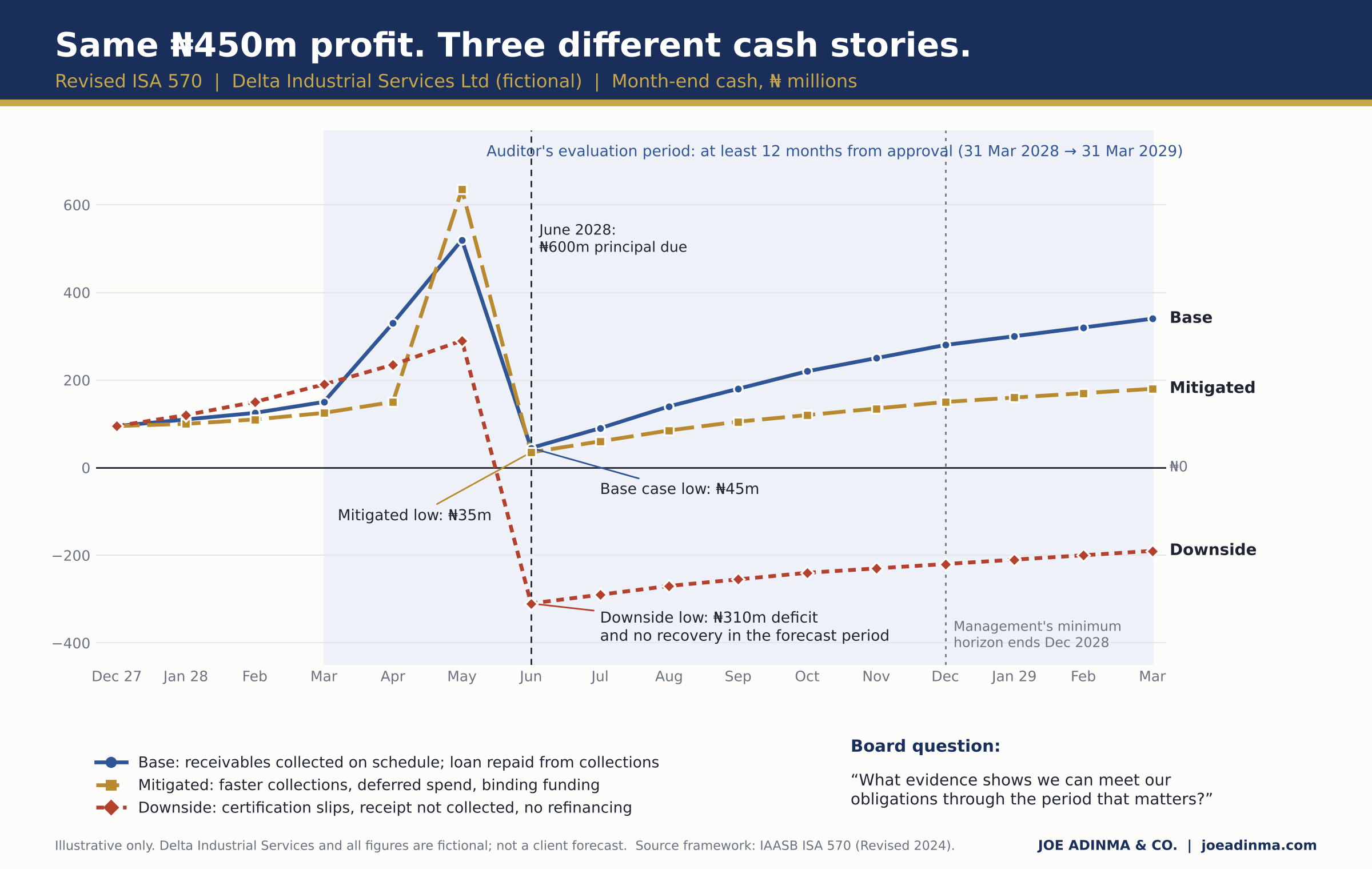
Figure: Delta’s three cash paths across the auditor’s evaluation period (illustrative).
The base case assumes customers pay broadly on schedule and the loan is repaid from those collections. In the downside scenario, the April certification slips, that receipt never arrives in the forecast window and no refinancing is secured; cash turns negative at the June maturity and stays negative to March 2029. The mitigated scenario assumes an evidenced combination of faster collections, deferred non-essential spending and a binding funding arrangement before the repayment date. The precise mitigating actions must be documented; neither the table nor the chart proves that such support exists.
The Nigerian layer: the people who sign are on the hook too
In Nigeria, the going-concern judgement does not stop at the auditor’s desk. Under the Companies and Allied Matters Act 2020 (CAMA), the directors must prepare financial statements for each year (section 377), and the board must approve them, with two authorised directors signing on its behalf (section 386). [6, 7]
For every company other than a small company, section 405 adds a personal layer. The chief executive officer (CEO) and chief financial officer (CFO) must certify that they have reviewed the statements, that to their knowledge they contain no untrue material statement or material omission, and that they fairly present the company’s financial condition and results in all material respects. The same certification covers the effectiveness of internal controls, and failure to discharge that duty is an offence. [6]
The Financial Reporting Council of Nigeria (FRC) adds a further requirement: under FRC Rule 1, the CEO and CFO certification must carry each officer’s individual FRC registration number. [7]
Put that beside revised ISA 570. Fair presentation includes the basis on which the statements are prepared and the disclosures that basis requires. If Delta’s accounts adopt the going-concern basis without disclosing a material uncertainty that the evidence supports, the officers who signed have certified that judgement too. An unsupported going-concern conclusion is not only an audit finding; it is a certification problem.
For public companies, CAMA section 404(7) gives the audit committee the duty to review the scope and planning of the audit and to keep the effectiveness of the accounting and internal control system under review. That makes the audit committee’s planning meeting the natural first checkpoint.
At that meeting, the committee should ask the auditor how management’s forecast horizon will be assessed, which assumptions need external corroboration, how downside scenarios and post-year-end receipts will be tested, and what could change the going-concern reporting—and set a timetable for any unresolved financing or covenant evidence. [6]
Five questions the board should insist on answering
1. Are receivables both collectible and collectible on time?
Reconcile aged balances to subsequent cash receipts, disputes, certification milestones and the IFRS 9 expected-credit-loss allowance.
2. What must be paid—and when?
Map facility maturities, interest, covenants, payroll, suppliers, capital expenditure and tax settlements month by month.
3. Which assumptions are independently supportable?
Challenge projected margins, exchange rates, inflation, customer payments, new contracts and financing renewals against objective evidence.
4. What happens when the plan fails?
Stress-test late customer receipts, contract losses, higher borrowing costs and unavailable refinancing; quantify the lowest cash point.
5. Are rescue measures actionable?
Verify approvals, binding commitments, counterparty capacity, timelines and restrictions on asset sales or shareholder support.
What will the auditor’s report actually say?
The revised reporting model is more explicit than a generic statement that the auditor has considered going concern. Where the going-concern basis is appropriate and no material uncertainty has been identified, the auditor’s report includes a separate Going Concern section with the prescribed conclusions and a reminder that the conclusion is not a guarantee of future viability. Where a material uncertainty exists and disclosure is adequate, a Material Uncertainty Related to Going Concern section is required. Inadequate disclosure or an inappropriate accounting basis can lead to modified opinions, depending on the circumstances. [1, 2]
For listed entities (such as companies quoted on the Nigerian Exchange), additional entity-specific reporting about how the auditor evaluated management’s assessment is required in specified circumstances—for example, when significant judgements are involved or a material uncertainty exists. That narrative is not boilerplate: its wording and placement depend on the standard’s reporting provisions and the facts of each audit. [1, 2]
An unmodified opinion is not a certificate that Delta will survive. Conversely, a material-uncertainty paragraph is not a prediction that Delta will fail. The distinction matters for boards, lenders and investors who may otherwise misunderstand audit reporting.
The related fraud question: ISA 240 also changes
ISA 240 (Revised), the auditor’s fraud standard, takes effect on the same date: audits of financial statements for periods beginning on or after 15 December 2026. That does not make a weak cash forecast evidence of fraud. But unexplained optimism, contradictory debtor evidence, unusual journal entries or unsupported management representations can create fraud-risk considerations requiring a separate audit response. The going-concern and fraud standards should be implemented together without confusing their objectives. [5]
BOARD TAKEAWAY |
The question that the ₦450 million cannot answer
So which number is real? Both—but only one of them decides whether Delta can pay the bank in June.
Delta’s ₦450 million profit may be accurate, overstated because of expected credit losses, or perfectly valid yet irrelevant to the timing of a ₦600 million loan repayment. The directors cannot decide which without examining the underlying evidence.
Revised ISA 570 does not eliminate business risk. It makes it harder to confuse a hopeful forecast with a supported conclusion. In Port Harcourt, where one delayed contract certification can change a supplier’s cash position overnight, that is not an abstract audit reform.
How we sourced this analysis
[1] IAASB, ISA 570 (Revised 2024), Going Concern, issued 9 April 2025. [2] IAASB, Frequently Asked Questions (FAQ): Reporting Going Concern Matters in the Auditor’s Report, 15 May 2025. [3] IFRS Foundation, IAS 8 Basis of Preparation of Financial Statements. [4] IFRS Foundation, IFRS 18 Presentation and Disclosure in Financial Statements. [5] IAASB, ISA 240 (Revised), The Auditor’s Responsibilities Relating to Fraud in an Audit of Financial Statements, published 8 July 2025. [6] Companies and Allied Matters Act 2020, sections 377, 386, 404 and 405. [7] Financial Reporting Council of Nigeria, Directorate of Inspection and Monitoring, Getting Financial Statement Certification Right: A Practical Guide for Nigerian Companies (2026).
At the time of writing, we had not identified a separate FRC pronouncement specifically addressing implementation of revised ISA 570. The international effective date should not be confused with a separately confirmed Nigerian implementation directive. CAMA section references were checked against a published text of CAMA 2020, independent copies of the Act’s table of contents, legal commentary and the FRC’s certification guide, which cites the same sections. All Delta figures and scenarios are fictional.
[1] ISA 570 (Revised 2024), Going Concern — IAASB
[2] Frequently Asked Questions: Reporting Going Concern Matters in the Auditor’s Report — IAASB
[3] IAS 8 Basis of Preparation of Financial Statements — IFRS Foundation
[4] IFRS 18 Presentation and Disclosure in Financial Statements — IFRS Foundation
[6] Companies and Allied Matters Act 2020 — official gazetted text (print)
[7] Getting Financial Statement Certification Right — Financial Reporting Council of Nigeria
Related reading: IFRS 18: The 2027 Standard That Is Already a 2026 Problem; Receivables on the Balance Sheet Look Like Money. IFRS 9 Says: Prove It.; My Sales Are Up. My Profits Look Great. So Where Is My Money?; The Cash Is Already Inside Your Business; Borrowing at 30%+.
This article is general information, not professional advice on any specific entity’s circumstances.