
Inside the Rev360 Breakdown That Blindsided Nigeria's CIT Filing Season — and Why Digital Tax Compliance Now Depends on the Evidence You Keep
By Joe Adinma, FCA, FCTI — Managing Partner, Joe Adinma & Co. (Chartered Accountants)
Last updated: 15 September 2026 — as at this date, we have not identified any publicly available NRS announcement granting the extension or general penalty waiver LCCI requested for taxpayers affected by the 30 June outage.
At around 4 a.m. on 30 June 2026, a taxpayer named Monsuru Olurebi logged onto Rev360, the Nigeria Revenue Service's new tax platform, to file before that day's statutory Company Income Tax (CIT) deadline. He ran his office generator for more than six hours. “I couldn't achieve anything,” he posted publicly afterward. He was not alone.
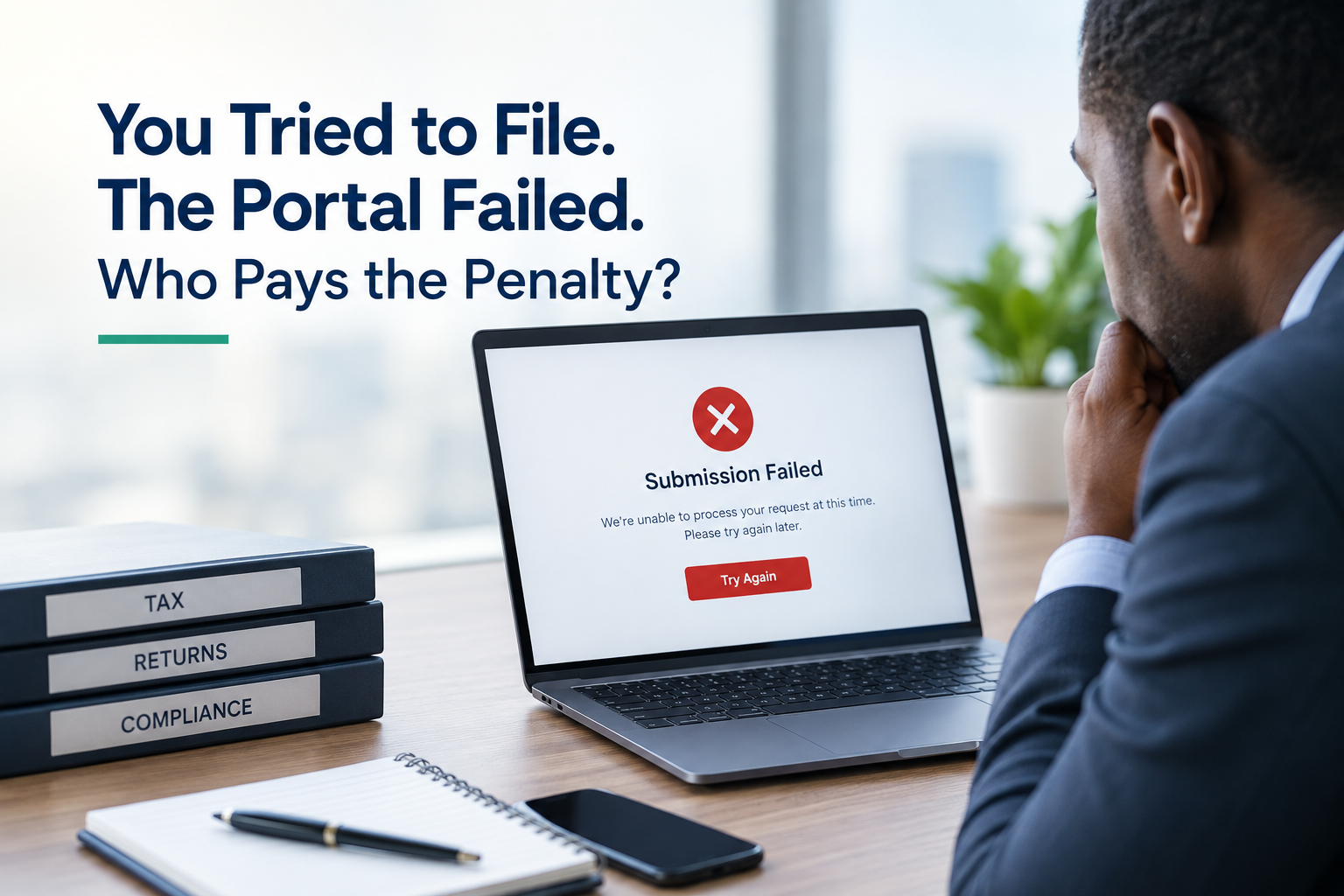
Across the country, tax professionals spent the final, frantic hours of the 2026 CIT season watching login failures, validation errors, failed uploads and timeouts stand between many taxpayers and a statutory deadline carrying automatic administrative consequences — raising an uncomfortable question for every business that had been ready and had genuinely attempted to comply. “This is not how world-class platforms work,” one Lagos tax consultant posted publicly as the clock ran out. “Who pays the interest and penalties by close of business today?”
Six weeks earlier, that question would have sounded rhetorical. On 30 June 2026, it became the central compliance question of the season.
The Thesis
In a digital tax system, it is no longer enough to be compliant. When the platform fails, you may also have to prove that you tried to comply.
What Happened on 30 June
Rev360 went live on 30 April 2026 as the centrepiece of NRS's “Tax Administration 3.0” programme, replacing TaxPro Max as the single portal for taxpayer registration, filing, payment, audit management, objections and tax clearance certificates. The 30 June CIT deadline — the first nationwide filing rush the new platform had to withstand, two months after go-live — became its first real stress test, and by the Lagos Chamber of Commerce and Industry's (LCCI) account, the platform failed it.
In a same-day press statement, LCCI Director-General Dr Chinyere Almona described a portal that “suffered prolonged downtime on June 30 — the statutory CIT filing deadline, leaving thousands of companies unable to file with hours to spare,” attributing the collapse to “a predictable last-minute volume” that “exposed its lack of capacity, producing login failures, validation errors, and failed submissions precisely when businesses needed reliability most.”
“This is a platform failure, not a taxpayer failure.”
— Dr Chinyere Almona, Director-General, Lagos Chamber of Commerce and Industry, press statement, 30 June 2026
LCCI's demand to NRS was direct and threefold: extend the CIT filing deadline by one month; waive all penalties for companies that attempted to file on or before 30 June but were blocked by the outage; and urgently stabilise Rev360's capacity before the next filing deadline arrived. At the time of FIJ's 4 July 2026 investigative report, NRS had announced neither an extension nor a waiver. As at 15 September 2026, we have not identified any publicly available NRS announcement granting the requested extension or a general penalty waiver for taxpayers affected by the 30 June outage. The safer working assumption for any business holding evidence of a blocked attempt: treat the statutory penalty as live and running unless you are holding a written NRS confirmation that says otherwise. An unannounced, undocumented assumption of leniency is not a compliance position — it is a gamble, and one that adds another ₦50,000 for each subsequent month the filing default continues.
Figure 1: The Rev360 compliance pathway — how an outage becomes exposure, and the four-step way back out.
The Uncomfortable Legal Answer
As reported, Section 101 of the Nigeria Tax Administration Act, 2025 imposes an administrative penalty of ₦100,000 for the first month a taxable person fails or refuses to file a return, and ₦50,000 for every subsequent month the default continues. The provision does not distinguish between a company that never attempted to file and one that tried repeatedly, from 4 a.m., against a portal that would not respond. Section 101 contains no express exception for portal failure. Unless relief is granted, the statutory exposure therefore remains.
So Who Pays the Penalty?
In the first instance, the taxpayer remains exposed. The fact that Rev360 failed does not, by itself, erase the statutory filing deadline or automatically cancel a late-filing penalty.
Where the failure is properly documented, the taxpayer may have a strong case for remission — but Section 66 relief is discretionary, not automatic. That is the uncomfortable answer: a taxpayer can be prevented from complying by the tax authority's own platform, and still have to prove why the resulting penalty should not stand.
Not Every Failed Filing Is a Rev360 Failure
It would be a mistake to read every failed submission in this period as proof of a platform-wide outage. Consider three taxpayers on 30 June 2026:
Company A begins filing at 11:50 p.m. and discovers its balance sheet doesn't reconcile with Rev360's template.
Company B attempts to file at noon, but its own office internet connection fails.
Company C spends the day repeatedly submitting a properly prepared return, only for Rev360 to return server errors during the widely reported disruption affecting taxpayers across the country.
Only the third case sits squarely inside the breakdown LCCI described. The first two are taxpayer-side problems that can look, from the outside, exactly like a platform failure — and treating them as equivalent weakens the case for every business that genuinely was blocked.
Rev360's CIT filing runs through an offline Excel template: figures are entered, formulas auto-calculate tax liability, and the template carries hard validation checks before it can even be uploaded. As tax counsel Lily Faluyi has described it, the template includes a Statement of Financial Position check where “total assets must equal total equity plus liabilities. If your balance sheet doesn't balance, the system will tell you.” A progress bar must read 100% before submission is accepted; an incomplete upload, an unreconciled figure, or audited financials that aren't packaged the way the system expects will all be rejected — correctly — whether or not Rev360 itself is having a good day. “The platform isn't more demanding than the law was,” as Faluyi puts it. “It just enforces what the law already required, more visibly.”
A credible Section 66 case, in other words, rests on more than the word “Rev360” in a remission letter. It should ideally show: a prepared return, a timely attempt, genuine taxpayer readiness, a portal-side failure, contemporaneous evidence of that failure, and a prompt subsequent filing once the platform allowed it.
What Section 66 Actually Gives You
The Act does not leave the taxpayer without a remedy. Section 66 (Remission of Penalty) gives the relevant tax authority discretion to remit all or part of a penalty or interest where good cause is shown. A contemporaneously documented, system-wide outage would, in our view, provide a strong factual basis for seeking that relief — but remission is not automatic. Section 66 says the authority “may” remit, not that it “shall.” The discretion belongs to the tax authority — and that distinction should shape how a remission request is built and argued, not just what it asks for.
Build the Evidence Before You Need the Argument
Not all evidence carries the same weight when a remission request is being assessed. A well-built case leads with what's hardest to dispute.
Evidence | Evidential Strength |
Screen recording of a repeated submission failure | Very strong |
NRS helpdesk ticket or complaint reference created before the deadline | Very strong |
Email to NRS before the deadline, describing the attempt and attaching errors | Very strong |
Rev360 error screenshot showing date, time and error code | Strong |
Trade or professional body confirmation of the same outage (e.g. LCCI's statement) | Strong corroboration |
Browser or session records of the failed attempt | Supporting |
Internal email simply noting “the portal isn't working” | Supporting |
Screenshot taken after the deadline had already passed | Weaker |
An oral account that “we tried several times”, with nothing preserved | Weak |
A screenshot will not change the statutory deadline.
But when the system fails, the evidence you preserve today may determine whether you can defend the penalty tomorrow.
Case Study: Two Taxpayers, Same Outage, Very Different Cases
The following examples are hypothetical, built to illustrate the practical difference documentation makes — not a description of any actual client or matter.
ABC Manufacturing Ltd — the strong case
ABC's CIT return is due 30 June. Its audited accounts and computation are ready on 27 June. The company attempts filing at 10:14 a.m., 1:42 p.m. and 4:08 p.m. on 30 June; each attempt produces a Rev360 validation or server error. The finance manager screenshots each error, records the screen, emails NRS at 4:25 p.m. describing the failed attempts, and receives a complaint reference. The company successfully files on 1 July once the portal becomes accessible.
If a Section 101 penalty later appears, ABC doesn't merely say “Rev360 was down.” It can show that it was ready, that it attempted compliance before the deadline, that the platform prevented submission, that it notified NRS contemporaneously, and that it completed filing at the earliest practicable opportunity.
That is the difference between an excuse and an evidential record.
XYZ Traders Ltd — the weak case
XYZ Traders opens Rev360 for the first time at 11:52 p.m. on 30 June. Its accounts are not yet fully reconciled, its Excel template returns a balance-sheet validation error, and by the time anyone tries again, the deadline has passed. The next day, XYZ's finance team tells NRS the portal “wasn't working.” There is no screenshot, no timestamp, no complaint reference, and no way to show whether the company had a filing-ready return in the first place.
ABC presents the kind of fact pattern on which a Section 66 remission request can be credibly built. XYZ does not — and an NRS official reviewing a remission request has no way to tell the two apart except by the evidence attached to it.
Rev360 Is Now a Governance Risk, Not Just an IT Problem
It is tempting to read the 30 June breakdown as a single bad day for a new platform. The underlying exposure is structural, not seasonal. CIT falls due six months after each company's own financial year-end — so while 30 June caught December year-end filers, companies with March, June or September year-ends meet their own Rev360 deadline every month of the calendar. VAT returns are due on the 21st of every month; withholding tax remittances follow a similarly tight monthly cycle. Registration, filing, payment, audit management and objections now all run through the same platform that could not handle one nationwide filing rush in its first two months of operation. LCCI's own statement made the point explicitly, asking NRS to “urgently stabilize Rev360's capacity before the next filing deadline.”
The more of tax administration that moves onto a single piece of digital infrastructure, the more that infrastructure's resilience becomes part of every taxpayer's compliance risk — not a background IT concern for NRS alone to manage, but a governance question every finance function should be asking about its own filing calendar.
For boards and finance leaders, the lesson is larger than Rev360. Once statutory compliance depends on a government-controlled digital gateway, evidence of attempted compliance becomes part of the company's tax control framework. Filing calendars, escalation procedures, portal-error documentation and responsibility for preserving digital evidence should therefore form part of the organisation's documented tax governance controls.
None of this means Rev360 is a bad reform. A properly functioning integrated tax platform should ultimately reduce friction, improve transparency and make compliance easier, and much of what it now enforces — reconciled balance sheets, complete disclosures, an auditable trail — is a genuine improvement on what a paper-based or fragmented system allowed to slide. Nor does a portal outage excuse taxpayers who simply leave filing until the final hour, as LCCI itself acknowledged. But digitalisation creates a reciprocal obligation: if government makes a digital platform the gateway to statutory compliance, that gateway must be sufficiently resilient — or the law and administrative practice must provide a predictable mechanism for taxpayers genuinely prevented from complying.
The Rev360 Filing-Day Protection Checklist
File early. Treat the statutory due date as a deadline to be finished by, not a date to start on — LCCI itself attributed the June crash to “a predictable last-minute volume.”
Screenshot every error you encounter, with the date, time and portal URL visible in the frame — not just the error message in isolation.
Where possible, keep a screen recording or browser export of the failed session, not just static screenshots.
Email NRS the same day the problem occurs, describing exactly what you attempted and when, and attach your evidence. Do this before the deadline lapses, not after.
Keep the reference number of any complaint, helpdesk ticket or acknowledgment email — it is your timestamp of good faith.
Never assume a return is filed because the form “looked like it went through.” Confirm the filing status and retain the portal-generated acknowledgement, submission receipt, PRN or other available evidence of successful submission or payment, as applicable — a PRN alone confirms payment, not that every filing obligation was completed.
Corroborate your account. A trade or professional body statement confirming a platform-wide outage strengthens an individual company's case considerably.
Before blaming Rev360, rule out the taxpayer-side causes first — an unreconciled balance sheet, an incomplete upload, a local connectivity failure. A remission request built on the wrong cause will not survive scrutiny.
Build the buffer into policy, not memory. For every recurring Rev360 deadline — monthly VAT and WHT, and CIT six months after your own year-end — file 3–5 working days early as standing practice, not just when a headline warns you to.
What to Do If a Penalty Has Already Landed
A Section 66 remission request and a Section 41 objection perform different legal functions and should not be treated as interchangeable remedies, and a business should be careful not to let pursuing one cost it the other. Section 41 of the Act sets out the objection procedure for a taxpayer who disputes a tax assessment: 30 days from service of the disputed notice to lodge a written objection, and a 90-day window for the tax authority to respond. Section 41(6) provides that if the tax authority does not respond within that 90-day window, the taxpayer's objection shall be upheld. Section 43 then governs when an assessment becomes final and conclusive. Where a Rev360-related filing dispute results in, or forms part of, a tax assessment capable of objection under Section 41, the taxpayer should not assume that a pending Section 66 remission request suspends the statutory objection period. The two routes serve different purposes and should be protected separately wherever both are available.
The safer practice: pursue Section 66 remission on the strength of your evidence, but do not let that process run past the Section 41 objection window on the assumption that remission will resolve the matter. Preserve both routes until one of them actually closes out the exposure. We map the fuller mechanics of objections, collection-abeyance and Tax Appeal Tribunal rights in our earlier piece, “NRS Desk Review vs Tax Audit vs Tax Investigation: Why the Difference Matters.”
How Joe Adinma & Co. Can Help
If your business was blocked from filing through Rev360, we can help you assess your evidence and pursue relief — a Section 66 remission request, with your objection rights preserved in parallel. And if you'd simply rather not find out the hard way whether you're ready for the next deadline, we offer a short filing-readiness review beforehand.
Related Reading
For the fuller mechanics of objecting to an assessment, see “NRS Desk Review vs Tax Audit vs Tax Investigation: Why the Difference Matters.” For the wider standoff between statutory text and NRS's own platform positions, see “The Tax Law Says One Thing. The NRS Portal Says Another.”
This article is provided for general information and does not constitute tax or legal advice for any specific business. The ABC Manufacturing Ltd and XYZ Traders Ltd examples are hypothetical illustrations, not descriptions of actual clients or matters. Facts about the Rev360 outage are drawn from LCCI's public press statement and FIJ's investigative reporting as cited below; NRS's position may have changed since this update, and businesses should confirm current NRS guidance directly, or through their tax adviser, before relying on any of the above in a specific case.
Sources
Lagos Chamber of Commerce and Industry — press statement, “Rev360 Failure Demands Immediate One-Month Filing Extension and Penalty Waiver,” 30 June 2026
FIJ (Foundation for Investigative Journalism) — “NRS' Rev360 Portal Breakdown Forces Nigerian Businesses Into Tax Penalty Trap,” 4 July 2026
Nigeria Tax Administration Act, 2025 (Federal Republic of Nigeria Official Gazette No. 2025 No. 5 A 257) — Sections 41, 43, 66, 101
Sedah Advisory — Lily Faluyi Esq, ACA, “Rev360 Just Replaced TaxPro Max. Here's What You Actually Need to Know,” 30 April 2026
Tribune Online — “NRS to launch Rev360 tax platform April 30,” 2026
Mondaq (reproducing an NRS compliance notice) — “NRS Issues Compliance Reminder For Large Taxpayers Under The E-Invoicing & Electronic Fiscal System (EFS) Regime,” 2026